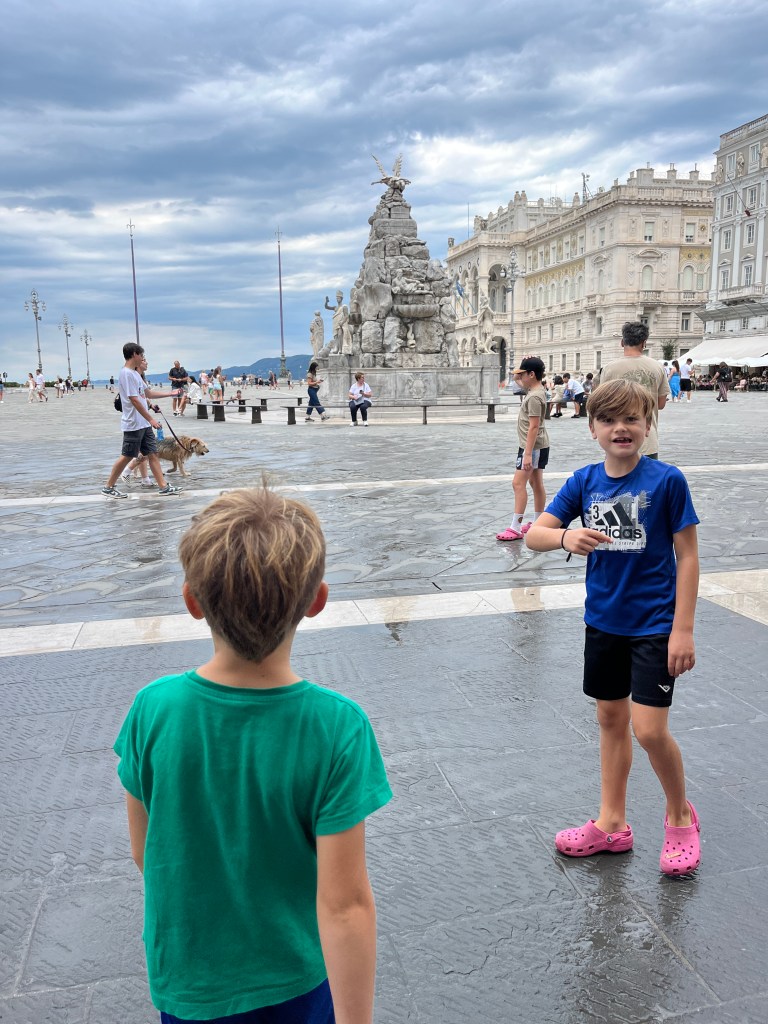
Trieste, Italy. This was another spot my partner popped on the itinerary. “The City of Coffee,” a complex history of border shifting, food and wine of Italian fame, unique museums, specialised galleries, storied monuments and architecture. The Euro usual. Sounded excellent. Problem is… sometimes we forget we have kids. And the kids are getting a little tired of it.
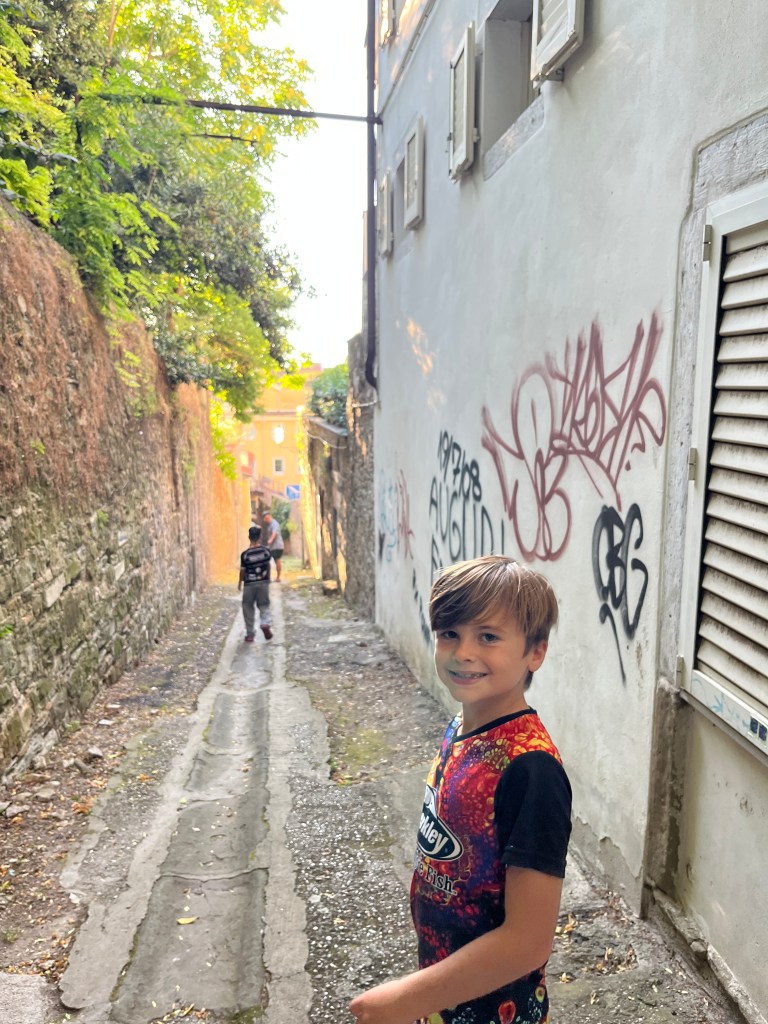
While Trieste is a charming city, it’s not the easiest to navigate with winding streets that require frequent map-checking, narrow sidewalks unsuited for wildly weaving boy tracks, and steep cobblestone hills and elegant stone stairways which we serenade with an embarrassingly high volume of gripes and groans. While my partner and I could easily spend a week filling our eyes, our minds, and our bellies with all this special city has to offer, the kids aren’t impressed. The kids don’t drink coffee, and they don’t love city walks. We have exhausted their tolerance for city tours, and they are fed up with exhibits of maritime museums, archaeology digs, and stories about dead people whose lives are alien to them. Fair enough. I’d have been over it by this point too if I were them. Appreciating history takes effort and imagination, personal history and complex context awareness. Italy is country number nine. It’s been a sustained effort. We’ve probably been asking too much.
So, between my partner working most days and the culture-boycott the boys have organised, Trieste has gone largely untasted… except on my little jogs and online explorations. Running is actually a very efficient way to see a city. I read a bit or watch some videos, and then I go run to check it all out. Once home, I usually have a few more things to investigate to satisfy the curiosity. It’s working out. Both the brain and the bod get a bit of a run. Sure beats dragging three sassy and snappy balls-n-chains around to “enjoy” the city. Lots of stares and stolen glances over shoulders have been cast our way in these streets. The protests are becoming quite spectacular. And our baseline is pretty up there.
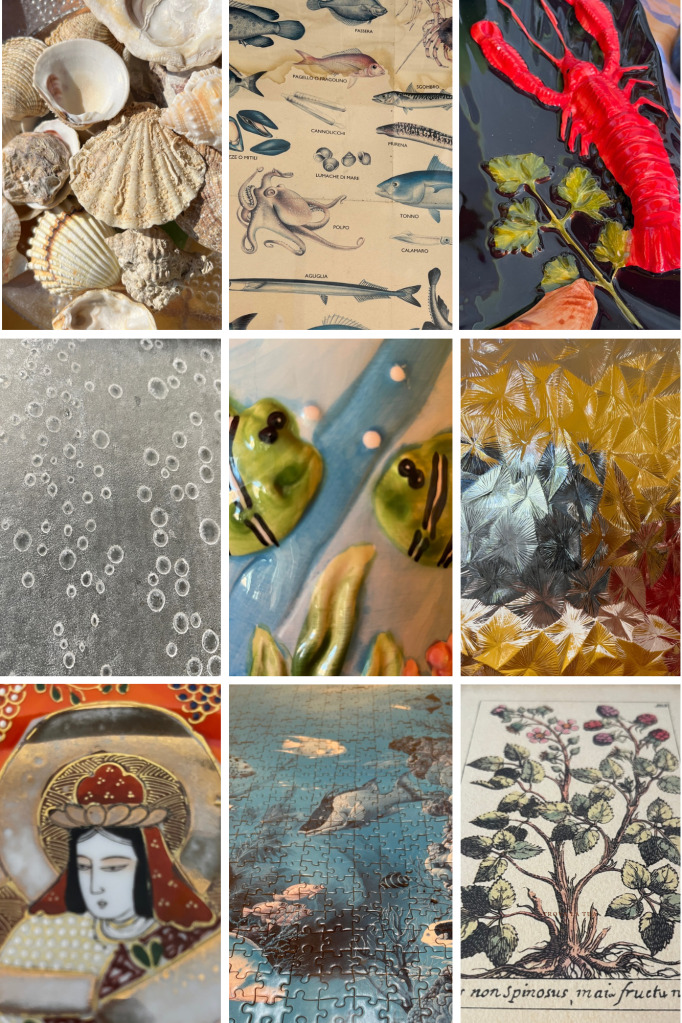
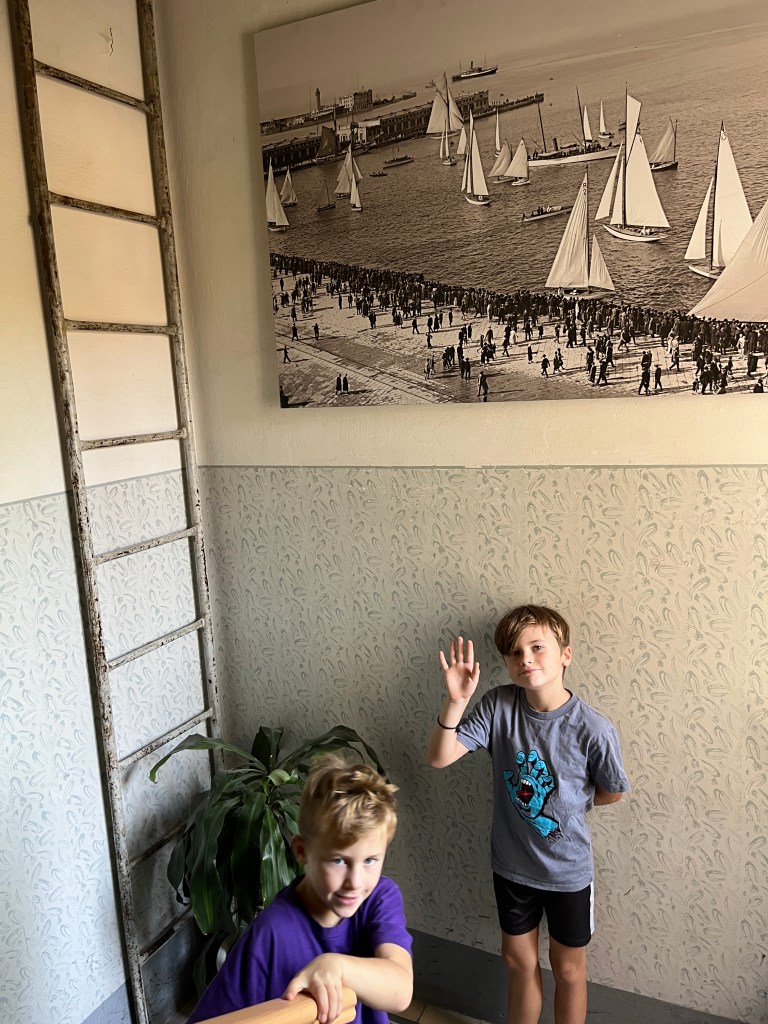
So, instead of exploring as a family, we’ve spent most of our days in our trendy little Italian apartment. Thankfully, they have a great game cupboard, and we’ve been playing cards, working puzzles, and constructing weapons and animals out of a kit of plastic triangles and sticks called Patri, “Made in West Germany.” And video games are still being phased out. (Why is this so hard?)
The house is artful and much bigger than we’d dare to hope. The boys share a room with blue sky and clouds painted on the ceiling- an ironic contrast to our stormy family climate. My partner and I share the living-room pull-out for ease of the early rise to Sydney work hours. The parquet floors are warm and smooth, and there’s a light-fixture with Picasso lino prints that glow. The books and tourist brochures on the shelves are in Italian and German. Only a Donald Duck book is in our native tongue.
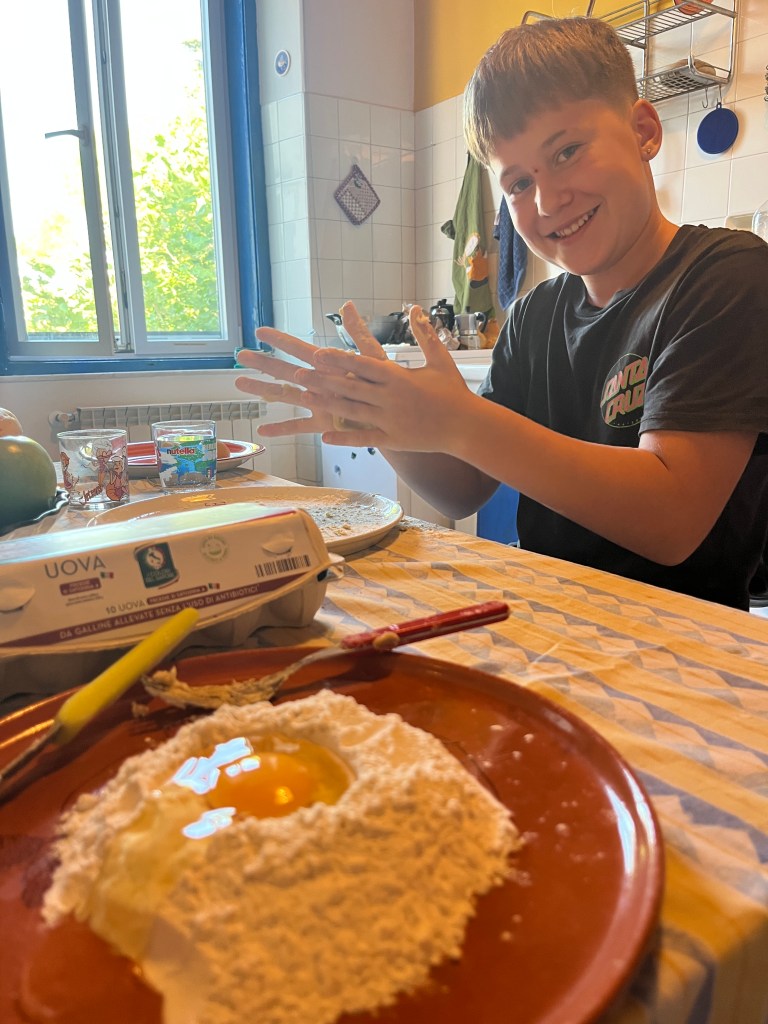
In the kitchen, the ceiling is painted red, the walls are yellow, and there is a retro fridge painted blue. The big Bosch artefact is not used as a real fridge anymore, but it’s taken a full week to deprogram our autopilots to reach for the little white bar fridge instead. I’ve had to tie a plastic bag on the metal handle because we’ve too often yanked on this antique beast when thirsty for a cool drink. It’s a very loved space with lots of stylish details, hints of family history, and quirky but cleverly used objects. We’ve realised here that we love a kitchen hangout space. We love the balcony lifestyle too, but you have to choose work or play in that set up. With a good kitchen, you can do both at once.
That’s something we’ve been doing on this trip in all these AirB&Bs. We’ve been taking notes on how we want our next home to be. What are the features that charm, the colours that give an appealing sensation, the spaces and objects that tick both form and function? Some people are so good at this. And others are… so clearly not. Anyway, we haven’t had this good kitchen vibe flowing for a while. Life is good with music over dinner prep with wine and snacks. It’s nice to have the boys bopping in for a chat and a handful of whatever’s on offer, pitching in on the cooking on occasion. That is one of our staple pleasures in life. And you need a good kitchen for that. This hip and happy Italian cucina fits the bill nicely.
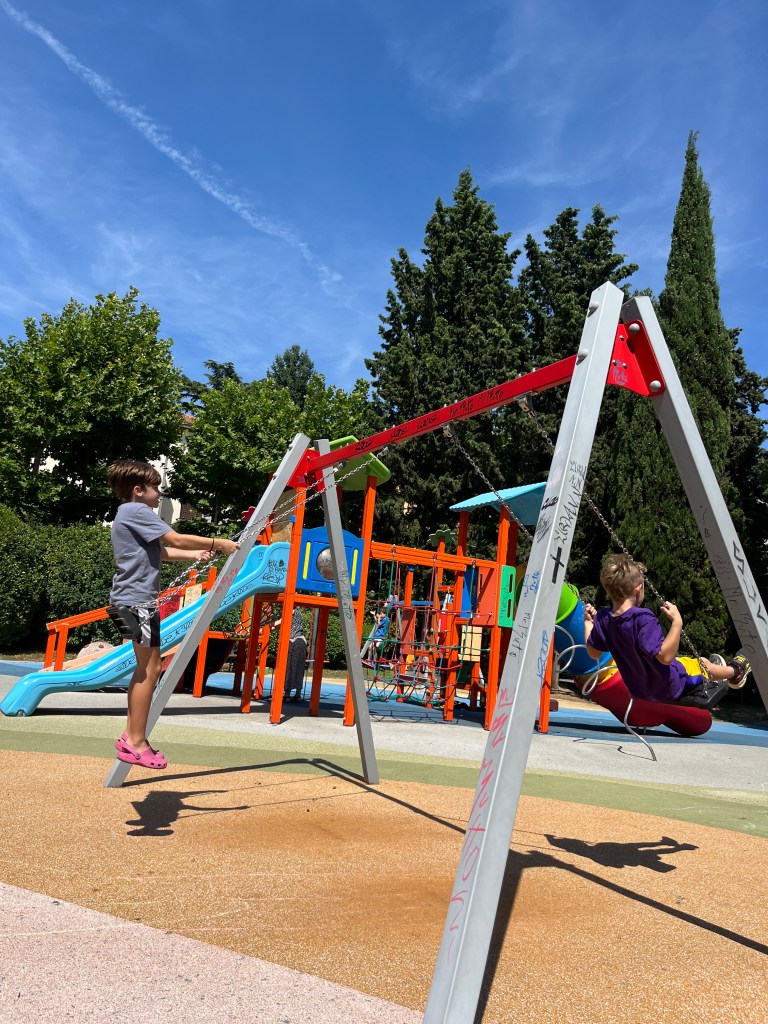
For outings, there’s a ten-minute walk to a park where new games have been invented, birthday parties have been crashed, and we’ve made friends with a boy who plays in his pjs and speaks YouTube English in catch-phrases like “Hell-naw, man!” and “I gotchu.” There is a bar across the street from the park that serves coffee in the morning, gelato in the afternoon, and glowing orange Campari spritzers in the evening. There are tables that line the park-side of the street, and a curvy, full-lipped, blond-pony-tailed waitress in leggings with that scrunch-seam up the middle of her bum saunters back and forth across the street with beverages on a little green tray. She has the unpolished manner of a girl-next-door, heavily dropping every glass and bowl of salty snacks on the metal table with clanks and clunks. She looks like she belongs on the arm of a sharp-suited man, but she lacks the polish to match her sex-appeal. Of course, we like her, and the boys are skilled at procuring extra bowls of snacks on her watch.
As this chapter of life demands, I’m only getting a basic understanding of Trieste. No deep dives here. Probably, though, the most unique feature one should be sure to appreciate is Trieste’s Third Culture Kid history. Like, Skopje… and also very much unlike it… Trieste has a unique identity which comes from various nationality changes over the years.
Trieste was long a Roman city-state and a trading port envied by the Venetians (whose attention it was good to avoid I have recently learned). Later, though, the city became part of the Austro-Hungarian Empire for many centuries (1382-1918). This influence is obvious in the architecture. After WWI, Trieste became part of Italy when the Austro-Hungarian Empire ended, but at the end of WWII, in the post-war transition period, Trieste had a brief period of being under German and Yugoslavian rule. Then, from 1947 to 1954, the city was designated The Free Territory of Trieste because of the post-war tensions between Yugoslavia and Italy. This crescent-moon-shaped piece of land at the top of the Adriatic Sea was then divided into Zone A and Zone B. In 1954, Italy got the city of Trieste, Zone A, and Yugoslavia got Zone B, the city surrounds. It very much looks like a stolen little sliver of post-war spoils when you inspect it on a map. Sorry if that was confusing… Border history recap: Roman -> Austro-Hungarian -> Italian -> German -> Yugoslavian -> Free State -> Italian, again. (Warning: This history was provided by a nurse. Just sayin’.)
So, you can see, Trieste is a bit of a Third Culture Kid, neither here nor there. It’s unlike any city in Italy, yet, no other culture could be said to culturally claim this very Italian place. Even the “Austro-Hungarian Empire” influence is a mix of Eastern European influences, as well. I don’t have time for the deep dive I’d like, but the point is: the people of Trieste are unique. Proudly. And this is why my partner brought us here.
The Triestini speak Italian, as well as their own local dialect, a form of the Venetian language that incorporates German, Slovene, Greek, and Serbo-Croatian features. The people are known to have a passion for coffee, complete with a distinct ordering style and etiquette. They also have a rich literary heritage, including James Joyce as an inhabitant for over 15 years (Dubliners was mostly written here). There is also a great appreciation for the arts, which is evident in all the museums, theatres, and galleries around the city. There is a fashion scene too, which has me self-conscious of my travel-worn, world-school anti-chic wardrobe. Not that I’ll put any effort into rectifying this. Being fashionable is not on the list of priorities this round. I’ll be cool again someday. If I ever was.
There are a couple fun facts about Trieste to share. One is that confetti was invented here. Actually, in Italian, the word “confetti” still refers to a candy-coated almond that is thrown as a celebratory practice at weddings. Sounds painful. And expensive. And wasteful… Or gross. Perhaps that’s why Ettore Fenderl, in 1876, got the idea of cutting up coloured paper triangles to throw during a carnival parade in Trieste. It’s a superior material- easier clean-up, cheaper, more environmentally friendly, prettier, and less dangerous than hard little almond bombs. (I should disclose that there is another contender for this claim of paper-confetti inventor. Around the same time as Fenderl, an Italian silkworm breeder from Milan started selling paper circles from his silkworm operation as celebratory tossing material… not sure how it was used by the silkworms.)
Anyway, it’s nice to be in the birthplace of confetti, which is so obviously an Italian word now that I really note that -etti ending. Throwing confetti is one of those carefree, festive practices us funny humans take delight in doing. (And if we don’t, it’s probably because we need to loosen up a bit.) Throwing confetti is a signal of commemoration. It’s a celebratory thing. It’s a moment-claiming thing. It’s a gesture of being present and honouring of whatever milestone, union, tradition, or triumph has come to pass. It probably represents one of the finest things we do as mindful beings. We rejoice in life and let the confetti fly! And it’s a visual expression of an inner feeling, really. It’s a sudden rise and showering fall that echoes the swells of human significance we all feel at times. What an invention. Bravo, Ettore. Confetti. A lovely innovation.
Another interesting element of Trieste is a phenomenon called La Bora. And it’s quite the marvel. It is defined as “a strong, cold, and gusty north-easterly wind that frequently blows down from the Karst Plateau towards the Adriatic Sea,” (Google AI Overview), but it’s much more than that. It’s in the history, the identity, the lifestyle, and the art of Trieste. But it’s more than that, even. I’ll explain.
The first time I heard this word, “La Bora,” was in the info sheet for Casa Tosca, our AirB&B. The “Windows & Shutters” section says, “When the bora rises (recognisable inside by the howling sound in the kitchen), keep all the windows at the back shut.” When the what rises?!? Howling? Okay. Then, I heard this word again when I was searching for museums I might be able to convince the kids to visit. El Museo Bora came up. Sounded cool to me. No takers on the museum of the wind though, would you believe? It’s by appointment only, anyway. I guess there aren’t a lot of takers, in general. Though, I would be one if I’d discovered this museo in time to make a booking.
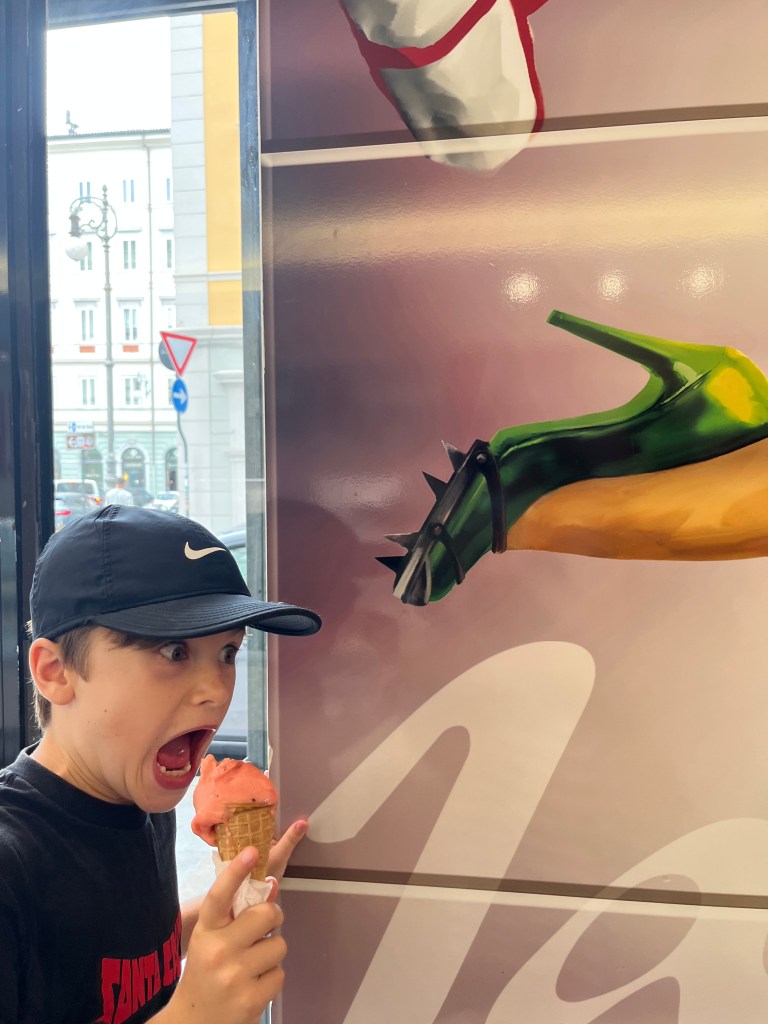
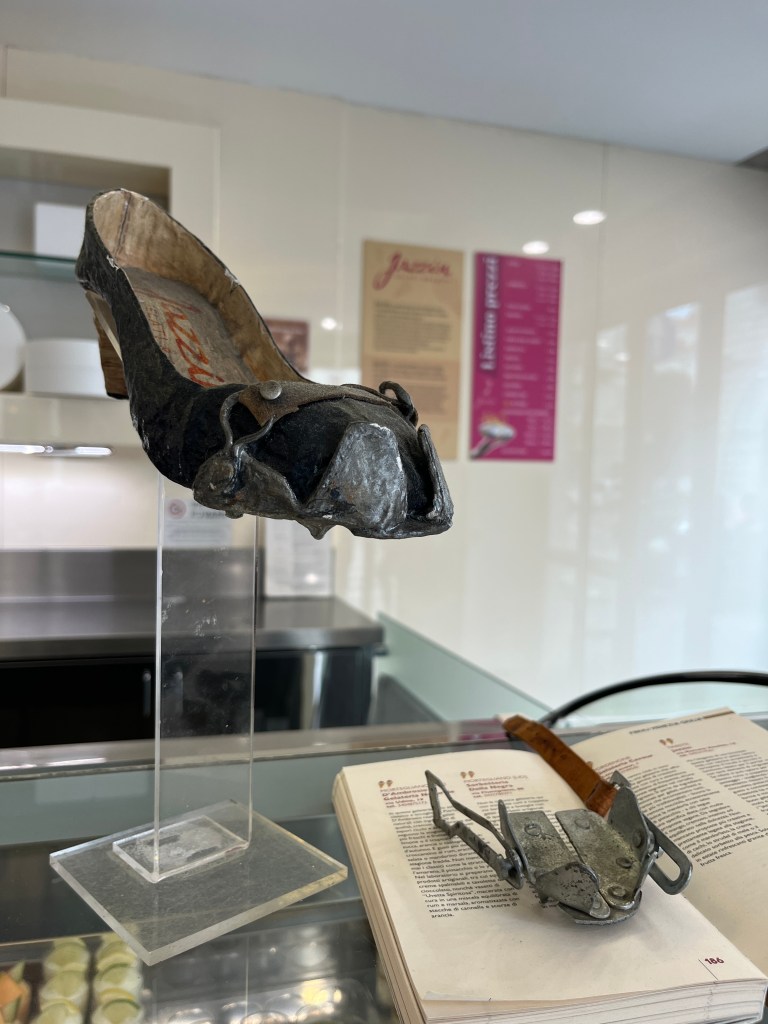
The next time I noticed La Bora mentioned was in a gelato shop called Jazzin. The shop itself looked typical, an attentive man standing behind a long glass case covering rows of metal trays filled with another of Italy’s finest inventions: dense, smooth ice cream formed into little waves with plastic name-tags riding in the creamy surf. Once the boys were all sorted, and I started to lovingly attend to my pistachio cone, I noticed the walls were depicting ladies’ legs in high-heeled shoes with strap-on spikes under the sole. Then I noticed a little sign that was kindly translated in English. It explained that Jazo is a term used to refer to ice in Trieste, and the Jazzini were crampon (traction devices) for the street ice which was made practically impassable by La Bora gusts blasting through the alleys of the city. The sign said this name Jazzin “combines the history of Trieste with our passion for ice cream.” Along with their Jazzini, rumour has it women used to also wear special weights on their skirts to keep them from flying up as they navigated the icy wind on the way to work. What a phenomenon. I had to learn more of this wind.
Now, I should say, I’ve got a thing with wind. It’s a love-hate thing. A respect-detest thing. I love the power of an unseen force. I love how its presence is evident in the strands of hair. I love how the wind activates sweat as a cooling system, and how it brings clouds and storms and change. I love its scents and temperature adjustments. I love how it powers homes, moves ships, and strips dead leaves from the autumn trees. I love how it partners with the sun to dry the washing, how it makes the flags ripple and whip, how it playfully flips off a hat and infuses the wilds into one’s hairdo. I love how it sends the trees dancing and swaying like a gospel choir and how it tenderly kisses your neck. I love that it shifts the desert dunes, the sierra snows, and the amber waves of grain. I love that I cannot see it, but its presence is certain. And everywhere. I love the wind, but I also hate it.
I never felt this way, really, until I moved to Australia and felt the madness of the “August Winds,” which really blow on through September and October, too. The rattling, the rapping, the whistling, the shrieking, the knocking, and the slow breaking and dismantling the wind can achieve really unnerves me. “Teeth on edge” is right. Sleep is restless. Walks are strained. Life becomes coarse and harsh. The upturned trash bins, the damaged plant life, the whole outdoor world beaten and whipped for undisclosed crimes. It angers me. I hate it.
But I’ve got a healthy draw to the things that anger me. I am invigorated with curiosity as to what a hate can tell me about myself. When I feel the rising heat of anger, my higher self usually jumps up and says, “Oooo, what’s under there?” My hero, Julia Cameron says, “Anger is our friend. Not a nice friend. Not a gentle friend. But a very, very loyal friend. It will always tell us when we have been betrayed.” She says, “Anger is a map.” I like to trail this emotion partly because I can claim power over it, but also because it usually leads me to wiser ground. This instance of the wind is no different.
So, what’s with the wind anger? It’s been fun to reflect. La Bora has helped me do so… even though our days have been mostly calm and bright. Aside from the genuinely unpleasant assault on the senses, the wind’s assault on the psyche is profound. The wind is maddening. It’s unsettling. It’s threatening and incessant. At least, that’s how I experience it. From students who drive their teachers mad, to artists who credit La Bora with their inspiration, these Trieste winds that can reach 150 km/h (93 mph), or Category 4 hurricane strength, certainly influence the minds of Triestini. But not only in the way you’d expect. I watched an excellent video about how La Bora impacts the culture of Trieste but also how it historically shaped the lay out of the city itself (https://www.youtube.com/watch?v=8kojuRGMimQ).
Let’s start with the physical effects. Architecturally, the city has railings all over the place and used to have ropes strung up through the piazzas for people to hold onto during La Bora, which people say only blows for 1, 3, 5, 7, or 9 days (any odd number). The old town was developed to suit La Bora’s wicked ways because the streets are narrow and winding, short and irregular. The Austro-Hungarian-built gridwork district of Neoclassical stone hunks is awful for La Bora. The wind whips straight down their broad passageways, creating blasting and dangerous wind tunnels. You can notice that the shutters here are reinforced with metal bars, and the windows are doubled paned. There are many well-known places to avoid during La Bora due to the dangers of being swept into the sea or the canal or into oncoming traffic. People walk differently, dress differently, and alter many routines to adapt to La Bora when she rises. Ferries don’t run, outdoor sports are cancelled, and even just getting the groceries home can be a challenge, especially for those who are physically frail to begin with. There are lost objects, flying debris, falls and injuries. It sounds like a pain in the ass to me.
But many Triestini don’t seem to see it that way. Many sources describe La Bora in a very different way. They love it. They see it as part of their identity and their city’s distinctiveness. Many see it as deeply cleansing, saying it clears the air completely, bringing magnificently bright skies and long vistas- a clarity also felt in the mind. Others say it is a symbol of resilience and keeps the local people strong. My favourite description, which was echoed on many sites, is more about the energy. The Discover Trieste website says, “[La Bora] is an essential element of this city, perhaps because it sparks real and intense emotions that few can ignore… The wind is energy in its purest state and it seems almost as if you can somehow absorb it and make it your own.” When I read this, it all clicked. The error of my ways was clear. La Bora wakes the people of Trieste. It enlivens them. Because they allow it in. Unlike me, they know what to do with this unseen, unyielding force. They embrace it.
I think I understand my anger with the wind now. I pit myself against it. And that’s not wise with an unstoppable force. Resistance, tension, and rigidity are juvenile responses to a might as great as the wind. I’ve been breaking myself against it when I could have been absorbing its strength. I’ll work on that. Could be some good evolution ahead.
Of course, this has got me reflecting about all the other grand forces of my life: the rat-race routine of modern human living, the flow-disrupting shoves of technological “advancement,” the riptide of phones, social media, and video games in the lives of my children, and the three seriously formidable life-forces of the children themselves. What else have I been futilely resisting like the wind? And how might I start to approach their influence in my life differently?
I’ll do that reflection privately, but all this has been a darn fine reflective gem to unearth when I’ve been hosting a bit of a pity party for my pent-up, frustrated world-schooling spirit. Thank you, Trieste, for your insights. Though we didn’t get to know each other well, and I didn’t get to feel your full strength, I’ll take your lessons with me. I think I’ll expand this little epiphany into something wonderful in time. And I’ll be sure to cast heaps of celebratory confetti into the next La Bora cousin I meet. And I’ll think of you, dear Trieste, when I find myself with confetti in my hair and the folds of my eyelids and the teeth of my smiling face. Brava e grazie! Very glad we came.









 Mapping the Gap
Leave a comment