Fast travel means less time- less time to absorb, less time to reflect, less time to process, and less time to write. There is a lot to feast on this week, so I’ll just toss out a quick intro of this last chapter on the Dalmatian Coast and serve up the tasty bits through the photo captions.
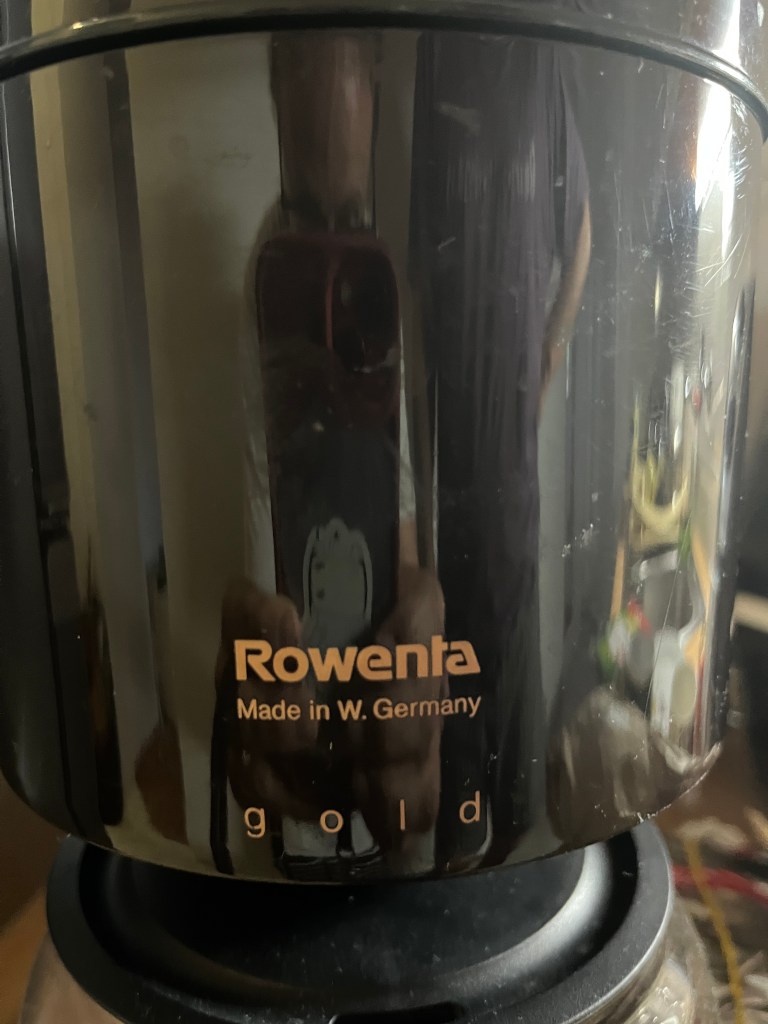
We have been playing in the city of Split, Croatia for the past fews days. Our AirB&B was an over-priced apartment that was really a relic of the early 80s. There were heart-shaped pillows, tiles, and mirrors, shaggy rugs, pussy-willows in vases, a stove and oven with no discernible markings on the dials, about six figurines of the Leaning Tower of Pisa, and a drip coffee machine that was “Made in W. Germany.” This well-preserved retro abode was set in the middle of a sea of apartment blocks surrounded by concrete slabs, tiny playgrounds crawling with hot, little humans, and overstocked car parks slipped in all around.
We had a balcony that overlooked a little slice of this landscape of local dwellings, and we told ourselves it was good to be among “the real people” of Split. In the mornings, I’d sit on the balcony, serenaded by riotous seagulls playing out the dramas of their rooftop domain. Not sure why they liked this concrete jungle a couple of k from the sea. They were clearly living their best gull lives though- caws and cackles that sounded un-birdlike, daring swoops and dives, quick duck-and-weave chases, and much surveying of the scene with heads held high. Their contribution to the atmosphere was much appreciated by me. Their soaring forms and the shadows they cast were light and playful company, a buzz of action to contrast my quiet calm.
Of course, none of this is what we came to see. Split is most famous for the palace built by the Roman Emperor Diocletian and the Old Town that grew within and around it. We saw a lot of that… but much more too. What do an olive oil factory, a famous YouTuber, a dog rescue organisation, a lantern-bearing woman named Doris, and white-water rafting have in common? They are the highlights of our week in Split. Take a stroll through the scroll…
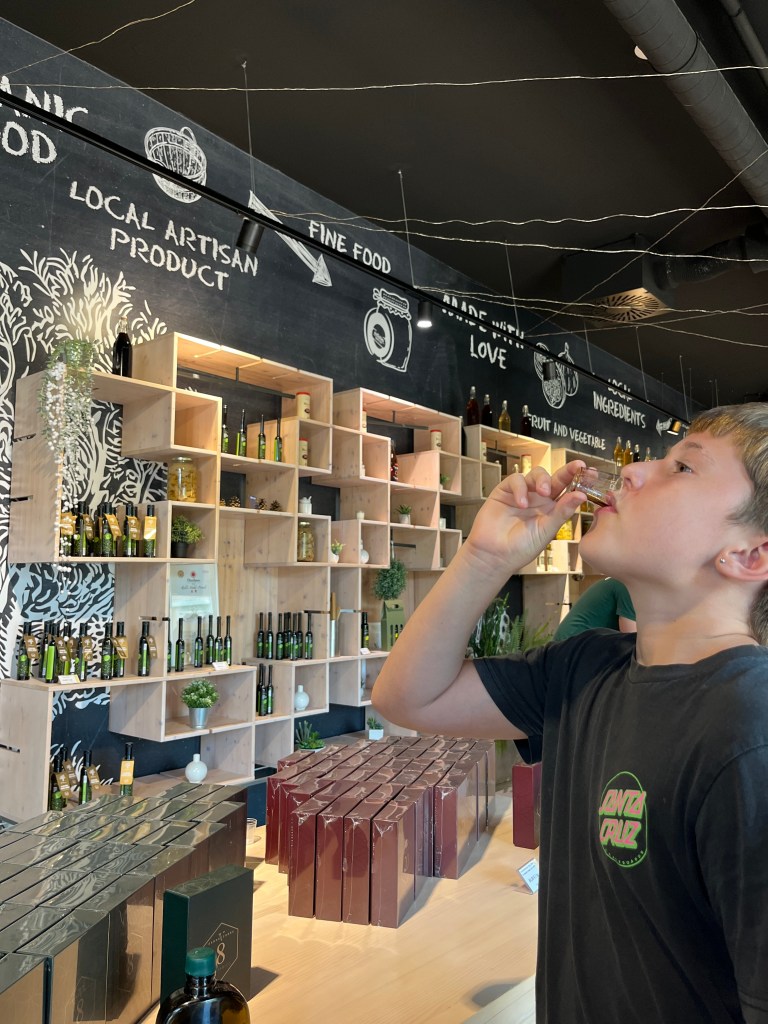
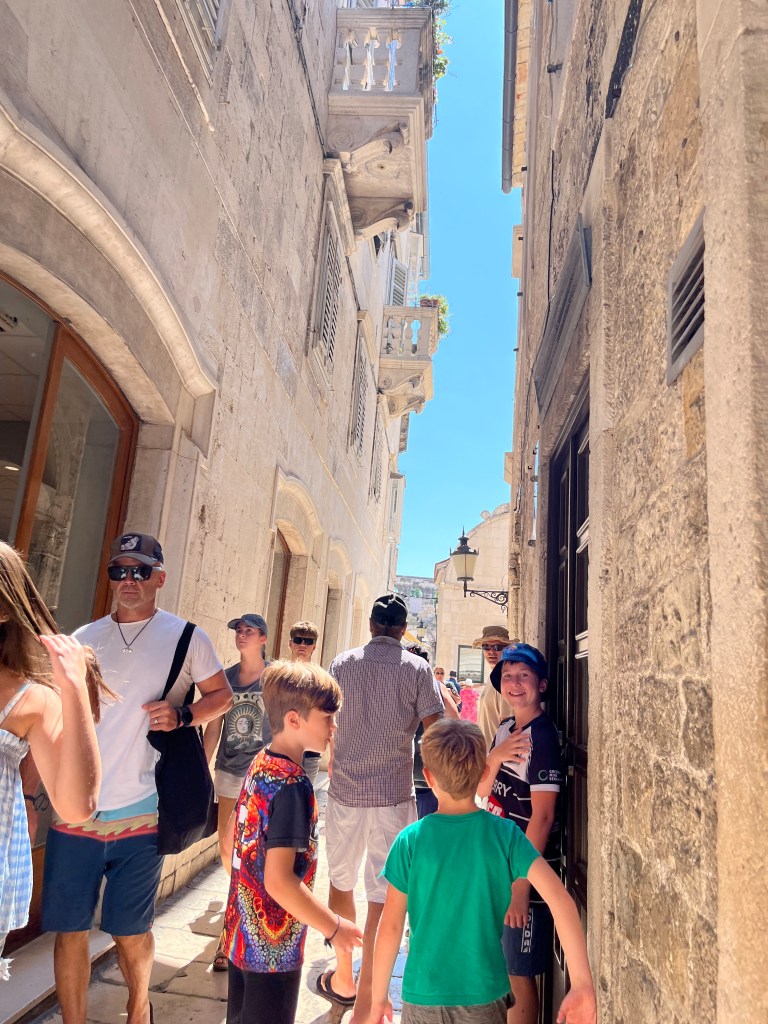
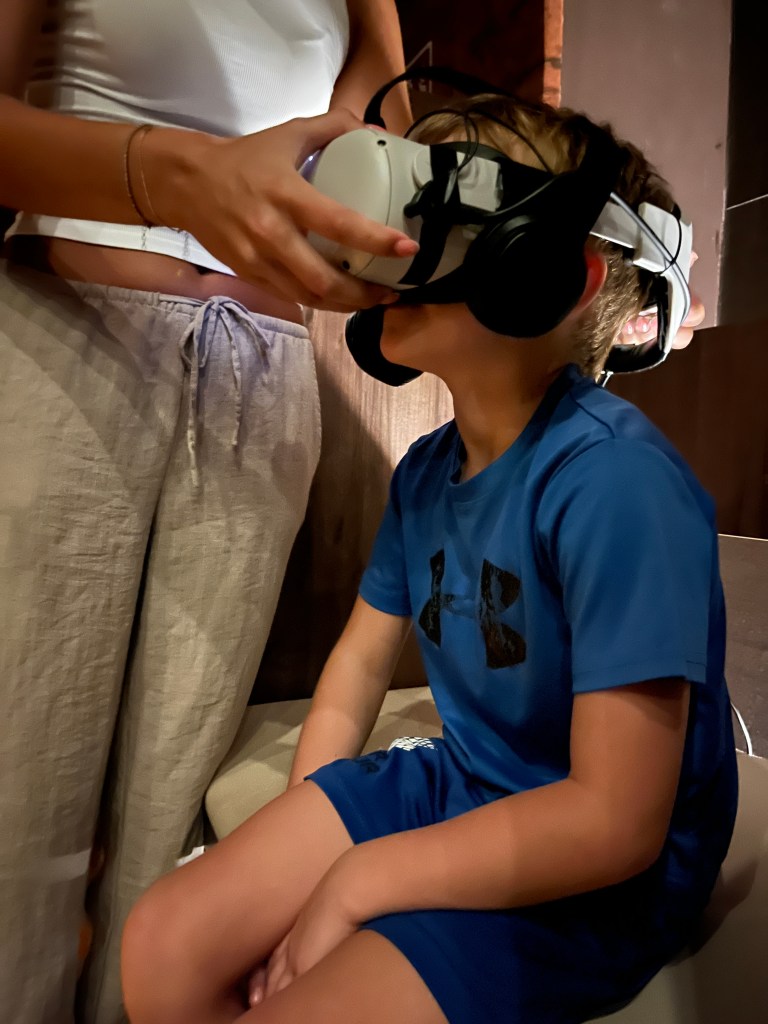
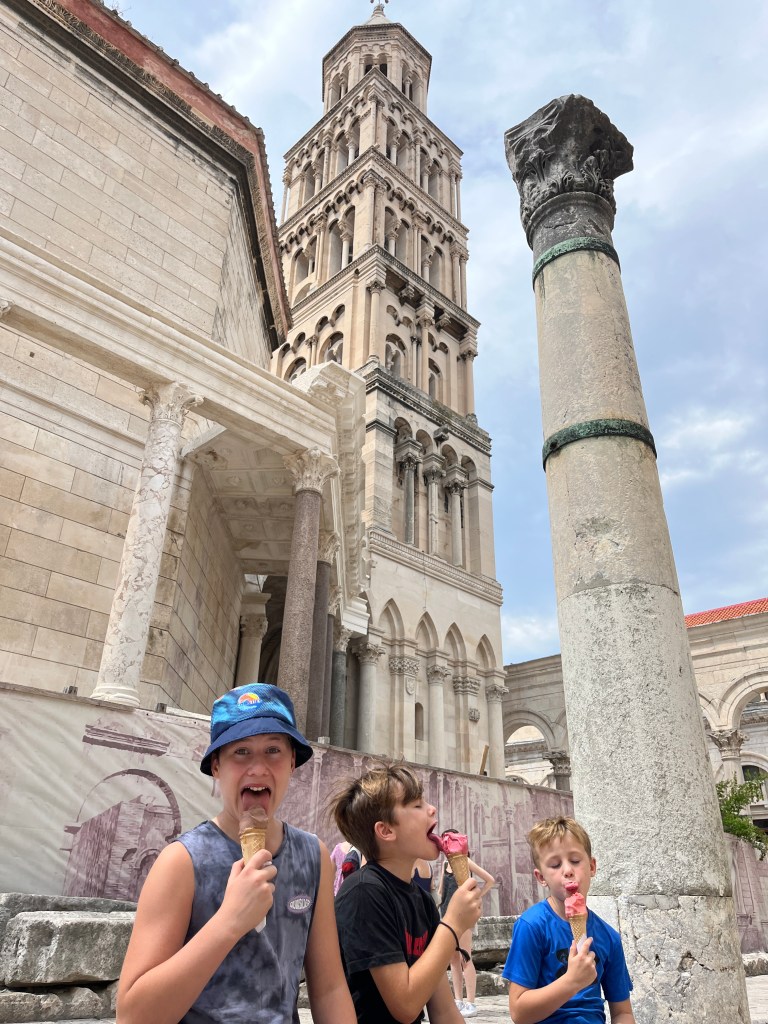
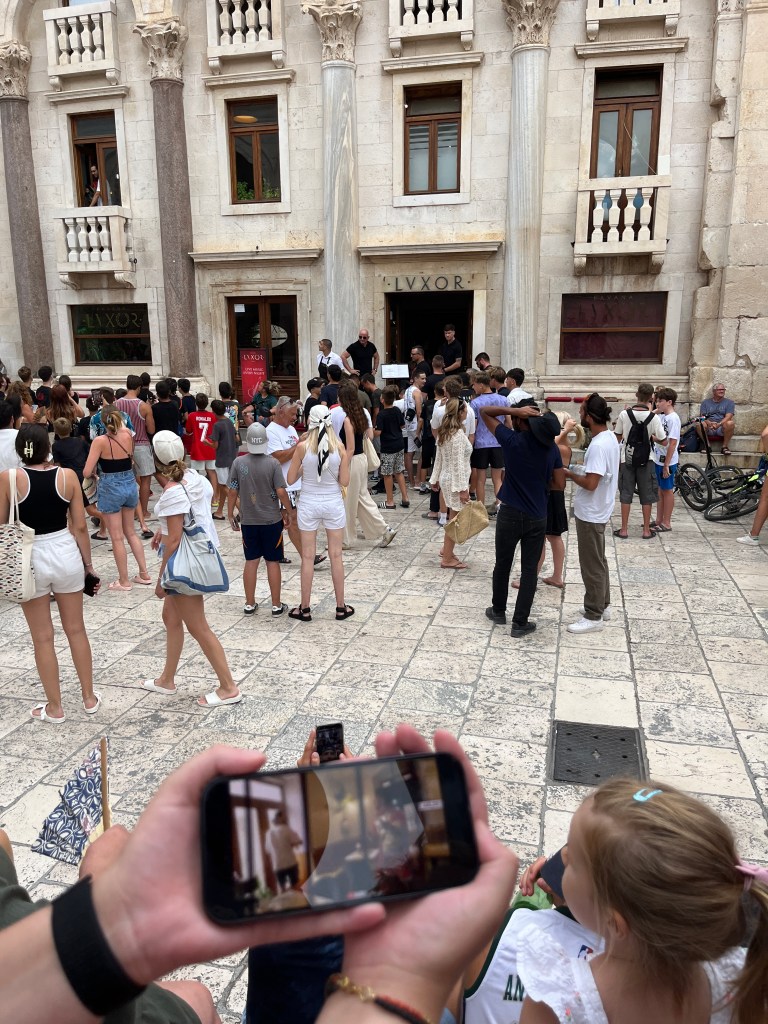
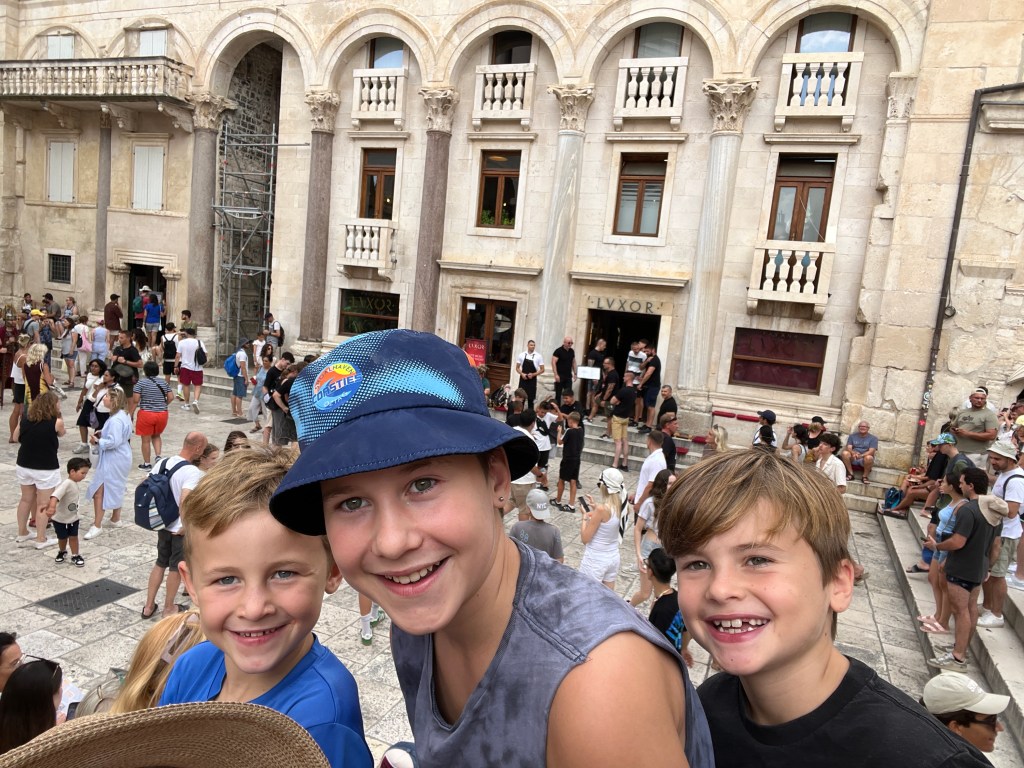
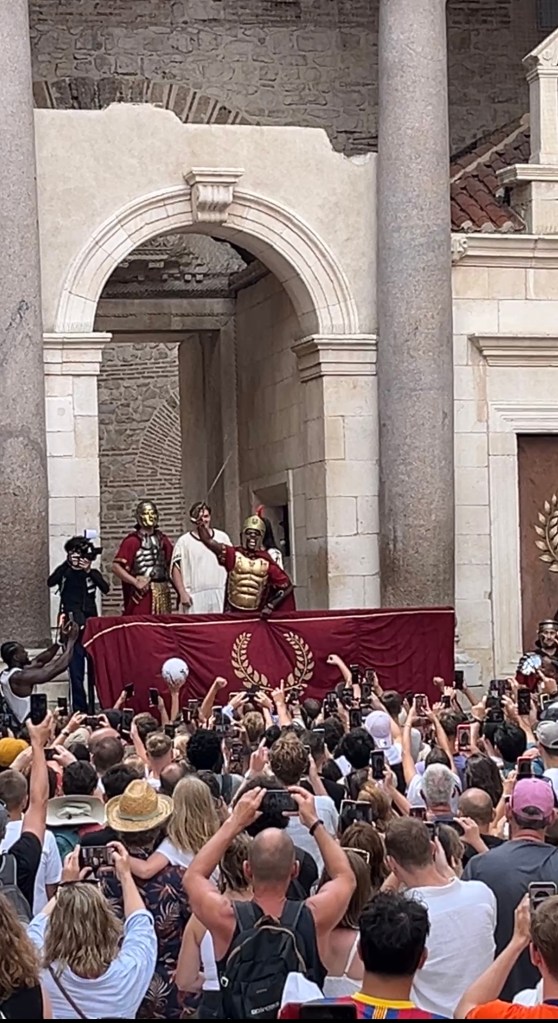
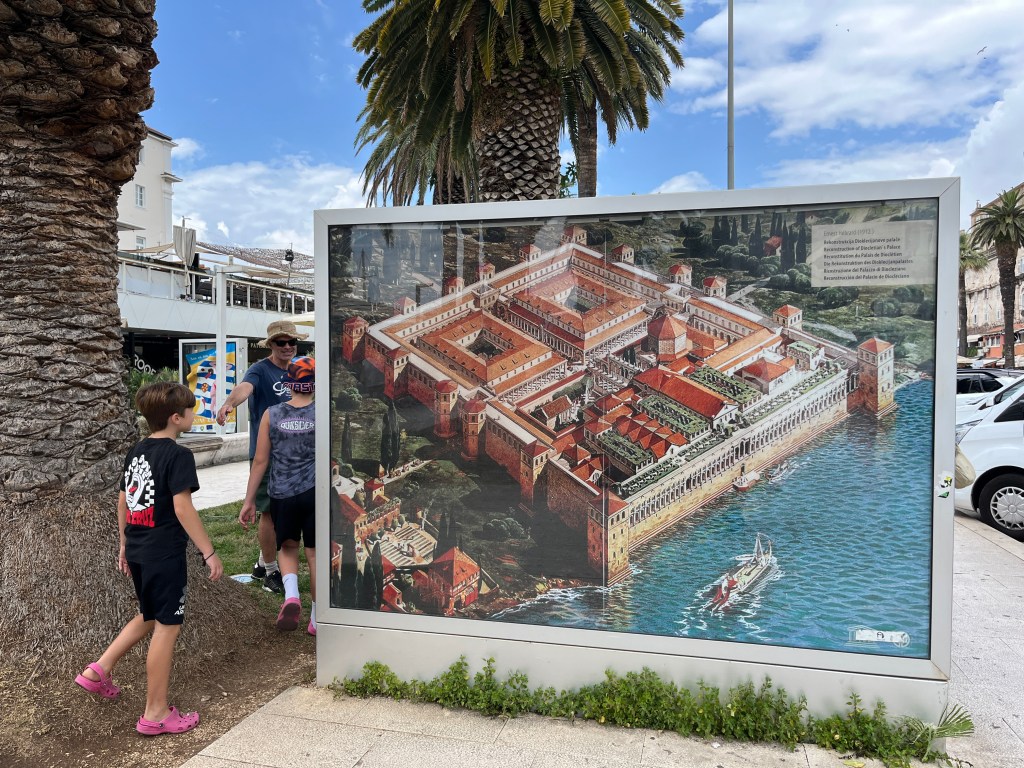
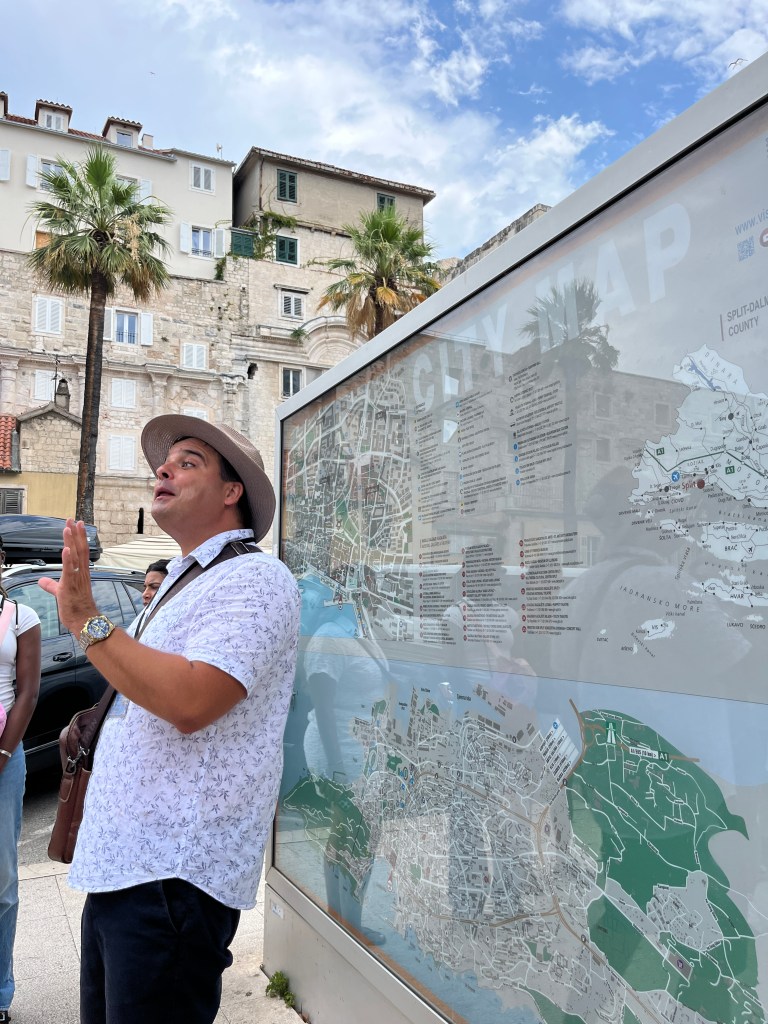
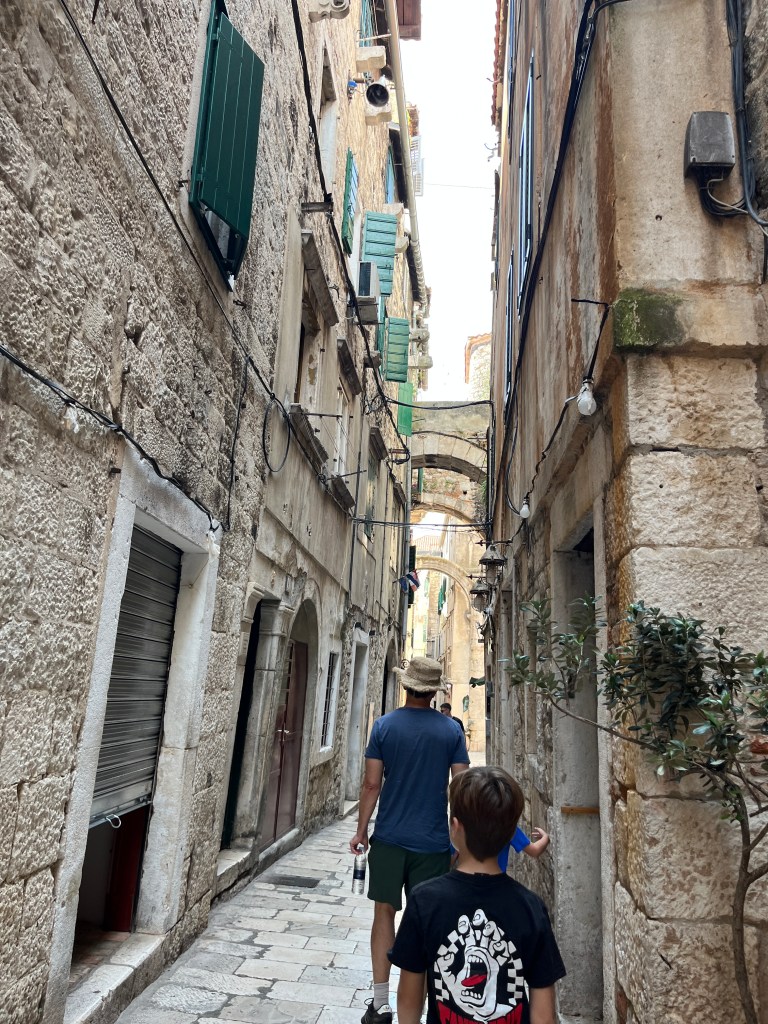
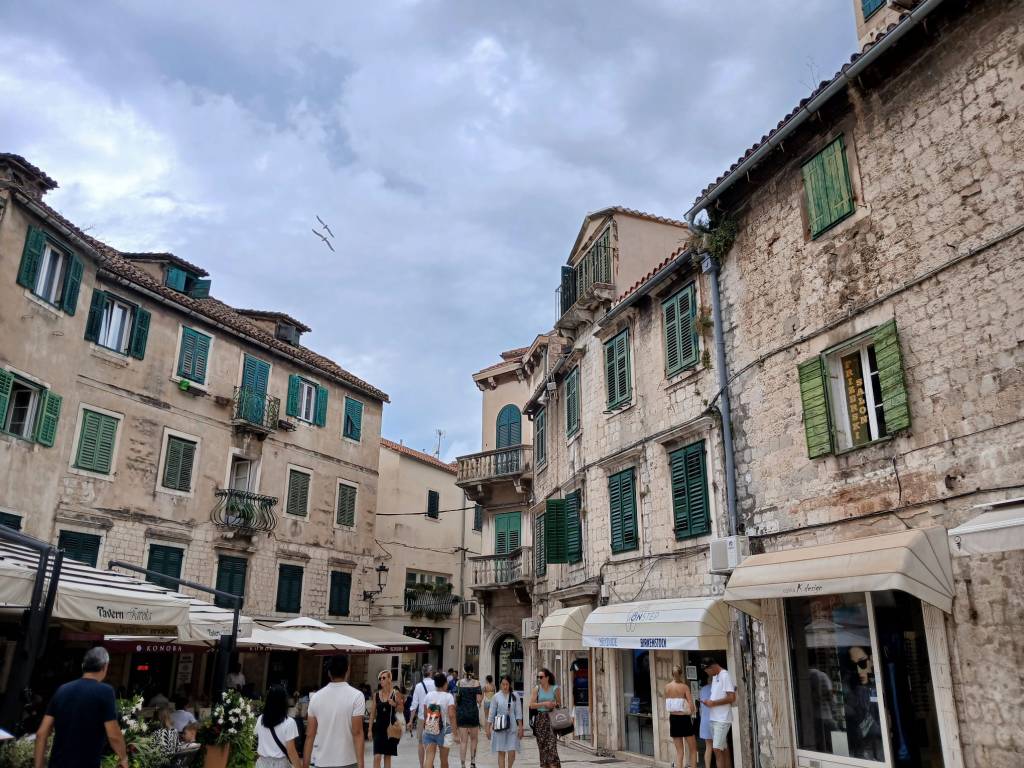
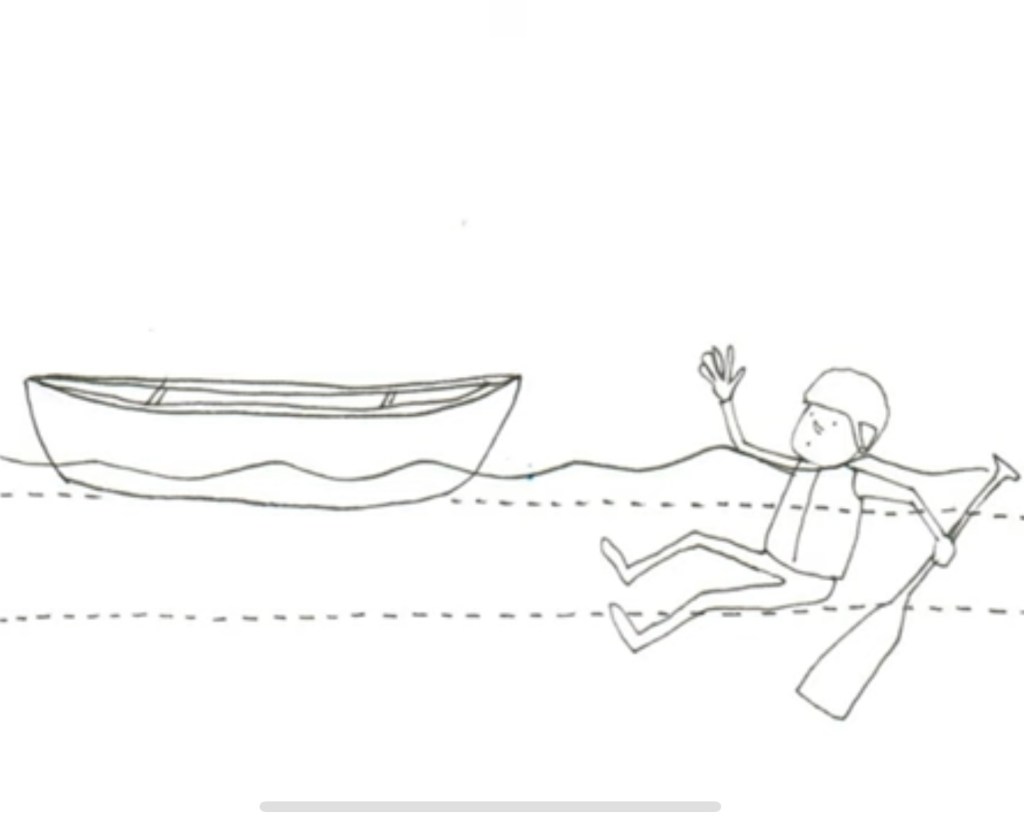
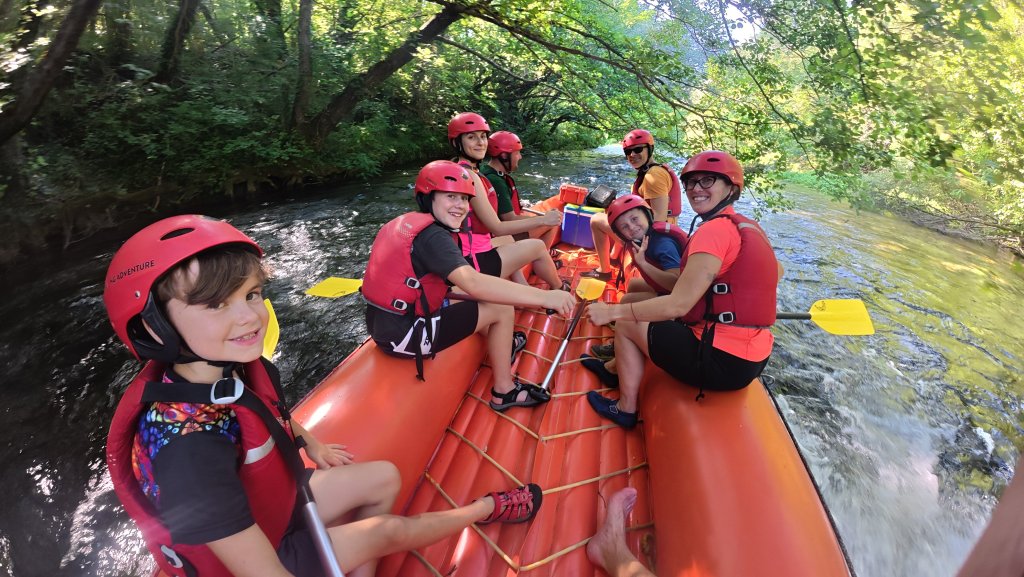
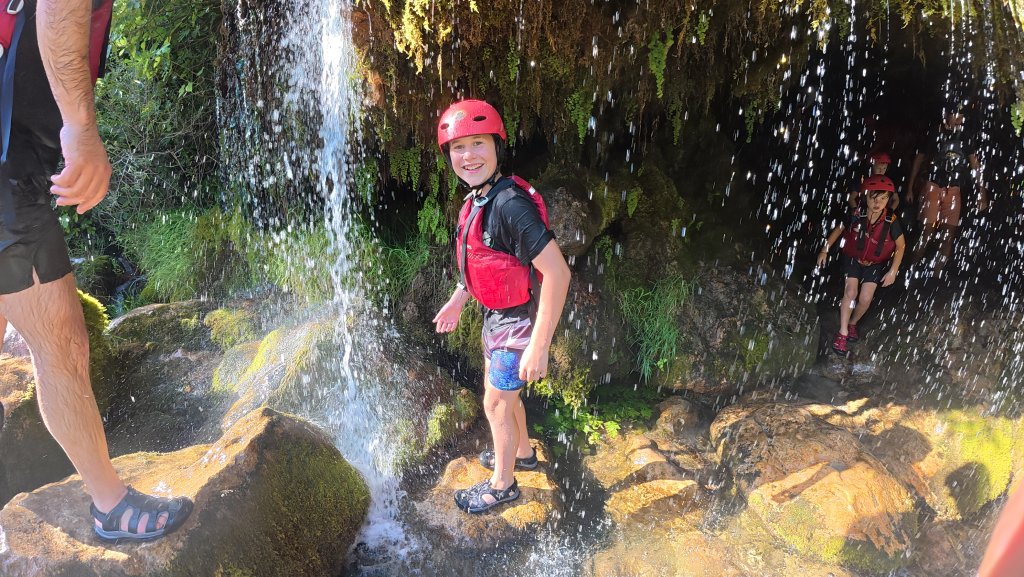
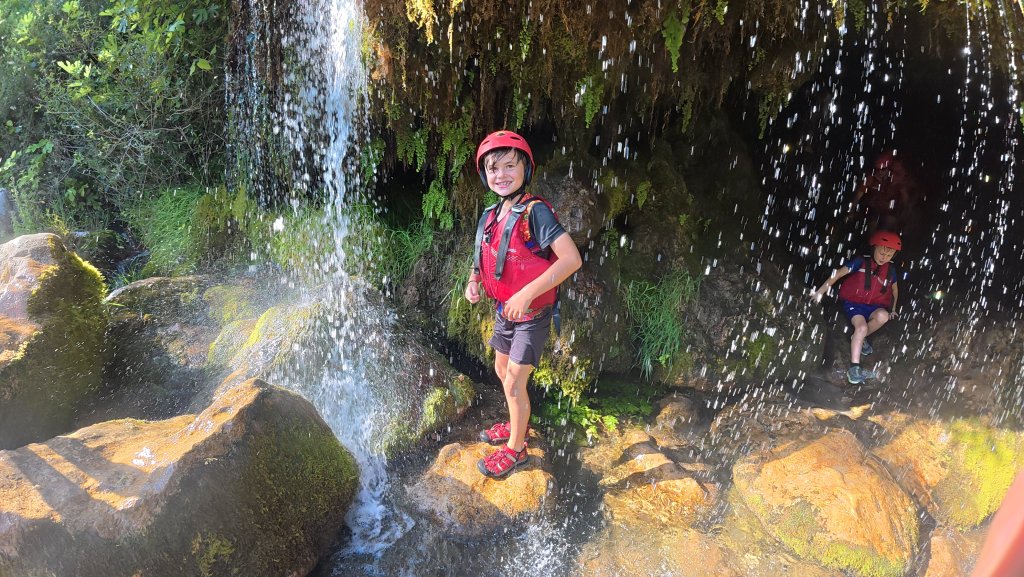
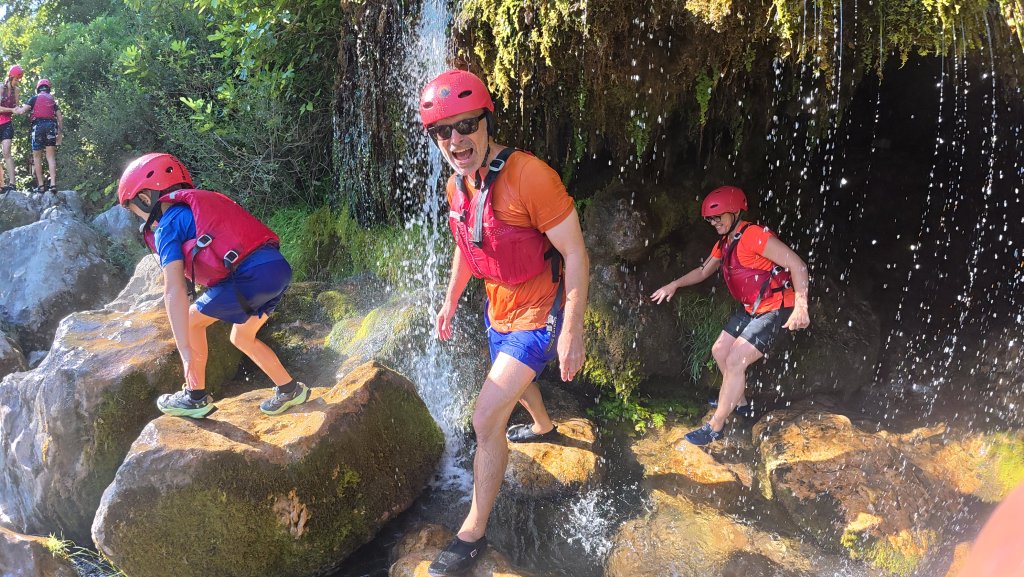
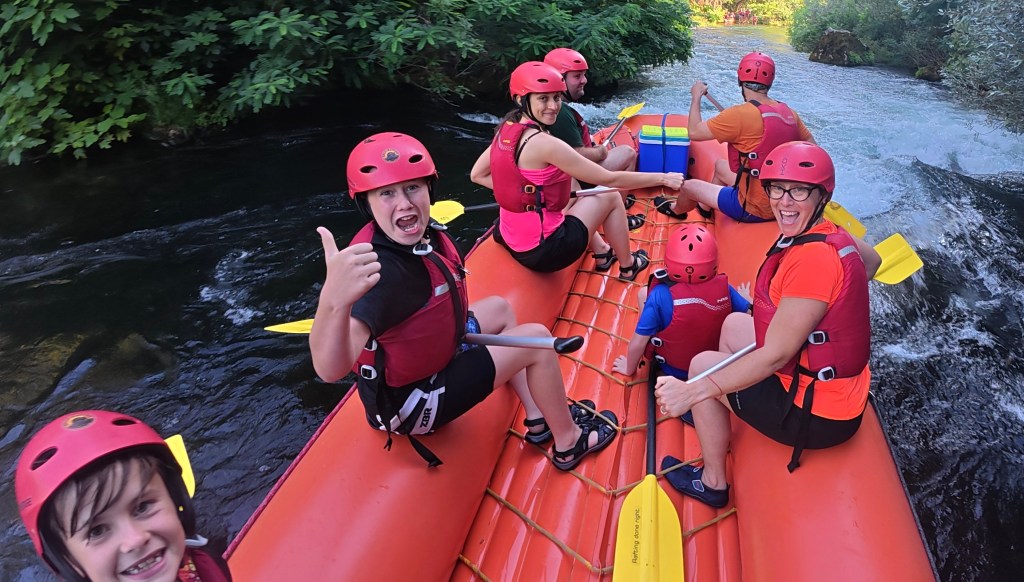
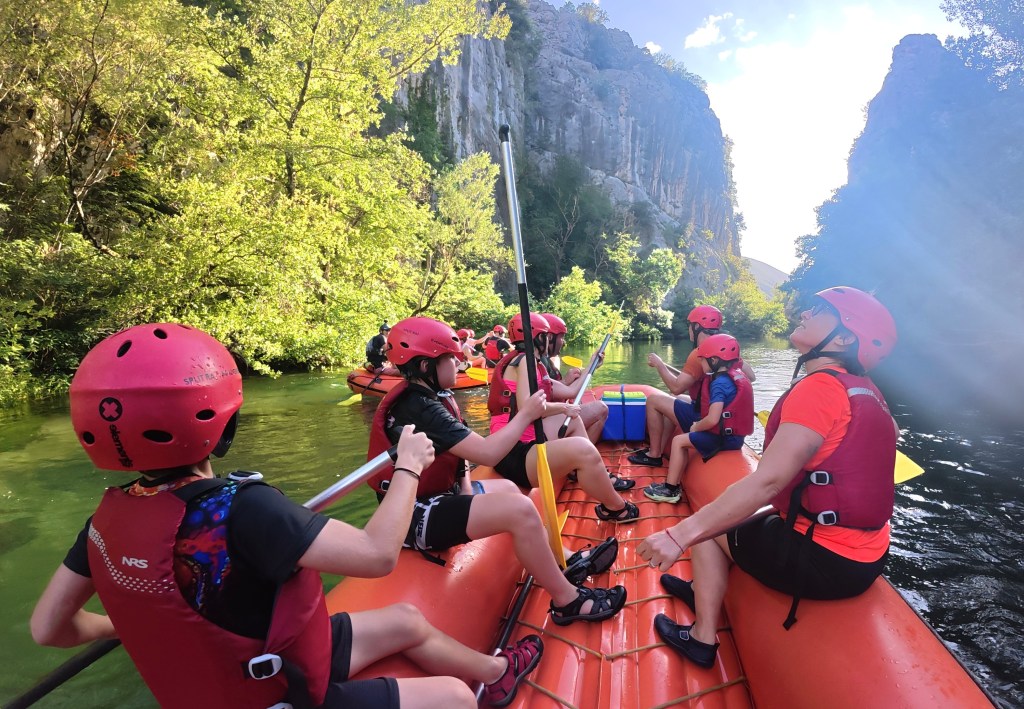
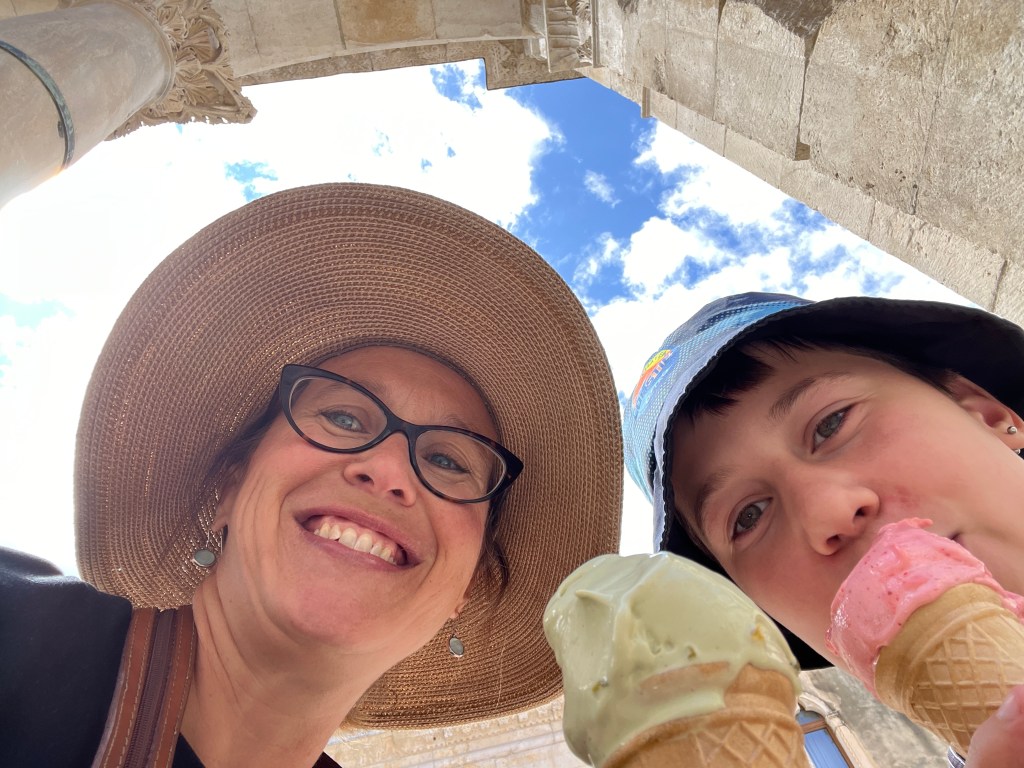
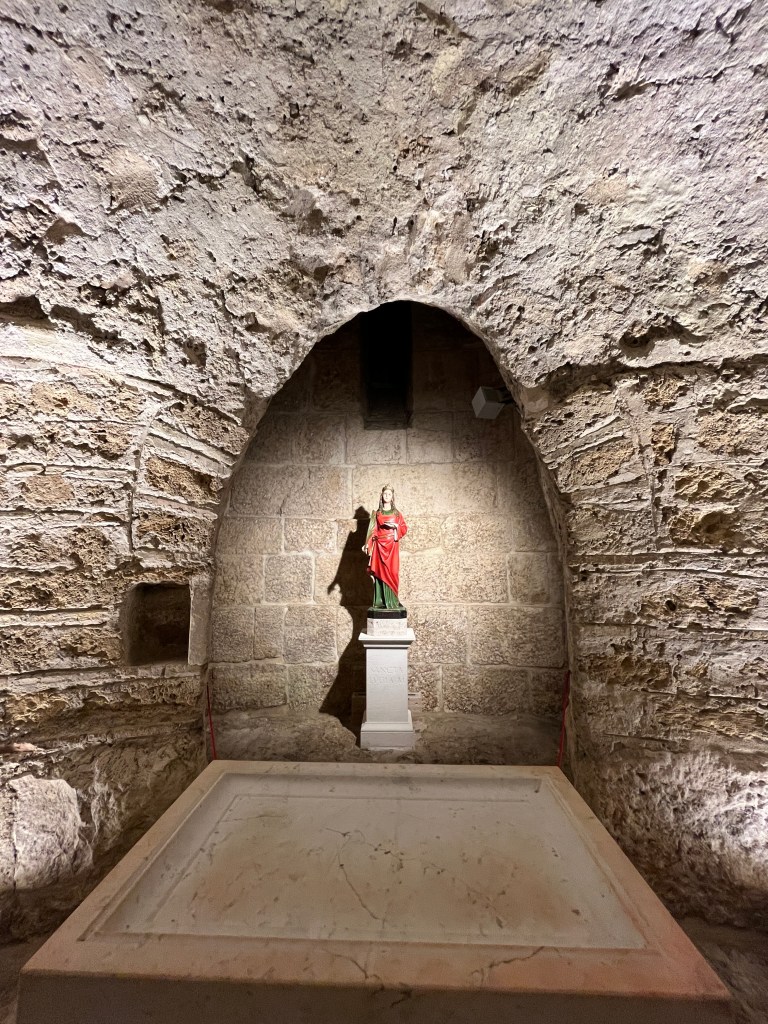
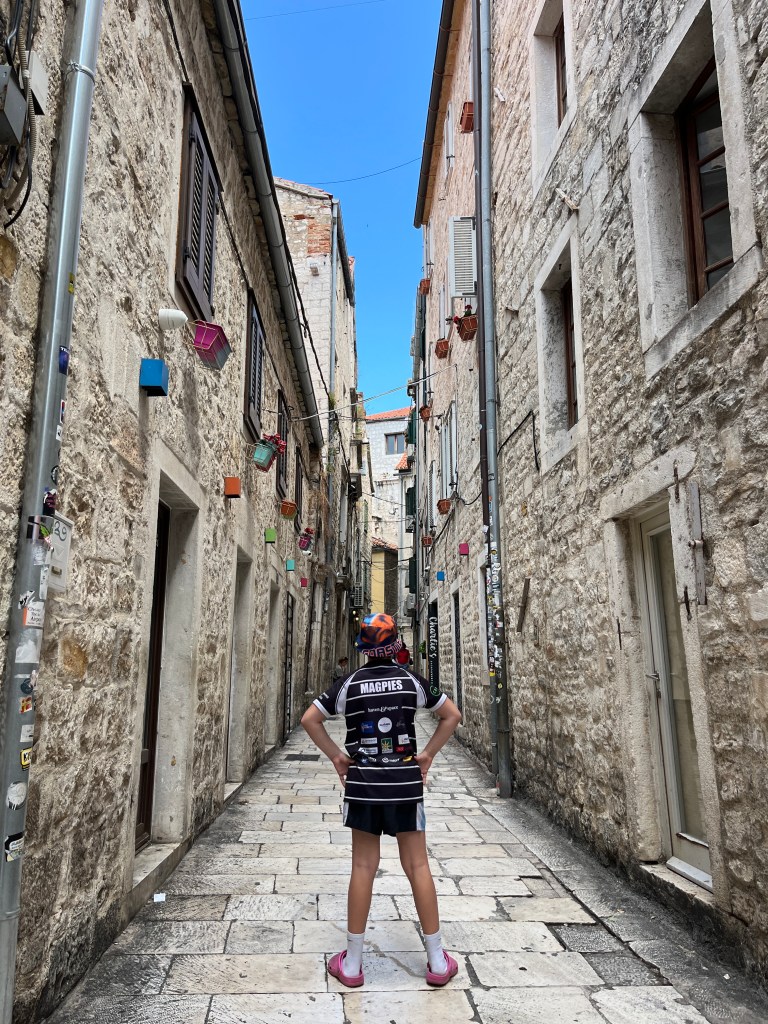
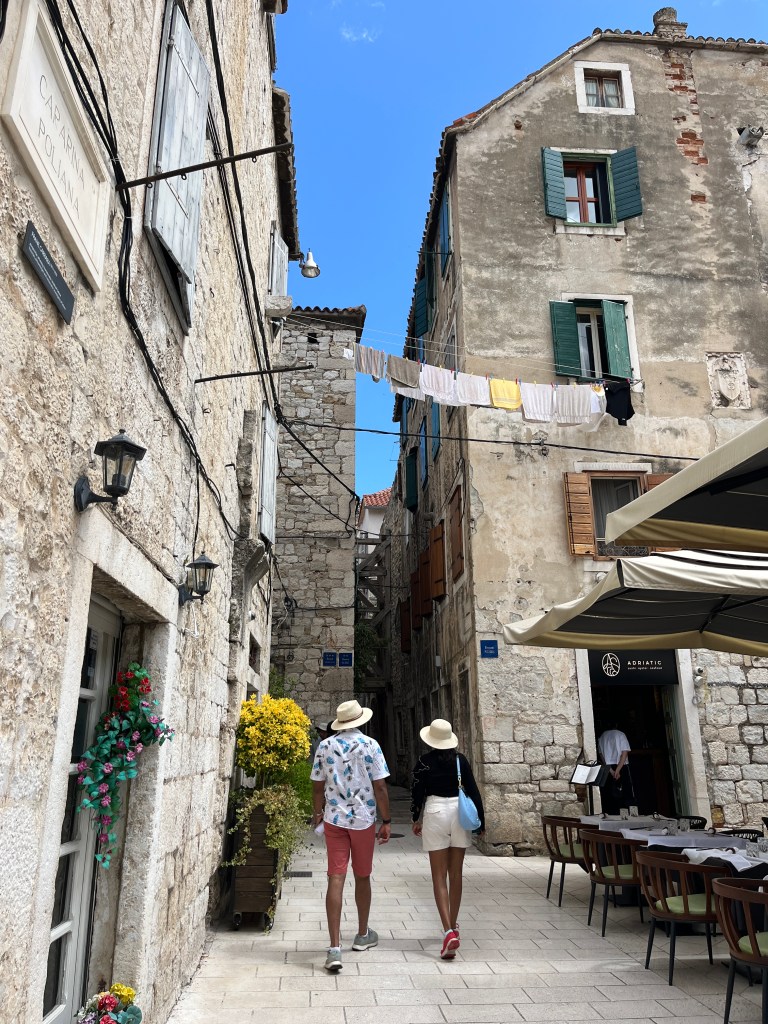
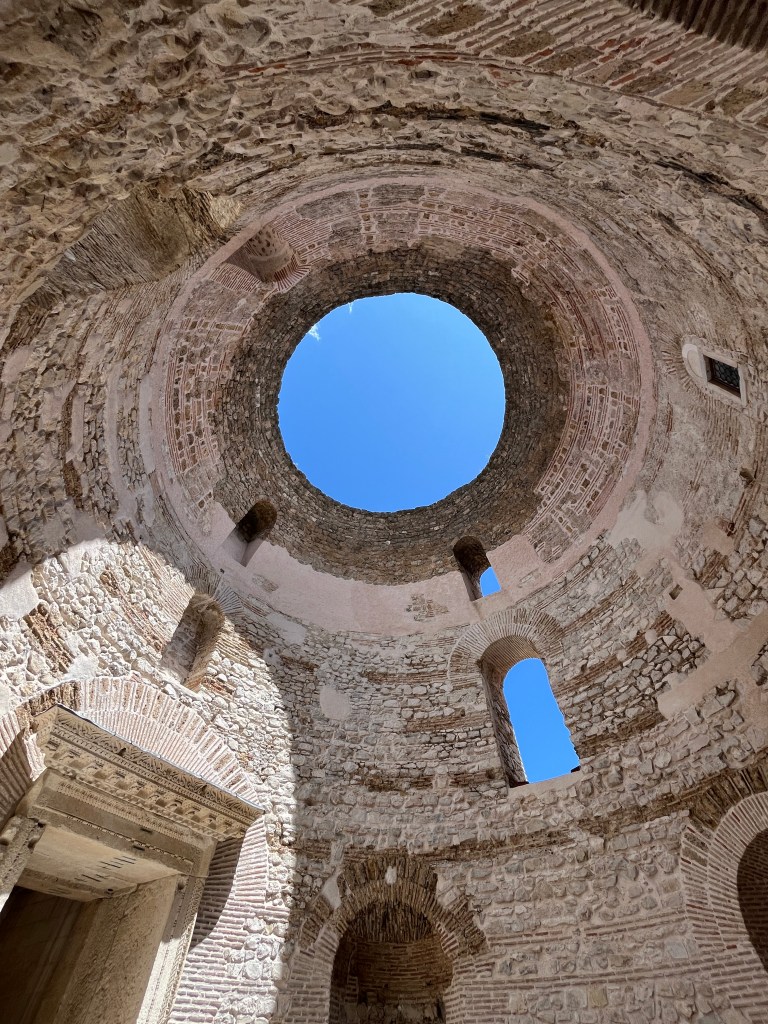
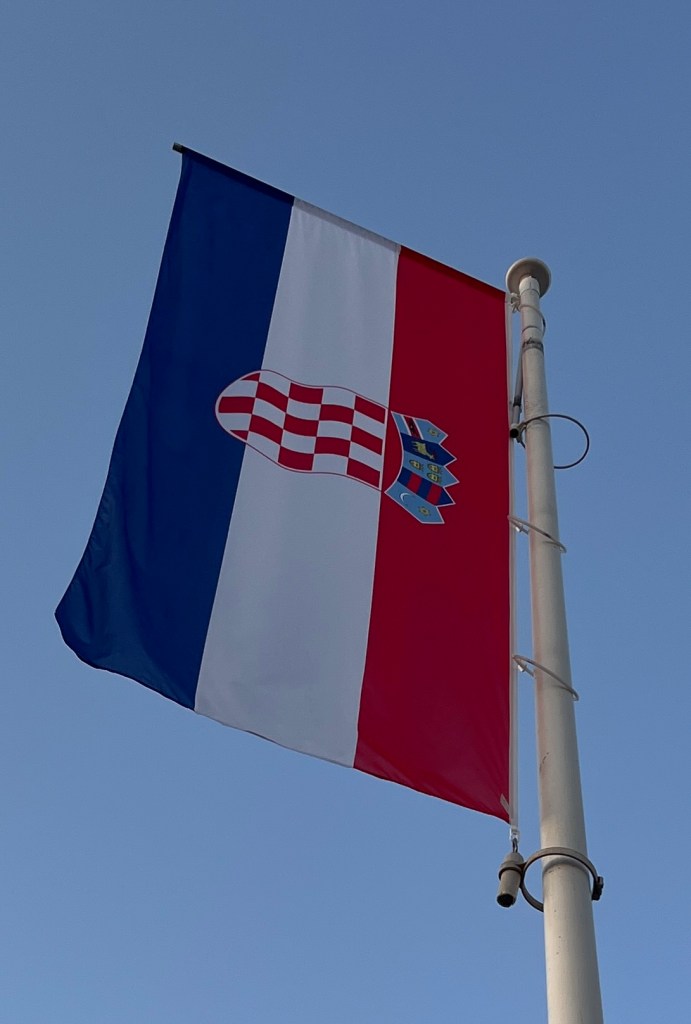
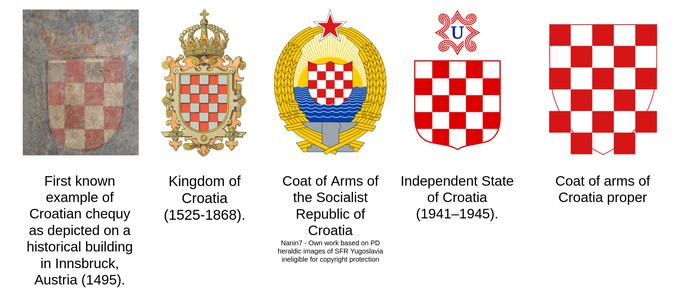
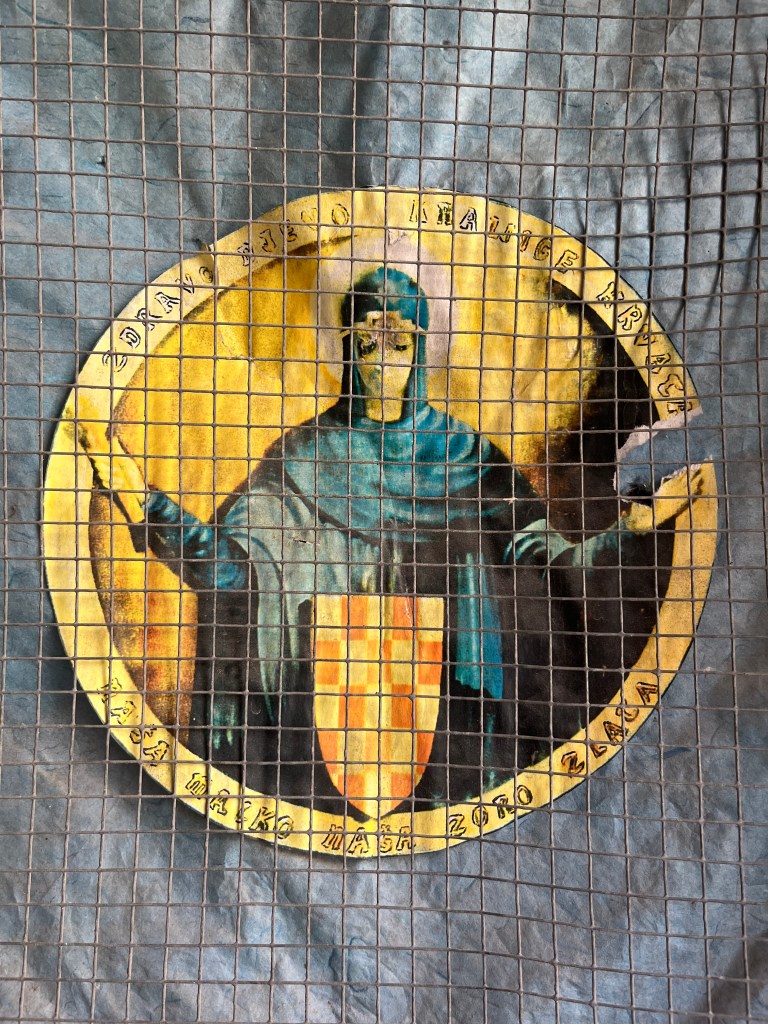
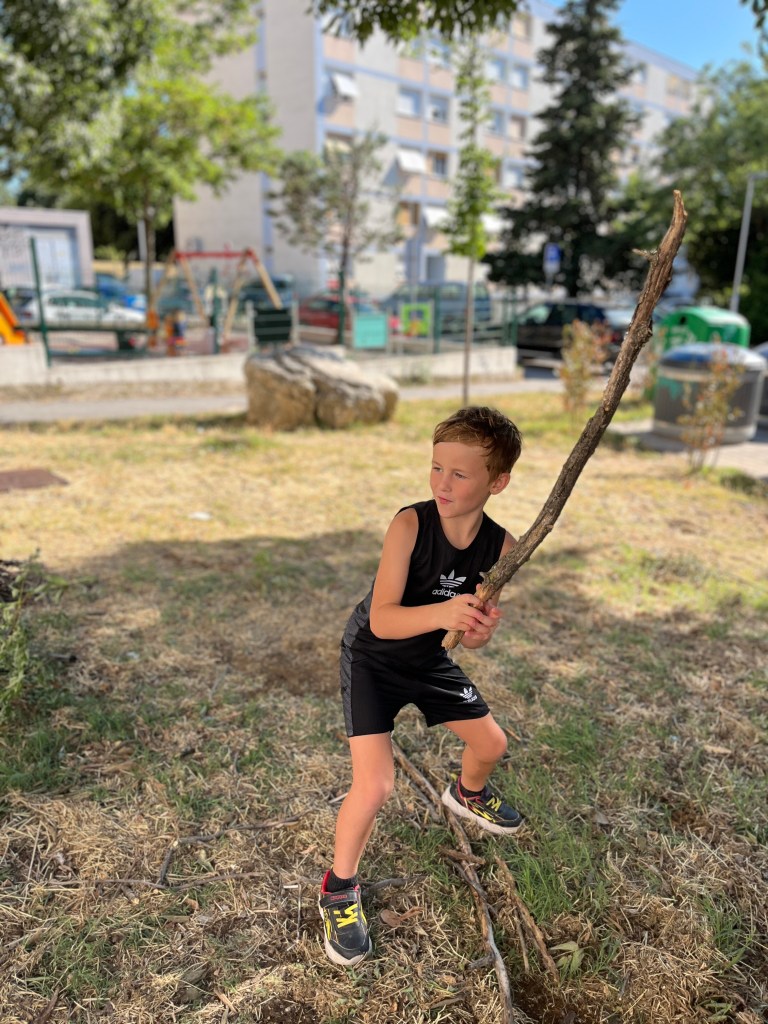
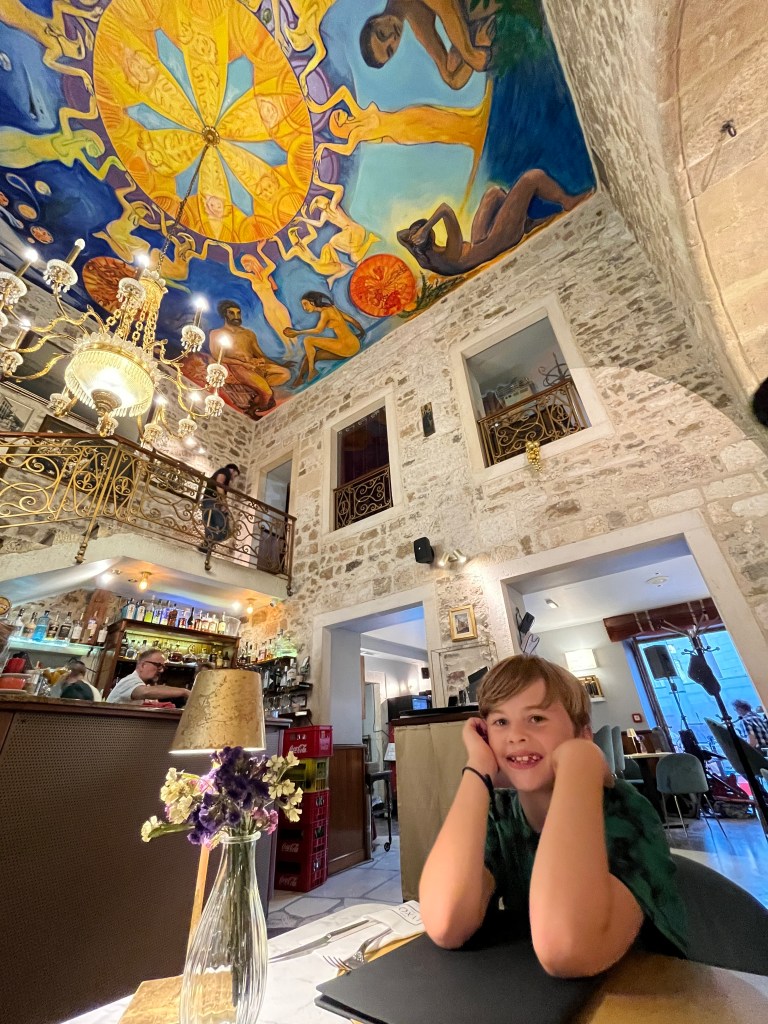
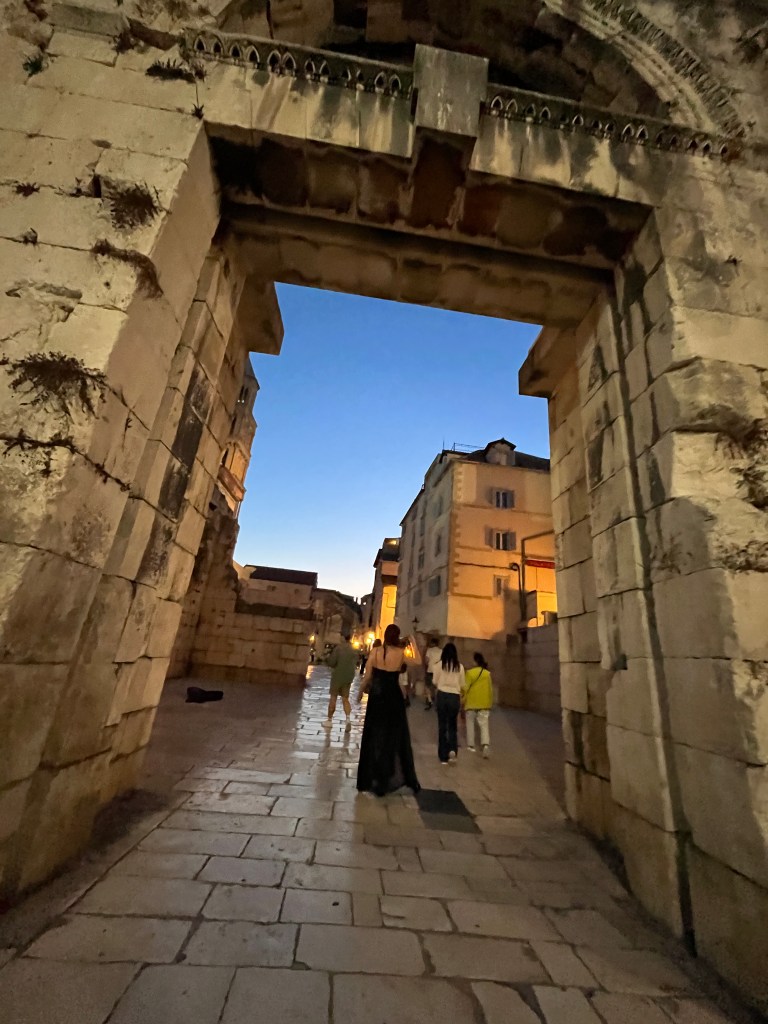
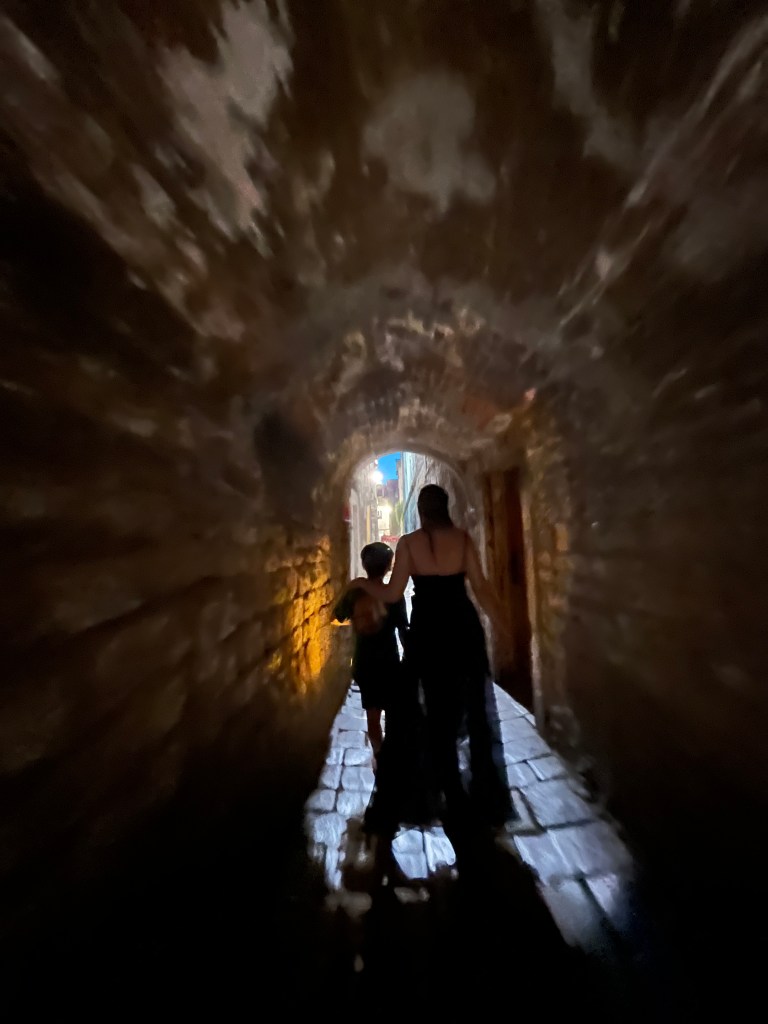
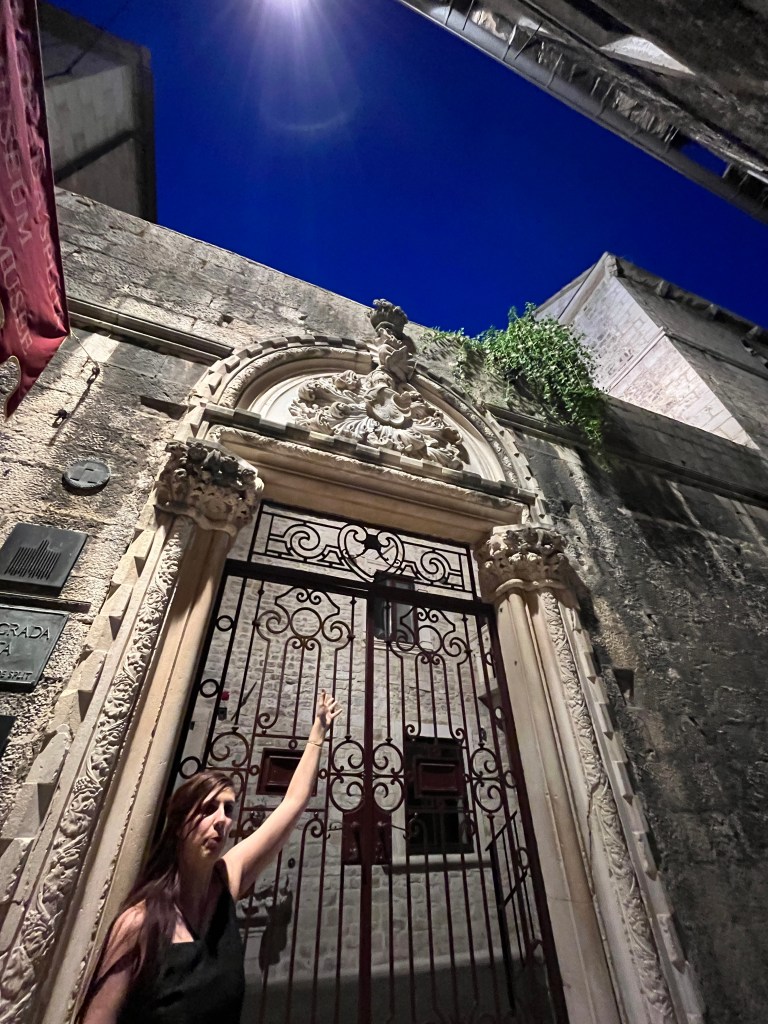
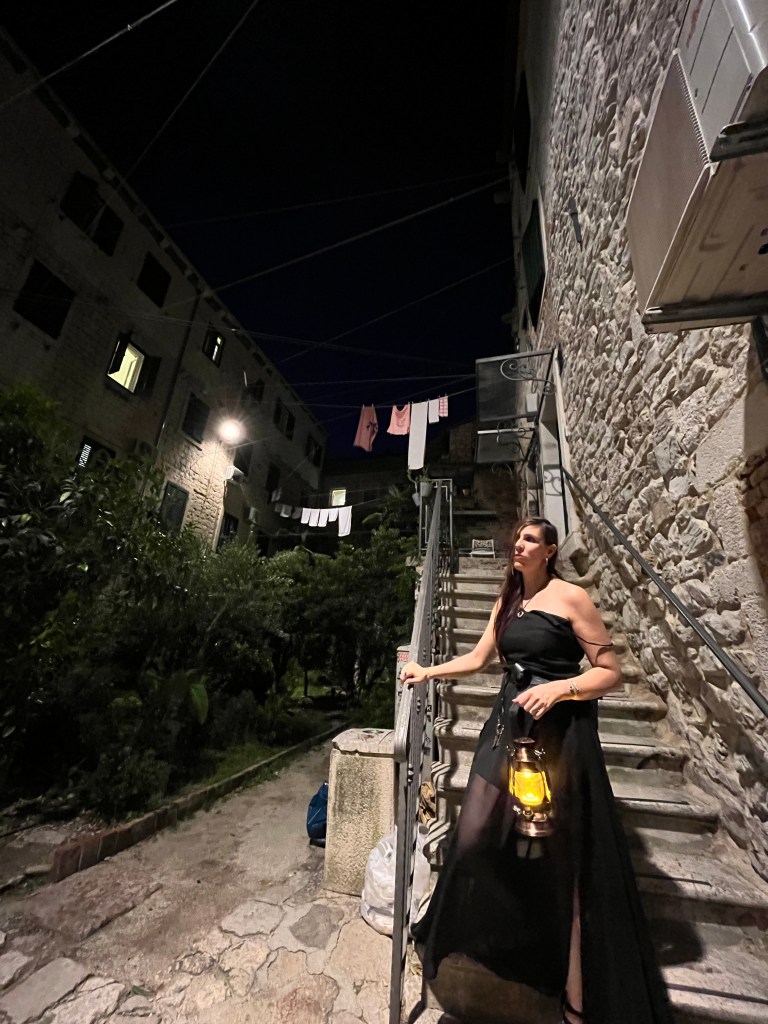
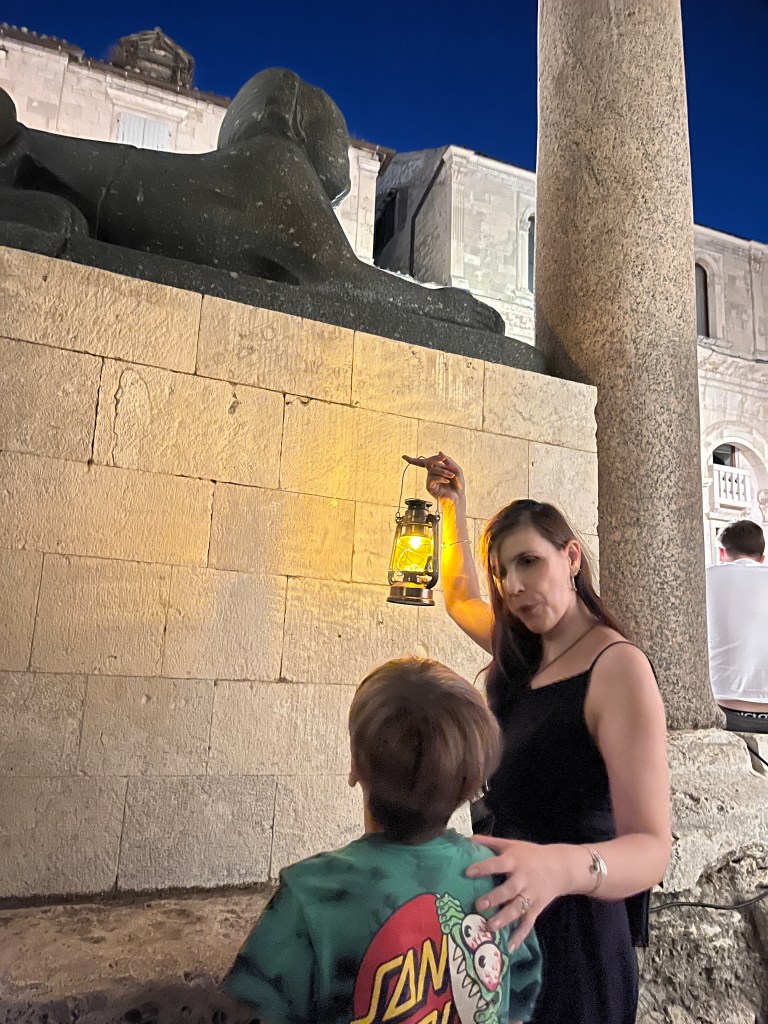
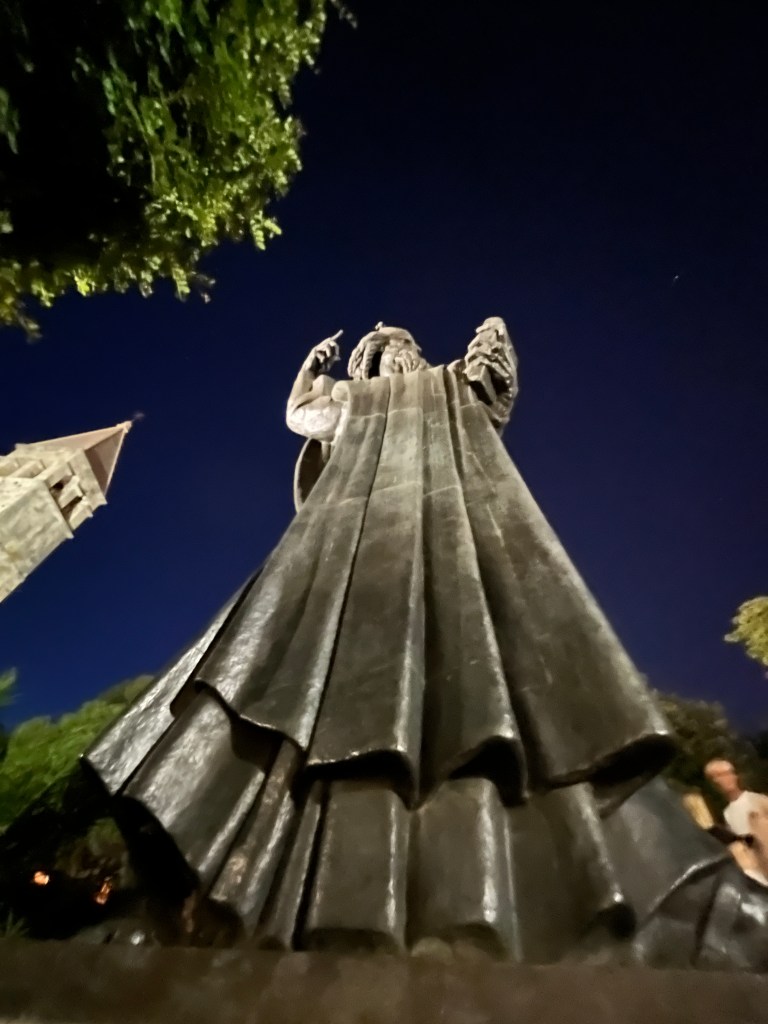
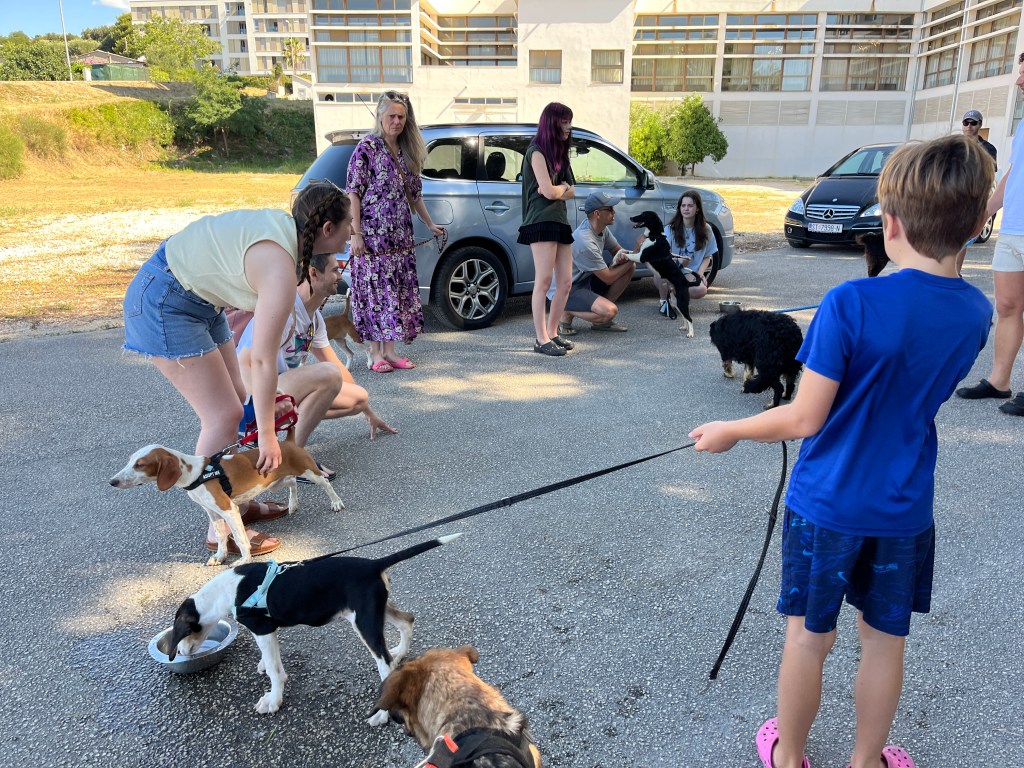
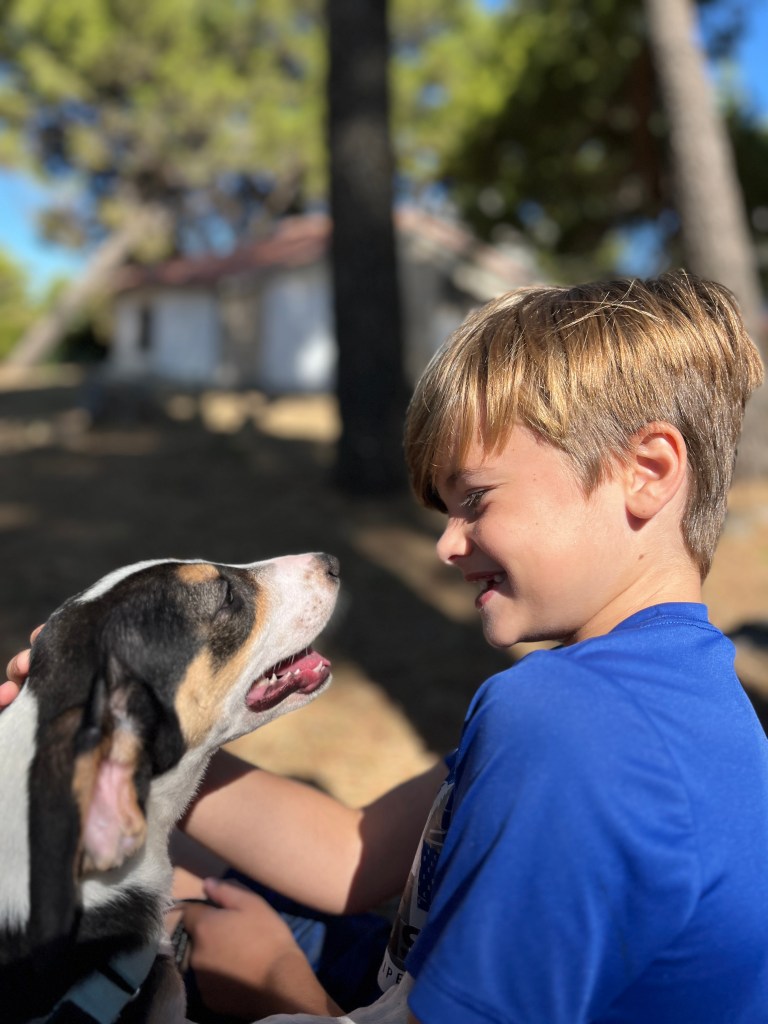
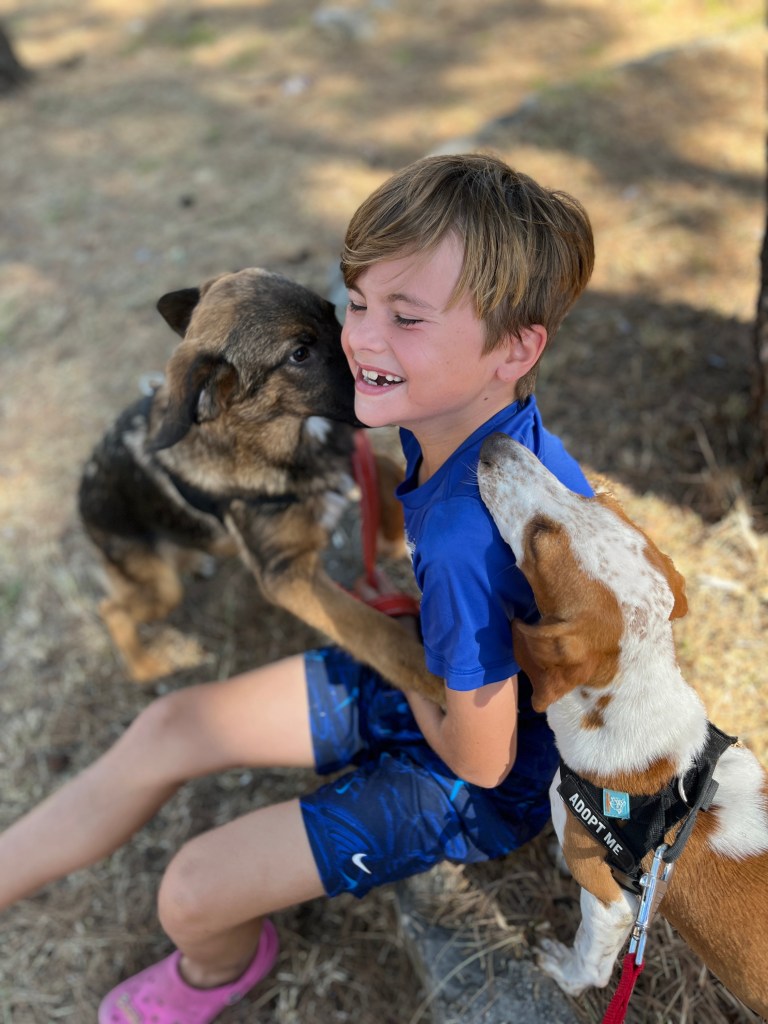
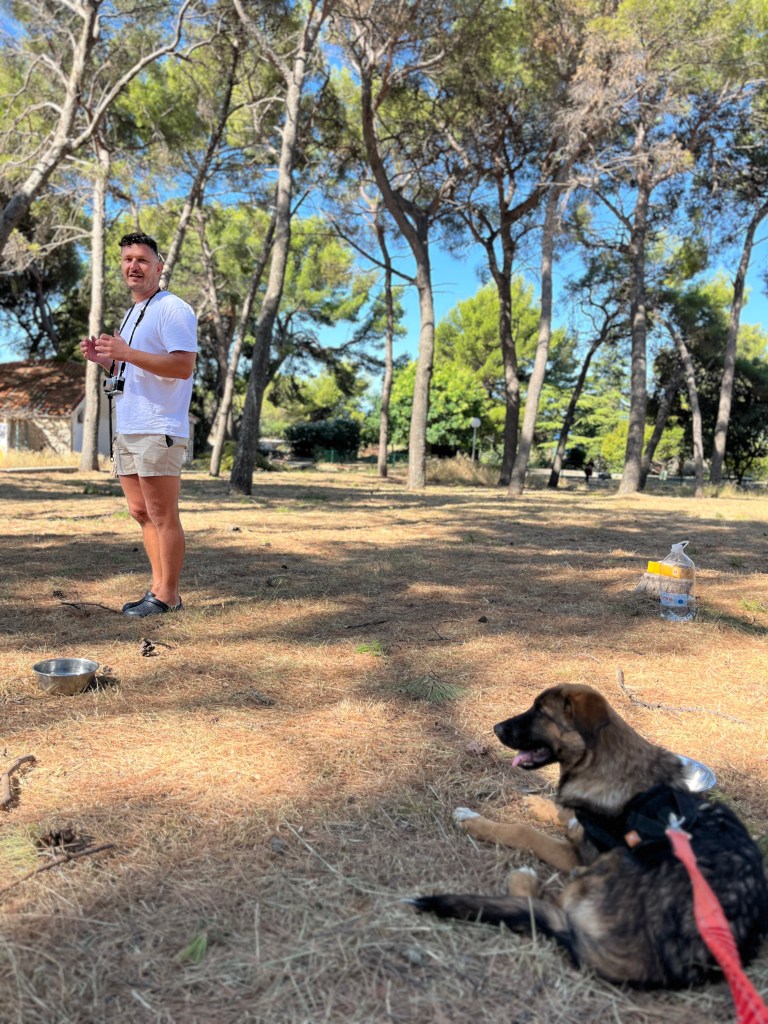
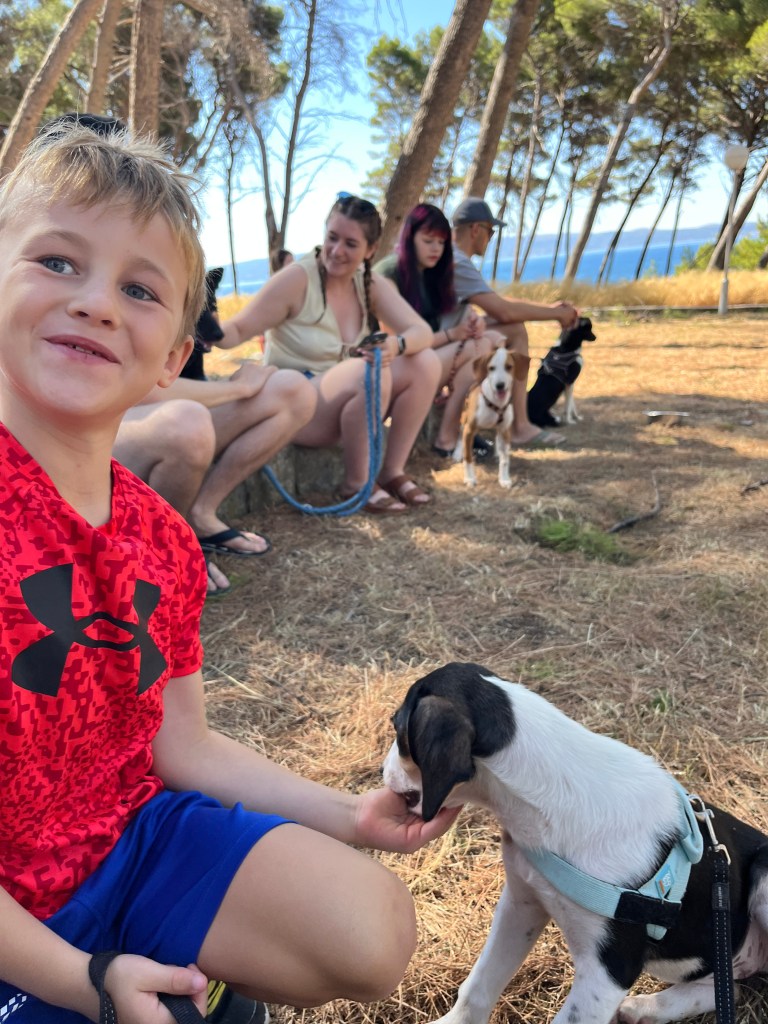
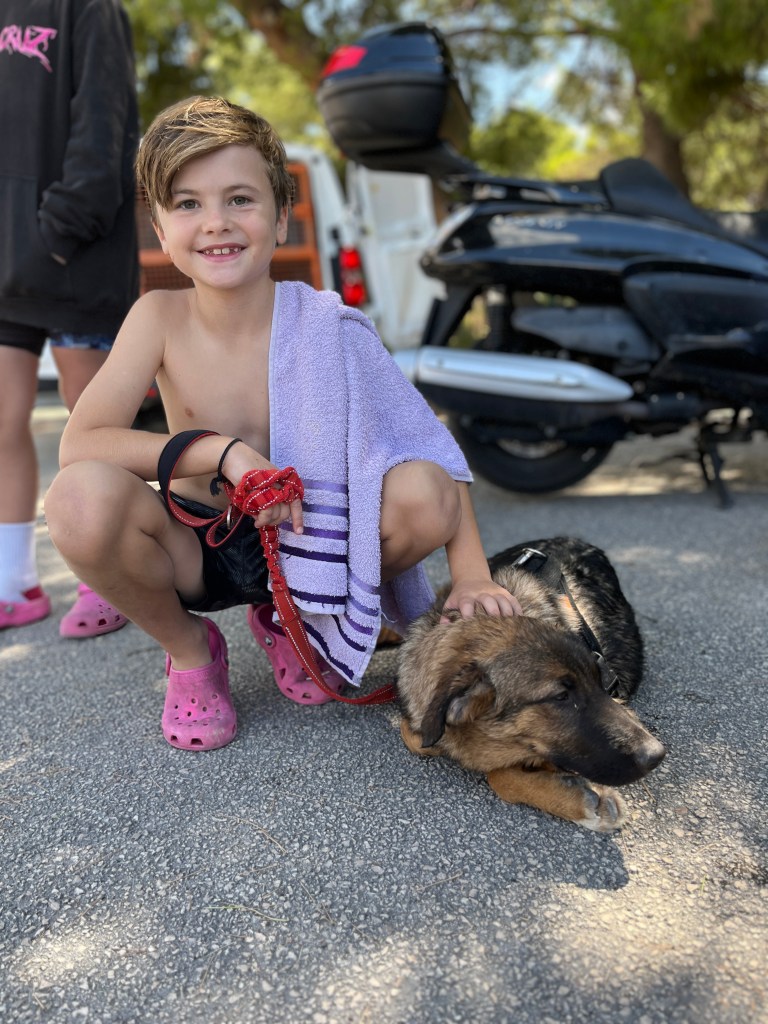
On the drive from Dubrovnik to Split, we stopped in for a tour of an olive oil factory- Stella Croatica. Unfortunately, I hadn’t factored in that the workers had the weekend off, so we didn’t get the visual process as I’d hoped would foster a life-long appreciation of olive oil in the boys. Tours were still on offer though… the kind that end in a massive gift shop. The company makes many products from the offerings of the land- beauty products, citrus sweets, honey cream, sauces, and more, including this fig cake, which has long been used by workers in the orchards and groves of Croatia to give them an energy boost- the original energy bar.Much like wine-tasting, there are Ss to olive oil tasting. 1) Swirl- in a blue glass (so the colour doesn’t influence the assessment) with your hand over the top to trap the scent, 2) Sniff- look for the smell of anything earthy as a good sign, 3) Sip- bitter or pungent is what you want, 4) Swallow- you should feel a burn deep in the back of your throat. We were also told that much of what we can buy at the store is “lamp oil” quality that is deemed “virgin” after being run through a machine. I have to admit I was consoling a tour-boycotting child while the guide explained this, so I didn’t get all the key pieces of information. Apparently, the only way to really know if it’s “virgin” is to taste it. The definition of “virgin” is that neither heat nor chemicals are used to extract the oil. It’s cold-pressed. The “extra” has to do with low acidity levels, meaning it’s more fruity and rich.This family-run operation actually has its olive groves on an island that’s part of a National Park, so the museum-restaurant-tour complex we visited isn’t there. The gardens were beautiful though and included a section of poisonous plants and a section of endangered species that required special permission from Zagreb to obtain the seeds… as you can’t legally harvest them in the wild… which is kind of a mind-bender if one is intending to propagate. Anyway, along with lavender, they also extracted the essential oil Immortalis (held above), which is supposed to be good at reversing the development of fine-lines on the face. This is the essential oil extraction process, and it makes big bucks.The tasting room/gift shop was epic with about 50 products to try, including shots of balsamic vinegar! Our coffee journey continues with this relic in our Split apartment.I went on a run and took my phone, which I don’t usually do. I can usually just get a route in my head and go to a pretty area and back, but the roads were too confusing for that. Apple Maps offered a route that was “less busy.” This meant that my jog was through car parks and abandoned places like this.As usual, the graffiti was telling tales. Torcida Split is a supporters club of Hajduk Split Football Club. They leave quite menacing street art all over the city. Masked men are their symbol. This old train line was a popular pedestrian thoroughfare to the beach.Diocletian was the Roman Emperor from 284 to 305 CE. His rise to power was said to be prophesied by a Gallic priestess. She told the young, promising soldier that he would become emperor on the day he killed a boar. According to tales, this made Diocletian an avid boar-hunter but to no apparent effect. However, after Emperor Numerian was murdered, Diocletian, who was a commander, killed the accused murderer in front of the army and claimed power for himself. The accused murder’s name was Aper. “Aper” means “boar” in Latin. Thus, a prophecy was fulfilled, and Diocletian’s 20-year reign began. There are four gates to Diocletian’s Palace: Silver, Gold, Bronze, and Iron. This is the wall outside Silver Gate. I like the shadow of the cross here because Christians were considered the enemies of the Romans due to their monotheistic belief which was seen as a threat to Roman order, which gave god-like reverence to the emperor. (Or something like that… It’s more complicated, I’m sure.)Inside the gates, it’s July in Europe.To open the boys’ imaginations to the ruins of Diocletian’s Palace, we took advantage of a virtual reality activity called Diocletian’s Dream, where they explain a bit about the emperor, his era, and the palace.Over about 15 minutes of viewing, we were guided by a slave who taught us about how the walls were built, how emperors were often killed, what different rooms of the palace were used for, and how Diocletian lived. He is the only emperor to have voluntarily abdicated the throne after dividing rule of the expansive Roman Empire into four parts to be governed separately- making a tetrarchy. Above, you can see a clip from the show with Roman subjects prostrating before Emperor Diocletian in the Peristyle, which was the main square of gatherings. There used to be gladiator fights, performances, and other Emperor-pleasing activities here. Now, at night, musicians play, and people gather to have drinks and relax in the cooling air. It was a very chill atmosphere… though maybe late night brings a different vibe. We didn’t find out.After the VR and before our real city tour to see what that palace looks like today, we had to slip in some gelato, and as we did so, a famous YouTuber appeared on the scene. I-Show-Speed is his name. A few weeks ago, the boys had said, “I-Show-Speed is going around the world too. Maybe we’ll see him.” “May be…” I said in that annoying don’t-get-your-hopes-up adult way. Well, ask and you shall receive! He turned up, strutting down the road with his entourage, and said to the boys, “Hey, where’d you get that ice cream?” The boys were totally star-struck. It was quite cute.I-Show-Speed was ushered into this Luxor restaurant and went upstairs. He was live-streaming, so the boys could watch what he was doing up there… as the crowds amassed outside. The man in the white shirt on the screen is at the window to the left. So odd.Look at this excitement. How could we not wait for this YouTube twerp to come out?He did come out. Eventually. Dressed like this. He stood where Diocletian stood in the Peristyle (below) and addressed his fans, who met him, not in prostration, but in the modern mobile phone salute. How weird our world has become.The good ole days… Cause this isn’t weird at all. Humans…The meeting point for our walking tour was nearby. Here is a depiction of the palace in its original glory with the walls right up to the Adriatic Sea. (There is now a large promenade between the two and lots of boats.) Current Old Town Split is half inside the palace and half outside. Expansion sort of spilled out of the walls.We have found GuruWalks in many cities to be excellent. They are free and run only on tips. I didn’t last long on this one due to our tour-boycotting “someone” in the family.Prior to the 1990s, this place was a dump, and no one wanted to have a property in the palace because it was inconvenient for shopping and parking and really run-down and foul. Now, a property here would be worth a mint. The whole area is very well-kept, and every turn offers a unique alley-view of doorways, arches, and interesting structural features. These are the “basements” of the palace that were used for storage originally and then trash and sewage in living-memory of older Split residents. Very recently, they were where Daenerys Targaryen held her in dragons in Game of Thrones. Now, it’s a thoroughfare from the water’s edge promenade to the Peristyle.In Dubrovnik, I’d noticed all the shutters were green. Same in Split. The internet says this was historically the case because the green paint of the time was thought to contain something that deterred insects and also rust. Now, they are just keeping to the historical tradition, I think. There are some lovely shades of aged green.Prior to our river rafting trip, we did a bit of world-schooling on rivers. Above and below are screenshots of a YouTube video: https://www.youtube.com/watch?v=nKBrFv164xQ Hydrology 101 by Boreal River. This was such an excellent introduction to the physics of rivers. We learned that the slowest moving water is by the shore and in shallow water- further in = faster flow. We also learned about eddies, calm areas where the water runs upstream, circling back on itself due to the current encountering a nearby obstacle, like a rock. They can be safe spots if you find yourself accidentally in the rapids.Realising that the surface speed of a river is much slower than the speed of water below felt like a really good safety lesson for us all. I’d always heard that a river is running faster than it looks, but I never understood how this worked. Surface loads go medium speed (the raft or a log), suspended loads go quickest (us in lifejackets), and bottom loads go slowly (unconscious people not in vests). The video also taught us (at a very basic level) how to read the flow of the river following the physics: Water always goes in a straight line. So, water doesn’t follow the curves in a river, but runs in a straight line and bounces off the bends of the river’s edge, like a billiard ball bouncing off the bumper.The River Cetina is an hour south of Split. It was shockingly pristine and the perfect cooling temp for summer. This was a very memorable float through a Croatian woodland paradise.The boys were ready to cliff-jump as usual. Old hat. The water was so clear and full of bright green plants. There were zero signs of human presence except for the rafts and a veteran of the “Homeland War” who has been allowed by the local government to summer at the rivers edge. This grey-haired, grey-bearded man in a fold-up chair exchanged a little chat with our guide as he rolled a smoke and we passed by on the flowing water.The joy on everyone’s faces for this three-hour adventure was worth every penny. We had some moods brewing at the outset, and all of them were dissolved by this gorgeous river and our story-telling river guide, Ivan.There was a point where everyone had to make a choice, and they couldn’t change their mind. To avoid a dangerous rapid, we had to either do a little hike or swim through an icy-cold cave and climb in the dark. Our brave boys all elected for the cave, and it was c-c-c-cold but so beautiful and exhilarating! This is us emerging.Grump-free KiddosI was really excited for this rafting adventure because my summers as a kid usually involved a trip to visit my grandparents in North Carolina, and our trip always involved rafting with my dad and sister on the French Broad River. The boys are just now all old enough. It was a raging success.Our boat-mates were a couple doctors from Romania doing this for the second time. All of our pictures are from Ivan’s GoPro cam, so I don’t have any of him, but he was a character. Being a paramedic and mountain-rescuer who spends summers on the river with tourists, he had a ton of stories and loved to tell them. From a trip involving an 80 year-old bucket-list-ticker who lost her teeth in the river to the 130 year-old body he found in a crevasse on a glacier rescue mission, Ivan was a story-teller extraordinaire.The beauty was really distracting.Back in Split, this guy was keen to explore the palace with me, which involved gelato, of course.So, Diocletian’s palace was actually an imperial residence, military fortress, and fortified town. Eventually, it was his retirement residence. He designed and built his own mausoleum, and apparently he liked to look upon it and reflect on the inevitable. After he was buried though, and the Christians came, they looted it, did who-knows-what with his remains, and turned it into a cathedral. They had considered destroying the whole structure because of the Roman Christian-killing Diocletian had overseen as Roman emperor, but they figured it was a greater insult to repurpose his mausoleum as a Christian house of worship- The Cathedral of Saint Domnius is still visited today.Beneath the former mausoleum of Diocletian, St Lucia’s Crypt is a pretty sterile place. “Crypt” had me excited for creepy darkness… but nothing more than this statue was down there among all the well-lit limestone. That and the smell of mould.We also decided to go high and climbed the bell tower. Quite steep.So fun to wander and wonder with this guy.Trendy people everywhere.Tons of cafes and bistros can be found down little alleyways and under super charming architecture. This is definitely an adult place to holiday. I suggested the boys tuck this one away in the memory as a romantic destination with a lucky partner some day.Where there are people…The vestibule of the palace is now a popular place for buskers and a cappella groups. The ceiling used to be covered with coloured glass, and when people would meet the Emperor, the light would make him look god-like. Flag history time! This one has a legend. King Držislav ruled Croatia from 969 to 997 AD, and legend says he was a keen chess-player. When we was captured by the Venetians, they made a bet. King Držislav had to play three games of chess to win his freedom and, in some stories, control over Dalmatia (part of Croatia). Well, he won all the games and, to commemorate his victory, he put the chessboard on the coat of arms. Below, you can see some examples of its use over time. Above the red and white checkers are five crests of the different regions of Croatia: Dubrovnik, Istria, Slavonia, Croatia Proper, and Dalmatia. I won’t go into each of their stories. As for the background, red symbolises courage and the blood of Croatian fighters, white is, as usual, for peace and purity, and the blue signifies hope and that love of all Croatian loves, the Adriatic Sea. For the record (and for my mom), Croatia is about the size of West Virginia.The evolution of the coat of arms from https://chessify.me/blog/the-legend-of-king-drzislav-why-the-chessboard-is-on-croatias-coat-of-armsAnother example I found in a palace alley. I couldn’t find why it’s red and white, not black and white.A wicked storm brought down tons of branches and sent the city into chaos for a day. Made for good stick-fighting for us.Back in action!Lots of injured and displaced creatures.Prior to a night tour, the older boys and I snuck off for dinner in the cool Luxor restaurant. Amazing pizza… I’d planned to take a photo… but I ate it with too much gusto. Seems like we are pizza addicts, but really it’s because it’s always the cheapest thing on the menu… the budget has taken some abuse over our five months on the road.“The Soul of Old Split” is an AirB&B “experience” that was another big win. The older boys weren’t too sure what to think about a night walking tour, but Doris was an actress, and after warmly greeting us as herself, she went into character: The Soul of Old Split, a passionate and magnetic story-teller- urban legend, history, and gossip galore!To begin with, we were given an introduction to “the people of Split,” their signature style. They are known to insult you as a sign of affection, for one. If they like you, you will be given a pet name that makes fun of your natural features in some way. The people of Split are also brusque and to the point, and Doris warned us that if someone comes up and says something that sounds rude, they are probably just saying, “Hey, what the hell are you doing with that lantern?” It’s all in good humour.We learned about a couple of the famous families of Old Split (crest above the door) and the murder mysteries that entangled them.We wandered around the palace to various story locations, and as we departed each spot, Doris would say, “Follow my light.” And sometimes she let the boys carry it.Some of the tales were of more modern legends like a famous Croatian singer, Oliver, who lived in the town or a couple who lived on their boat with their little dog, but were later found dead of exposure after an icy storm had destroyed their boat, a greatly felt loss to the community.There is also the story of the 12 Egyptian sphinxes around the city. Brought by Diocletian from Egypt, the sphinxes were thought to be bad luck by the Christians. All but one were beheaded. We saw at least one headless sphinx in town. This one, near the entrance of the Cathedral of Saint Domnius, kept its head for some reason, and the people would cover their eyes when they walked passed to enter the church as not to lay eyes on the creature and be cursed. Then a Vanderbilt from America came and offered to buy the sphinx. Well, that made those feisty Split residents grow a sudden affection for the sphinx, and they refused. Here he remains.Some of the sphinx heads have been placed around town as protectors of residences.Another storied statue is this one of Gregory of Nin (Grgur Ninski). He was apparently a bit of a revolutionary in the church, a Croatian Bishop who wanted the Catholic mass to be done in Croatian, not Latin, to make it more accessible to the local people. You can see how powerfully he is depicted here, like a magician or someone demonstrating great power. You can also see lines where this statue was cut and moved by the Italians during WWII. He used to be inside the palace, but now, Nin is outside The Golden Gate.. Apparently the local sculptor, Ivan Meštrović, is very skilled (and adored). The GuruGuide told my partner that one can tell the skill of a sculptor by how he forms the hands. They are very difficult to get right, and these hands are magnificent.You are supposed to make a wish on his big toe. Guess what I wished for.So, have I mentioned that AirB&B offers amazing “experiences” that you should check out next time you travel? No sponsored plugs here, but so many unique offering are out there. And you are usually supporting local people doing cool stuff on their own. This one was “A Beach Day with Rescue Dogs in Split,” which is run by a shelter called Bestie (https://bestiesplit.hr/en/). AirB&B doesn’t take any cut for non-profits, so all the money goes to the dogs. Yay.We met in the parking lot of the Zagreb Hotel, and then Zoni, son of the vet founder, arrived with nine dogs to introduce to us for our morning of play. This one is Bella, and she is one of two sisters.Then we walked to a park for a little chat and an introduction to how the shelter works. Kids aren’t usually allowed to come, but they let our three join when I sent a plea of a message. This guy’s giggles are doggie attractant. The more they licked, the more he giggled. The more he giggled, the more they licked. Heart medicine. Our guide, Zoni, spoke about his vet mother who started this shelter without any idea of how it would work. She leapt… and the net appeared. She was wise enough to know that getting caught in the “how” would never make anything amazing happen in this world. She trusted that the people, the funds, and the resources that were needed would appear if she just did what she knew was right. We should all do that.Lots of puppies. Totally adoptable. All the dogs got a dip and a swim… even if Zoni had to lovingly carry them out into the sea to let them swim back to shore on their own.Zoni’s shirt was perfect… he was 15 minutes late to our meeting.Bida was our favourite. You can see. Those eyes. These pups didn’t fill the Bronzie-sized hole in our hearts, but it was close.Meanwhile though, our sweet Bronzie is having a nice winter’s stay with her grandparents in Berry. Ma even fashioned her with her first wooly jumper. Can’t wait for those belly-rubs, Bronzie-girl.
This trip is proving to be like having an expanding family. Just when you think you couldn’t possibly love another country more, you expand to hold even more joy, admiration, and marvel. Hvala, Croatia. Thank you for welcoming us. We will see you again someday. I’ll be plotting my retirement with you in mind. See you before then, I hope.
wow Dede…. Croatia sounds absolutely amazing, and such a dream to add to your wonderful adventure. Thank you so much for all the detail, we’ve loved every single part of it! Thank you so much for taking the time!! You’re the best!! Xoxox


























 Mapping the Gap
Leave a comment