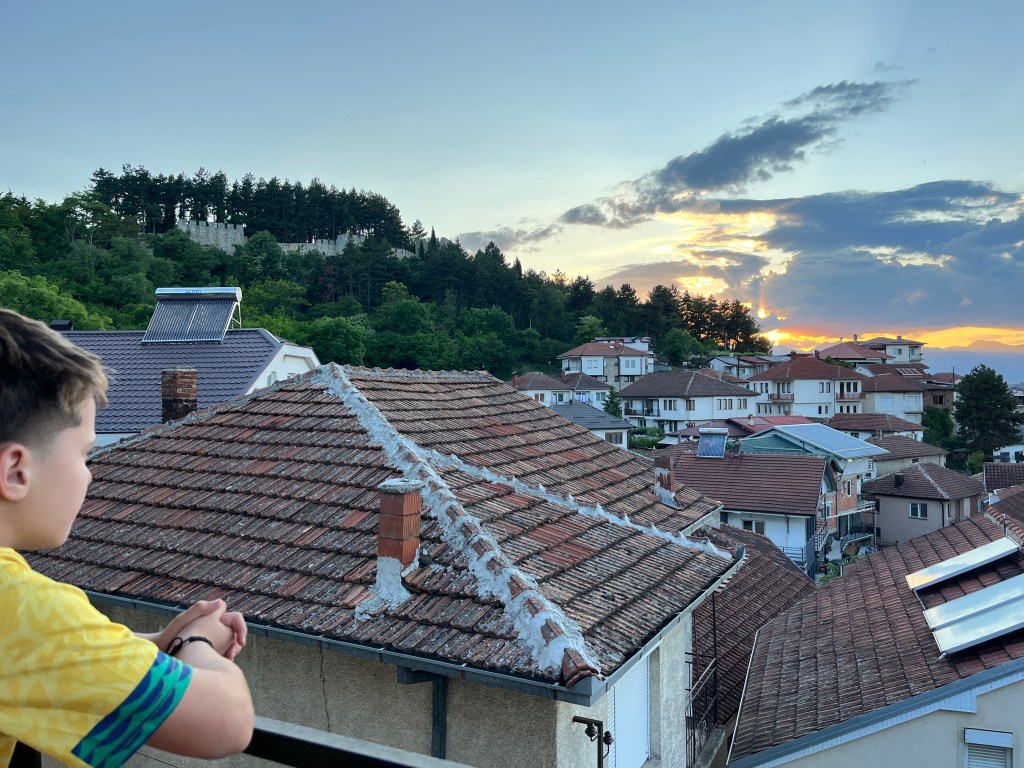
Upper Balcony View from Villa Lena (fortress wall on the hill)
Here we are in a town we’d never heard of two months ago. We’re settled in, waving to the neighbours, finding the best produce, with light-switches, faucets, and coffee all sorted. Home is now a traditional Macedonian three-story AirB&B in “The Pearl of the Balkans:” Lake Ohrid. This prehistoric lake didn’t exist in our minds or on our itinerary until I had a chance conversation with a Worldschooling mother in Hoi An last April. When I said we were going to Skopje for a week, she said, “Just Skopje? Aren’t you going to the lake?” “What lake?” Here we are. Home for the month of June. This is the type of spontaneity we wanted to invite on our Gap Year, to be guided by wispy leads that become realities, to not be in control of all the details, to allow Fortune to take the wheel on occasion. It’s been a bless-ed whim.
We had originally planned to be in Sarajevo for the month of June. Come to think of it, as I reread those words, “Sarajevo for the month of June,” I realise they always felt like gravel coming out of my mouth. I’m going to look out for that sensation in the future. That was an inkling I repeatedly ignored. Then again, how many people probably flinched when I said those words? I mean, who spends a month in Sarajevo? Sounded risqué, a bit audacious. You know, like we might be going someplace before it becomes hip or we might uncover something special in the prolonged stay. Or something.
Well, during our days in Vietnam, this month of June kept surfacing from the floodwaters of my mind. I kept discovering myself pacing back and forth, furrowing my brow about June. When I trailed the paces, I found myself circling Sarajevo with scepticism. Again and again. I joined some Facebook groups and some WhatsApp chats for expats. I started planting seeds for friends and meet-ups. Although I did get flickers of promising action, it was mostly a lot of adult events and melancholic parents of pent-up toddlers. Hmmm. I wanted this to work. My partner was very excited about this destination. He had sent me a document with a list of links back in Australia. “Sarajevo looks great,” was the subject line. I didn’t even click the links at the time. He was clearly smitten with the city, so I said, “Book it, babe.” And he did. Flights and all. Well, then, a little while later, a couple of month-long-stays wiser, I started to worry. Without any new information, I kept finding my mother mind in worry.
So, I took a closer look at our AirB&B booking. We’ve learned a lot in a couple months on the road. There are a few key things our family needs for extended sustainment. If we didn’t get the digs right, these month-long stays could be a serious sentence of hard time. We knew what we needed: 1) My partner needs to run video panels with a green screen at 2am without waking the whole house. 2) The boys need separate spaces, at least three rooms in total to allow peace a fighting chance. 3) A decent kitchen- five is a lot of bellies to feed three meals a day. 4) A big table or multiple small ones for schoolwork and dining. 5) Ideally, four separate beds (but we can work with whatever). Of course, consistent WIFI and a washing machine are musts. Greenspace outside the door is a bonus too.
It’s always a fun puzzle to try to piece together what’s what through the photo gallery on AirB&B. Our Sarajevo place was one of those listings that had close-ups of all the charming details: artful doorknobs, a beautifully painted fruit bowl, brass Ottoman light fixtures, and a colourfully distressed cabinet. Super atmospheric and persuasive. Upon closer inspection, though, you guessed it, I found the source of my intuitive circling. When I considered all the camera angles and looked beyond the exotic fixtures, I realised that the boys were slated to sleep all together in an open loft over the kitchen-slash-living-room, and also that said kitchen had only a sink and two burners, no countertop space at all. This apartment for five people had one bedroom with a door and only a coffee table and wooden-backed sofa for dining, study, recreation, and an eight-hour workday. Oh, and a couple squat, backless stools. The idea of making coffee in the morning without waking the boys was foolishly hopeful- an absolute essential for my mental health. The big tv-voice projection that accompanies the green screen at 2am was completely out of the question- a threat to all of our sanities. The month of June would have been a house of horrors. A bow of gratitude, once again, to my niggling source guidance. Thank you for your persistence.
We looked for other places in Sarajevo, but nothing sufficient appeared. My partner kept saying that they had a great children’s war museum, that the culture of the city was special, that WWI began here, but in the end, nothing looked like what we needed within our price range. Instead, we shifted our sights to the lake we’d overlooked in North Macedonia. We looked to Lake Ohrid, the oldest lake in Europe, a lake that predates the Ice Age. It’s between two and ten million years old. (Numbers get a bit fudgy when you get in the millions, I guess.) Here, near Lake Ohrid’s majestic shores, we have found a haven, a much-needed harbour in which to dock and drift a bit. Gentle progress has been at work here. Space. Light. Recovery. Integration. Which might make for a boring scroll, I’m afraid to say. Apologies, dear reader. We’ve been taking it easy.
Our house is situated beneath Samoil’s Fortress. I haven’t really dug into the history of this structure yet. This is the beauty of “slow travel.” No rush. So far, this stone beast is just significant as a backdrop to our little story. In this way (and many others), history is current. In this way, people of the past continue to be relevant to lives of the present. I feel them here, the people who paved the paths, who carried the stones, who crafted the steps, who stacked the fortification. We look upon them every day. We feel their mark under our feet. In this way, they live on in our story surreptitiously. The rise, crest, and fall of so many lifespans can be felt and understood if we allow our imagination to really have a session of vision. I’m enjoying this period of not knowing the history of this fort. It affords me the pleasure of unarticulated relations with the past. I can just open myself and feel what’s around. It’s really quite the quiet and powerful indulgence. “Slow travel” is good like that.
The fortress wall is perched on the edge of a hill in view of our upper balcony, and after experiencing an infusion of energy from this splendid spread of earth one morning, I promised myself (and the trees) to run or walk around it every day we are here. Each day since, I have felt a gentle magnetic pull to visit this hillside. The inclined land around this small fortress-topped promontory is laced with a network of stone paths leading to ancient churches, modern cafes, beaches, benches, and viewing points. Interlaced within this city-designed network is another system of walker-made paths, dirt ones made by shoes and paws. I’m getting to know all of the passageways. Feels like learning a new lover (without the wrongdoing), and I’m loving every curve I discover.
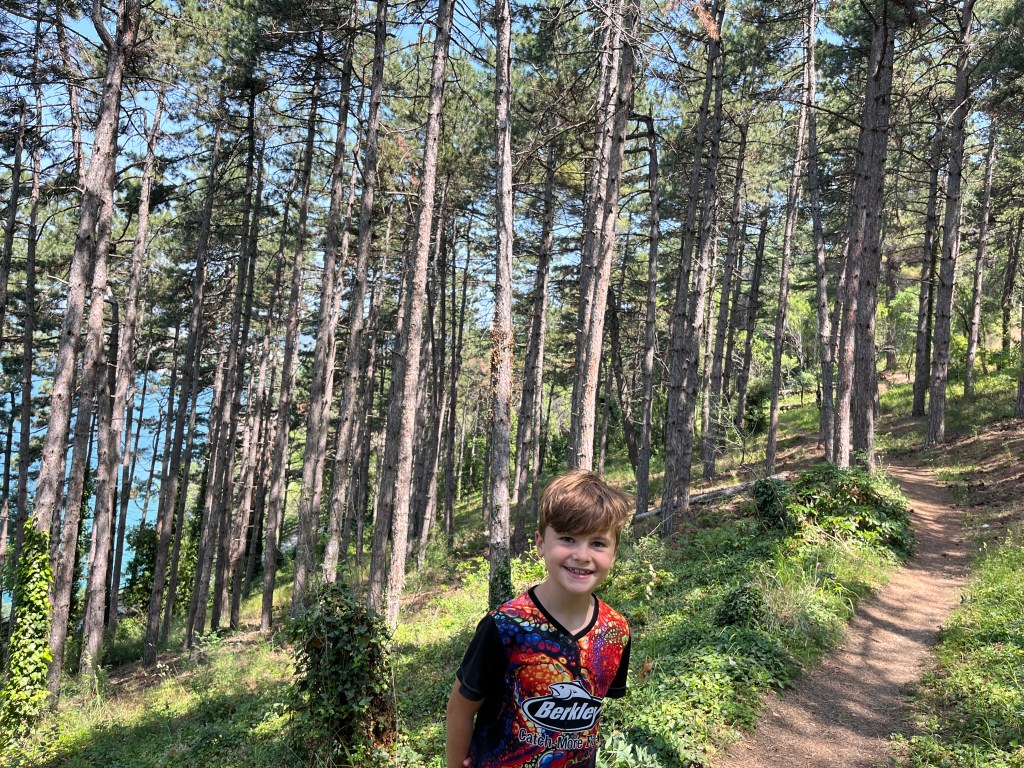
This ancient hillside is a mix of pine forest, patches of wildflower meadow, moss-covered boulders, ivy groundcover, the odd pile of once-structural stones, and breaks in the trees that offer expansive views of placid blue all the way to the mountainous skyline of Albania, which shares the lake to the southwest. A soundscape of birdsong quivers the ears, sending sensations of aliveness through any lucky walker of these paths. I think this musical magic works whether the person is aware of it or not. It’s a gift ever-flowing from the trees here. Along these unpopulated paths, an olfactory symphony of botanical scents simultaneously plays on the memory. So many familiar fragrances. So deeply known. So mine. There is a pre-existing intimacy here, yet I am a foreigner. This is all native to me, yet I only visit. It’s private, and yet I know I am not alone.
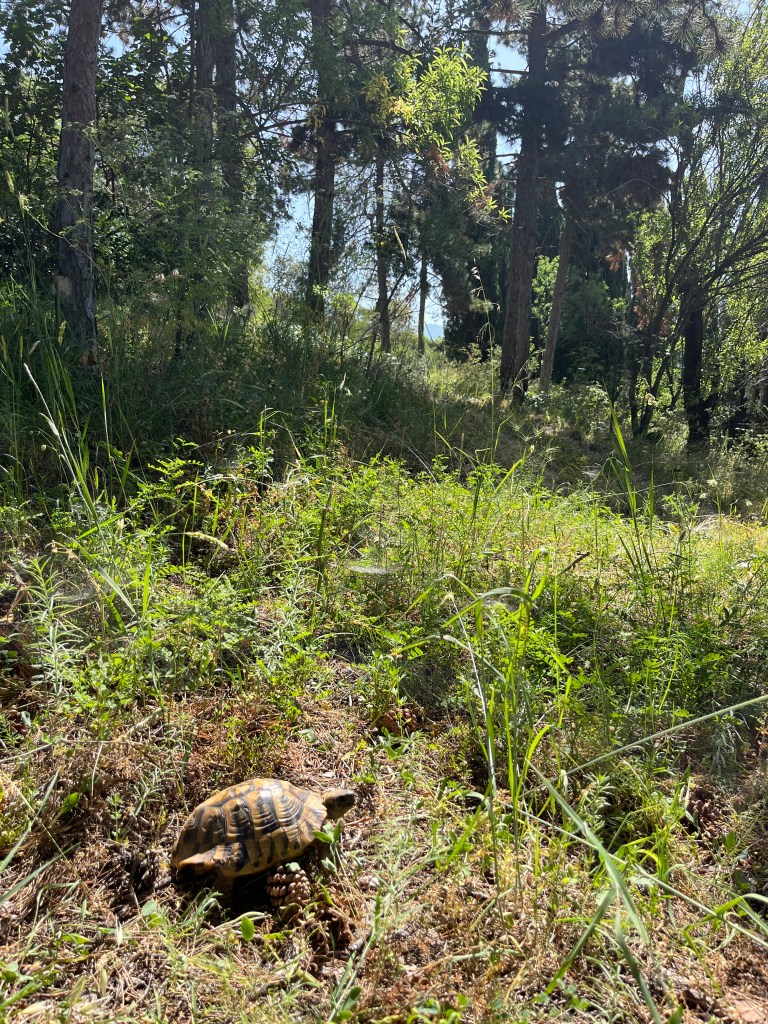
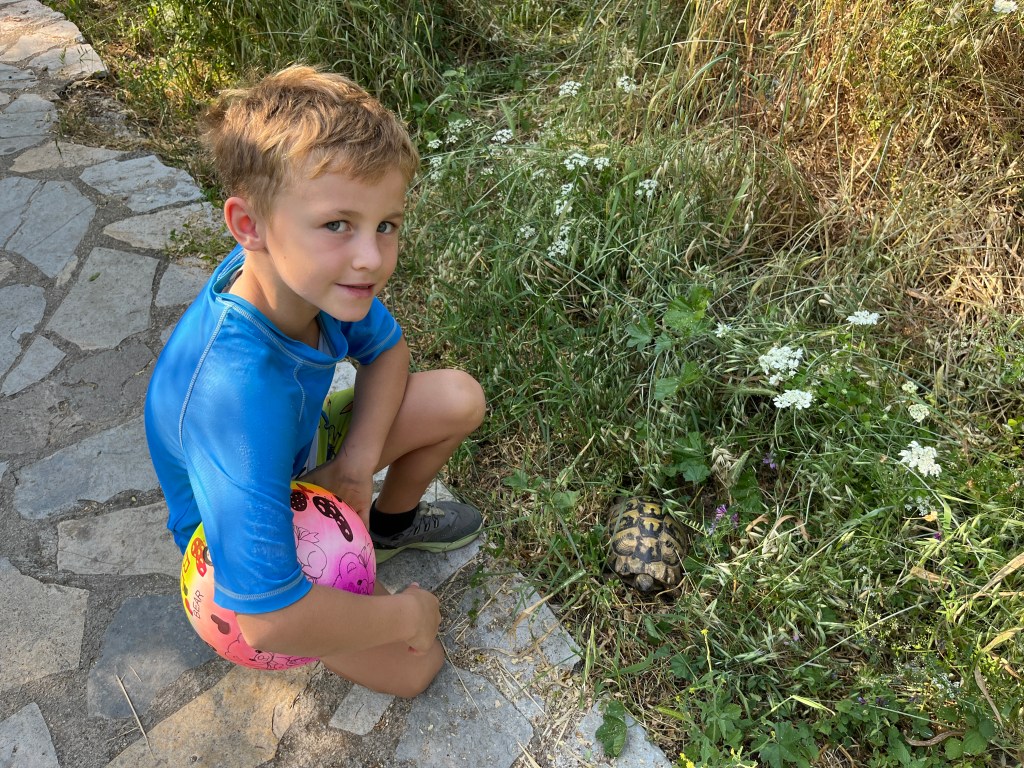
My favourite acquaintances on these walks and runs are the tortoises that have been popping up everywhere. Hermann’s Tortoise, to be specific. My first encounter was on a run through an unpaved path, a dirt trail lined with golden-tasselled grass. Just as I jogged along, a tortoise stepped into the narrow strip of track ahead. I stopped mid-stride, delighted to be met by such a sweet form. I said a little hello (as you should) and encouraged him out of his shell to carry on his way. After a moment’s hesitation, his little head emerged from the classically patterned shell, and I gazed at the gentle eyes with appreciation for his humble passage, the constancy of his roaming pace, and the softness with which he treads our shared planet. It was a beautiful moment to savour. But I was aware he may not have felt the same way, so I didn’t linger.
When I bid him farewell, and we went our separate ways, I carried this gentleness with me. “Slow down, sister. Have a stroll,” was the silent message he imparted. I did mosey a bit after that. Back at home, I looked up the symbolism of the tortoise in different cultures. The common themes are expected: longevity, wisdom, patience, and protection- exactly what I’d hoped to summon on these fortress runs. As always, Nature soothes, guides, and rouses. What a gift to have landed here.
On either side of these hillside excursions, each day in Ohrid begins and ends on a balcony. In the morning, on the lower balcony outside our bedroom, I light a candle and use the flame to set the incense burning. Then I journal, meditate, write this blog, stare out at the sky, research, plan, sketch, message friends, and do whatever the hell I want or need to. It’s relished time. My partner brings me coffee, and life is quite for a spell. It’s medicinal. This balcony gives the light, the air, and the green needed to ground me to this unusual passage of time. Gap Year Time moves differently than normal life. I’m watching it unfurl, and the grapevines that hang on the balcony are a reminder of the becoming that’s happening all around.
When we arrived two weeks ago, the vines were just peaking over the railing of our lower balcony, touting a dozen clusters of tiny, will-be grape buds. Now, the vines that were in their gentle springtime stretches are the greedy groping tentacles of Audrey from Little Shop of Horrors. I’ve been tucking and twisting them around the railing, trying to save our view and my chatty husband from complete envelopment. This perceptible growth is really a treat to watch though. This is why so many people love gardening. The tending and observance of a plant’s becoming allows one to recognise the passage of time in one’s own life. The maturation of ideas, the evolution of a struggle, the perpetual playing of the scenes and acts of one’s life are all in tandem with the Earth’s green flourishings, undriven by human hand. It’s life. It’s the miraculous becoming of life. And it’s just hanging there on the railing, bouncing in the breeze, synthesising sunlight into becoming. It’s potent medicine.
Our family is advancing alongside these vines and the little, green grape blossoms that are starting to be visited by the bees. Potential and possibility swell all around. What promises are pollinating? What bulbs of juicy fruit are in the budding? What marvellous flavours are gathering their chemical characteristics to become the fulfilment of human and vegetal assignments in life? There’s a lot of becoming around here, a lot seedlings of impending bloom. And there are lots of growing pains to prove the progress. Lots of stretching and reaching. Lots of twisting and tucking. Lots of tending and observing. It’s achy and angsty. Beautiful and blinding. It’s fleeting and expanding. These boys are becoming. Aren’t we all though? All of us lifeforms are always becoming. Ceaselessly. ‘Til fade to black. I take pleasure to ponder it all.
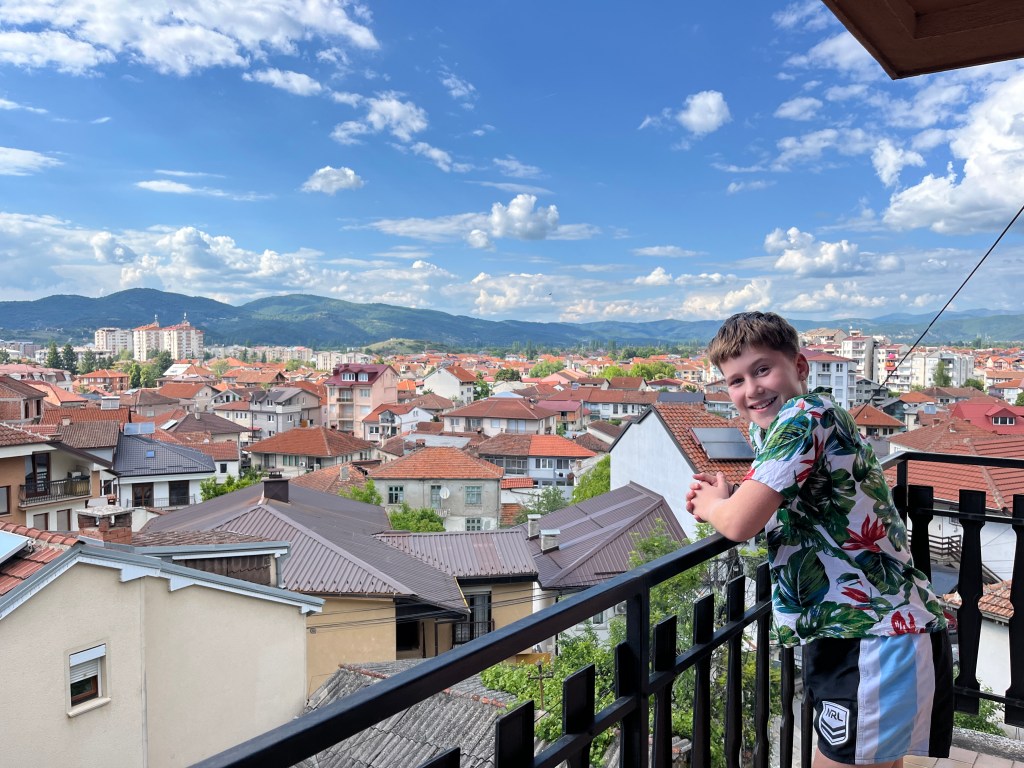
Each day also ends on a balcony. The upper one. Sometimes before dinner. Sometimes after. Sometimes with wine or beer. Sometimes with chocolate or cheese. While the boys entertain themselves with drawing, screens, and other antics, my partner and I sit on the balcony in pillow-padded chairs and take in the clay rooftops of Ohrid. From our perch, the small sea of houses is ringed with a spectrum of hazy blue mountains, snail-paced wedding-cake clouds, and whatever light-play pleases the sun that evening. We chat and sit silent. We wander in and out of musings. This is the recuperation we sorely needed.
Traveling reveals the utility of roots in life. It strains the spirit to live unplanted, we have learned. These month-long pauses allow our family to soak hydration and nutrients into our tendrilled anchors before we ask them to extract again. After two more weeks of Ohrid’s safe harbour, we have six weeks of “fast travel” ahead. During this time, we will move through six countries, joining familiar faces in four. After that, we have six weeks in Spain, and then back to the rusty-red soils of Australia we will go. It feels a long way away, but what a relief that’ll be. This Gap Year has been worth every labour, but nomads, we are not. That is clear. How happy our roots will be to rest, to reach deep, to know, at last, no more will be asked of them. For now though, I’ll just nourish myself on fortress runs and balcony suns and gather gumption to hit the road once again. Much grand adventuring lies ahead before these ragged roots will see rest. Now is a time to fortify and stock the energetic reserves for the path ahead. Lake Ohrid is the perfect place to do this gentle work.
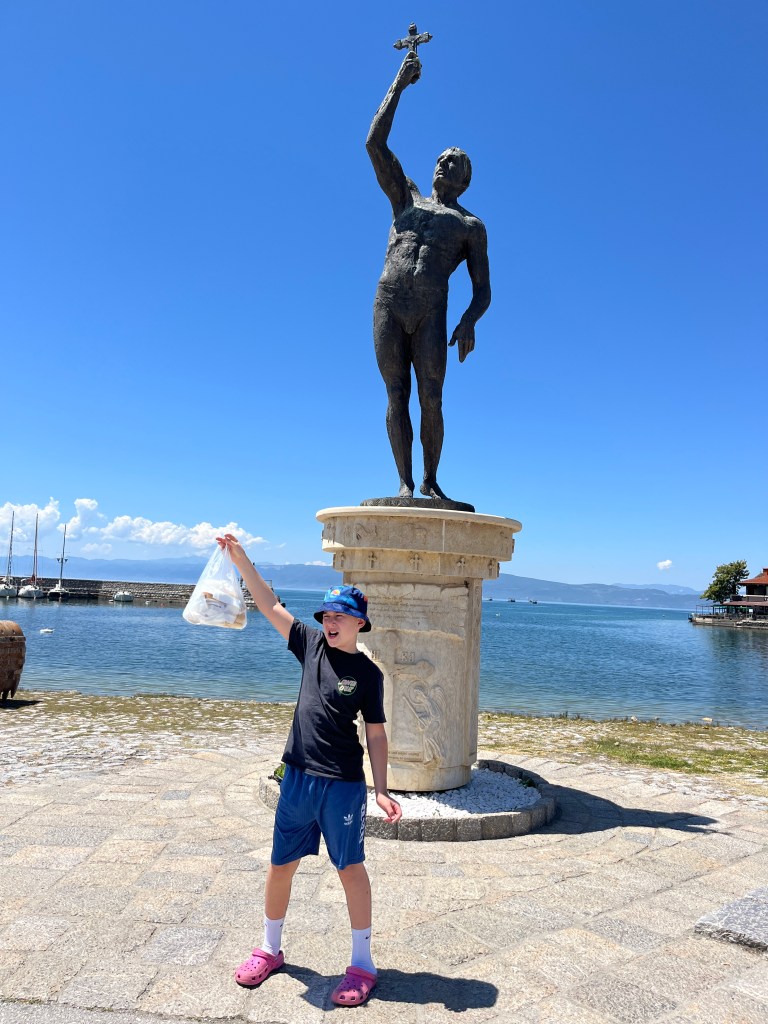
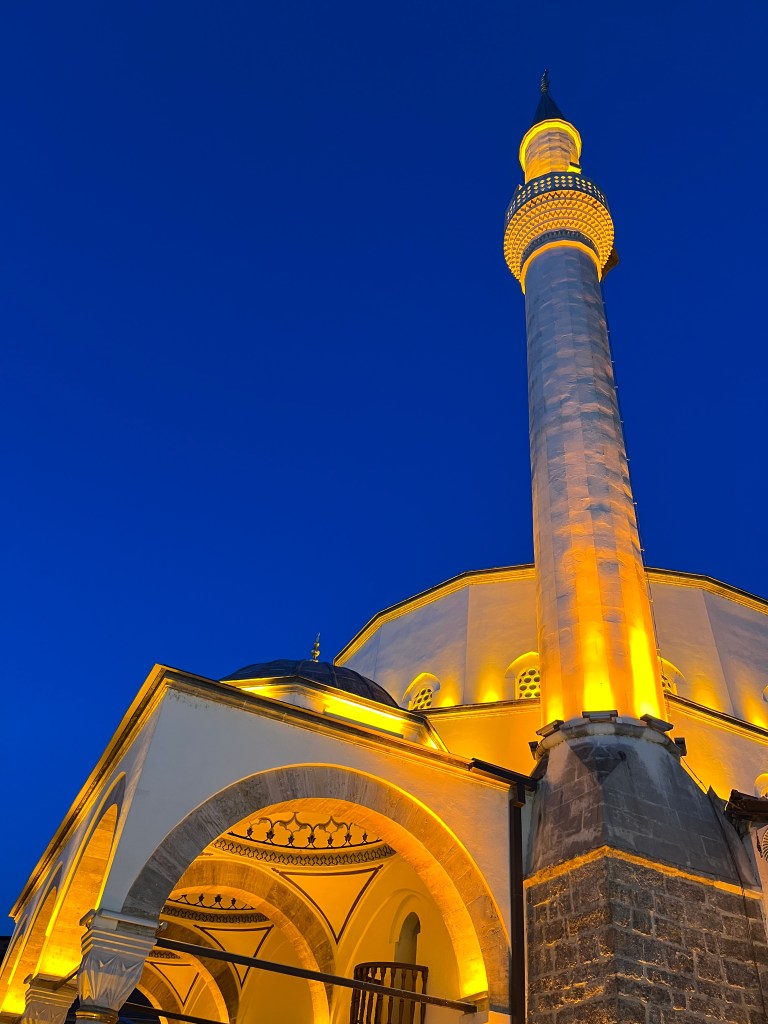
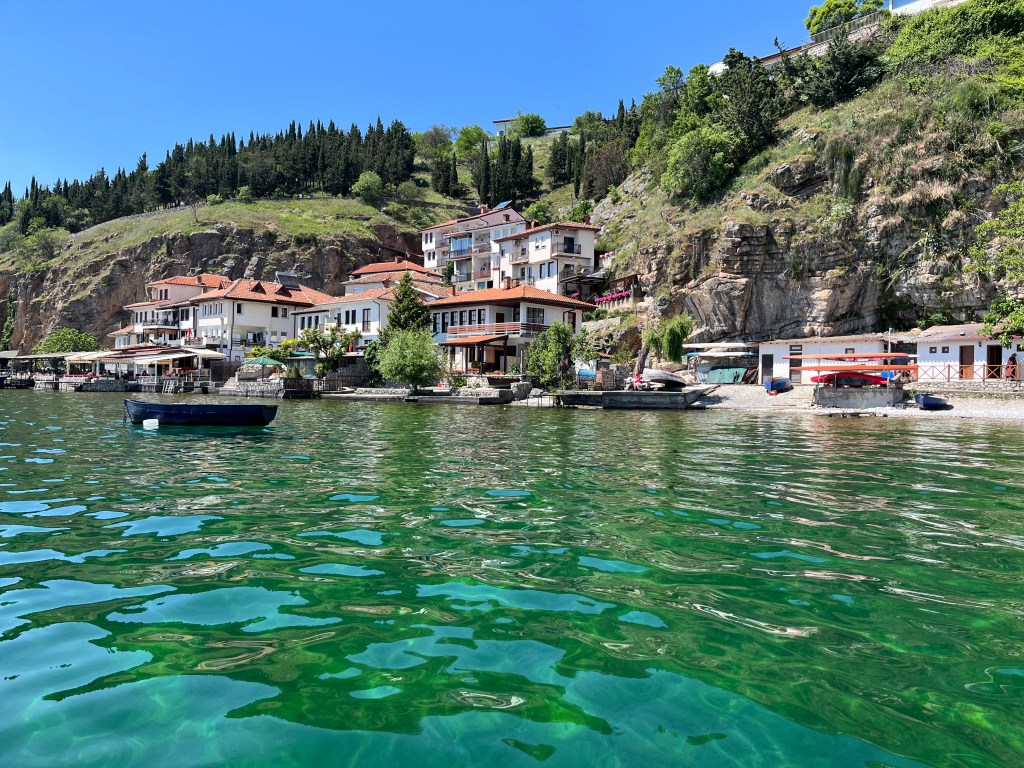
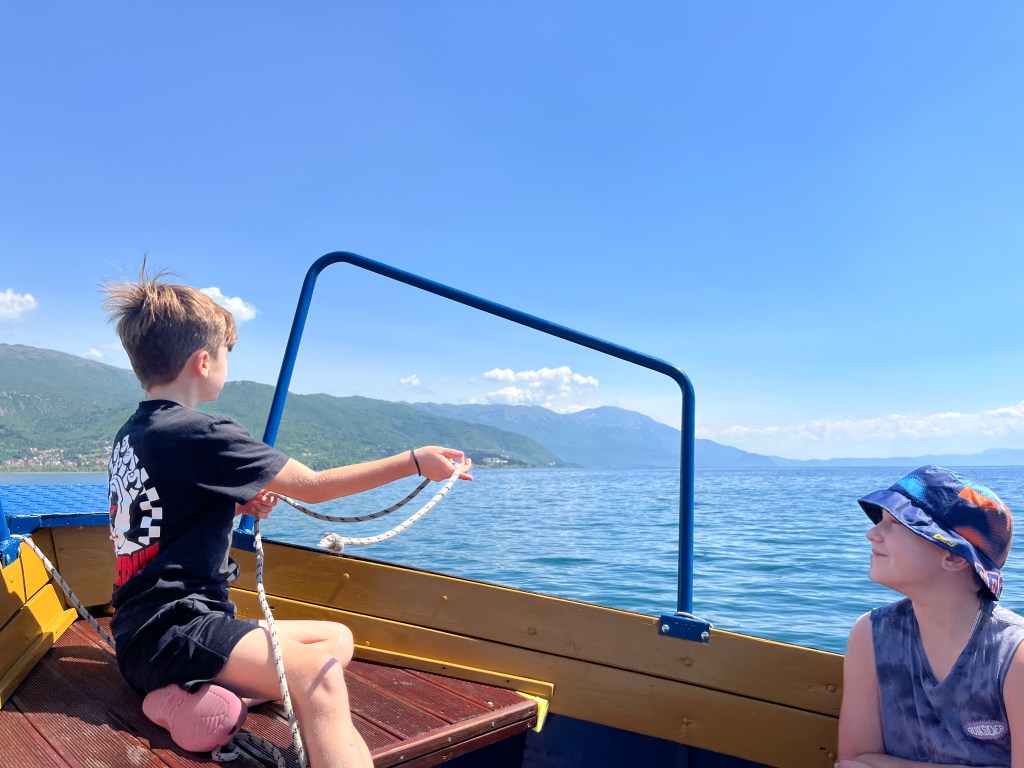
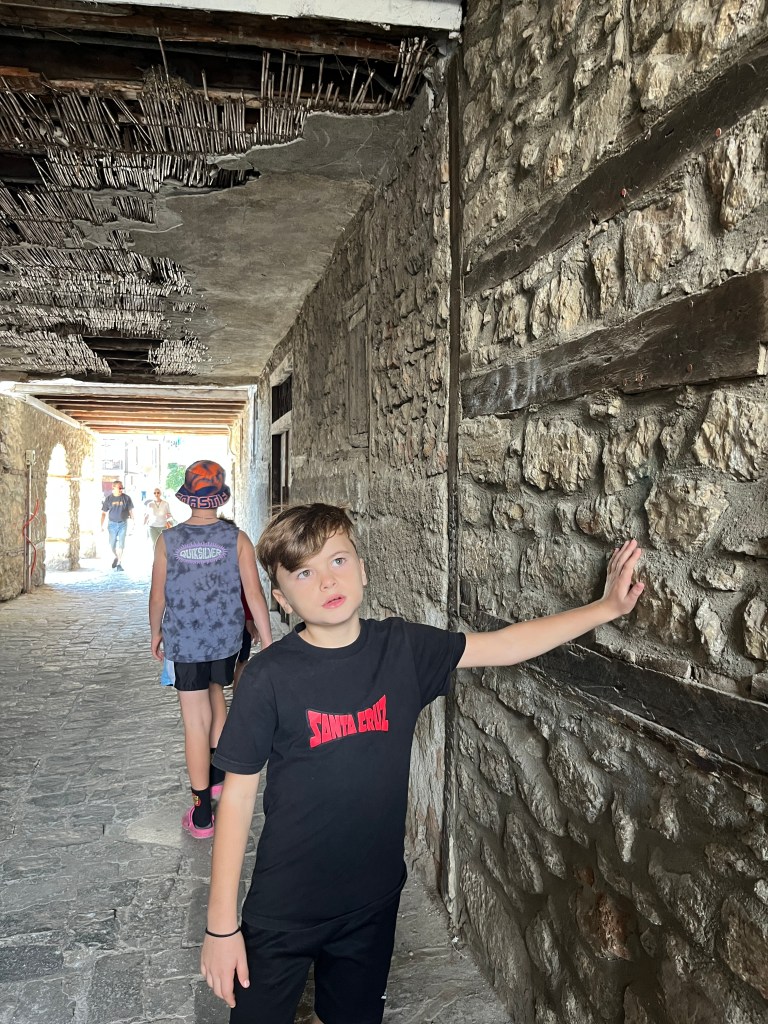
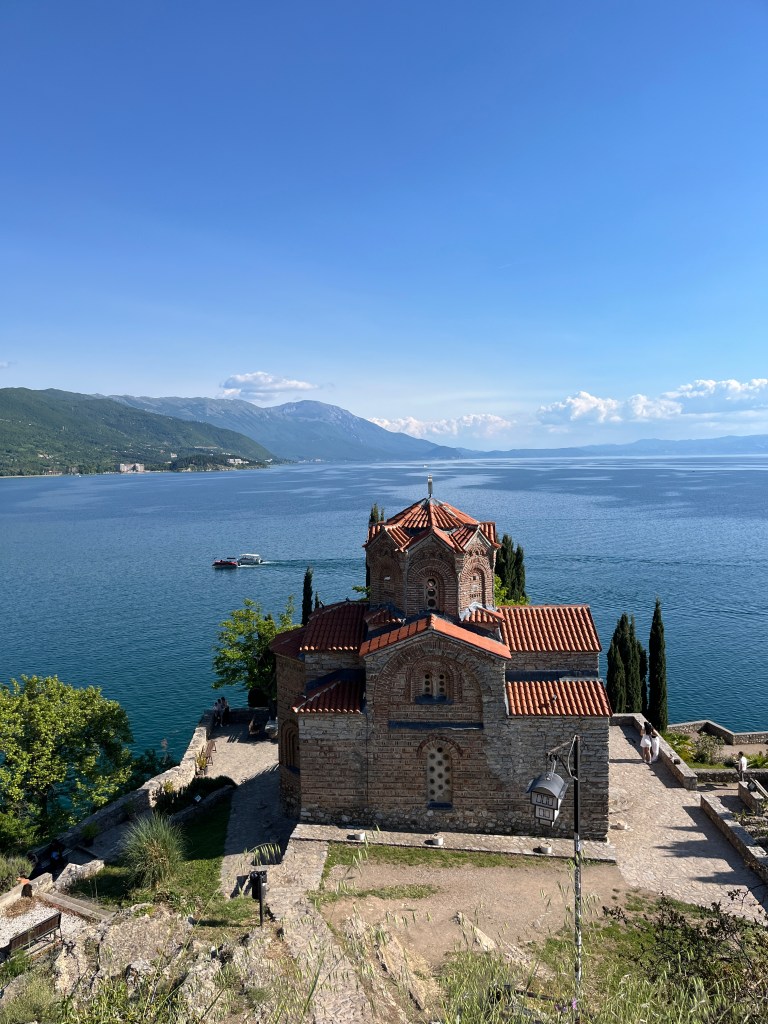
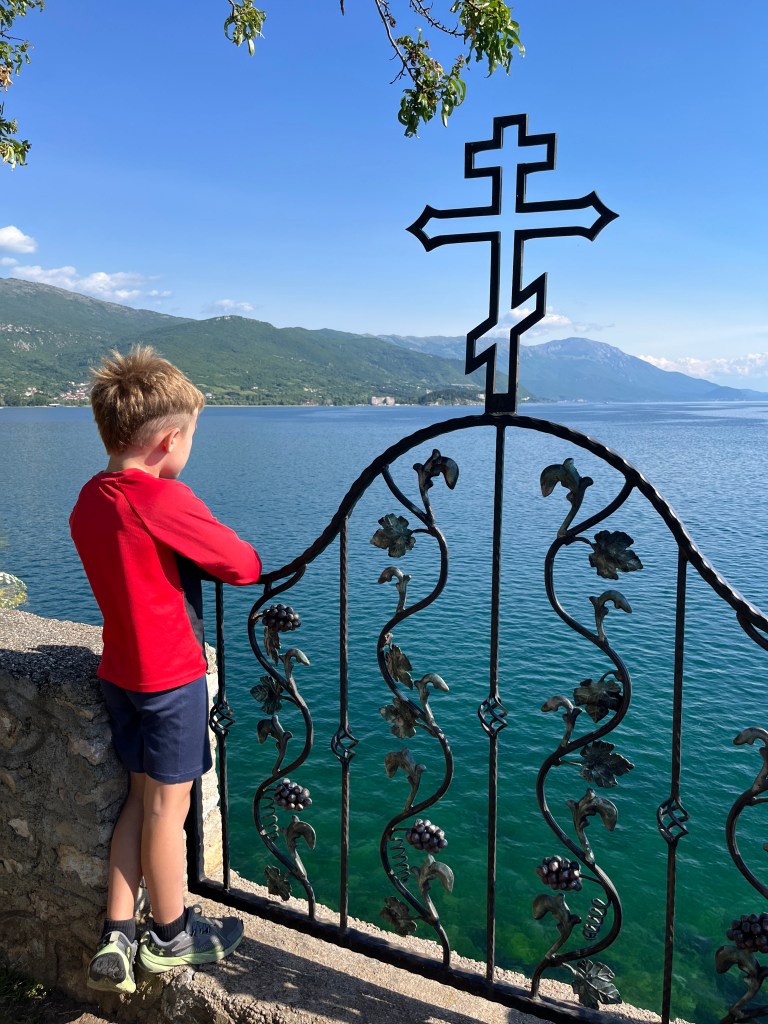
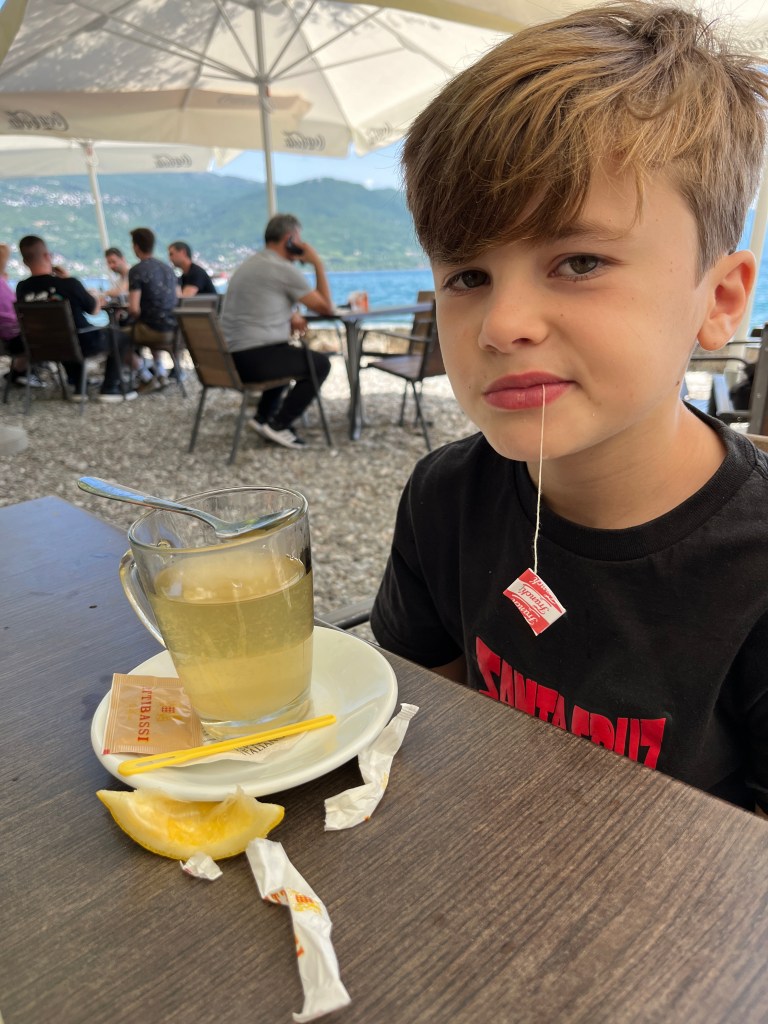
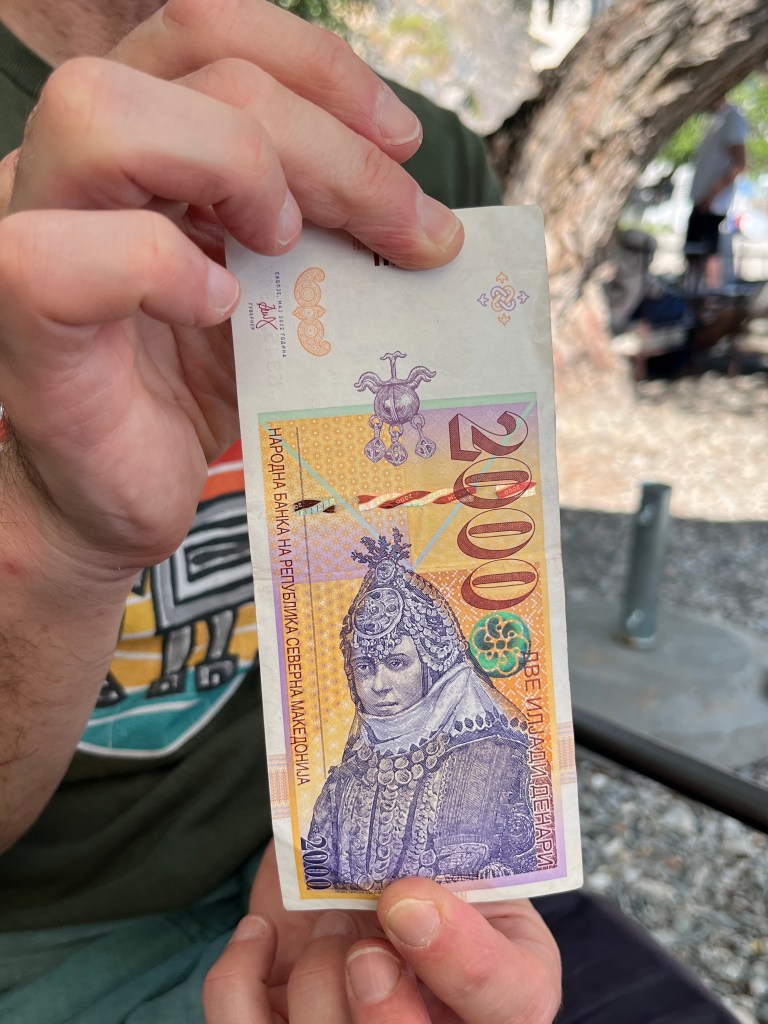
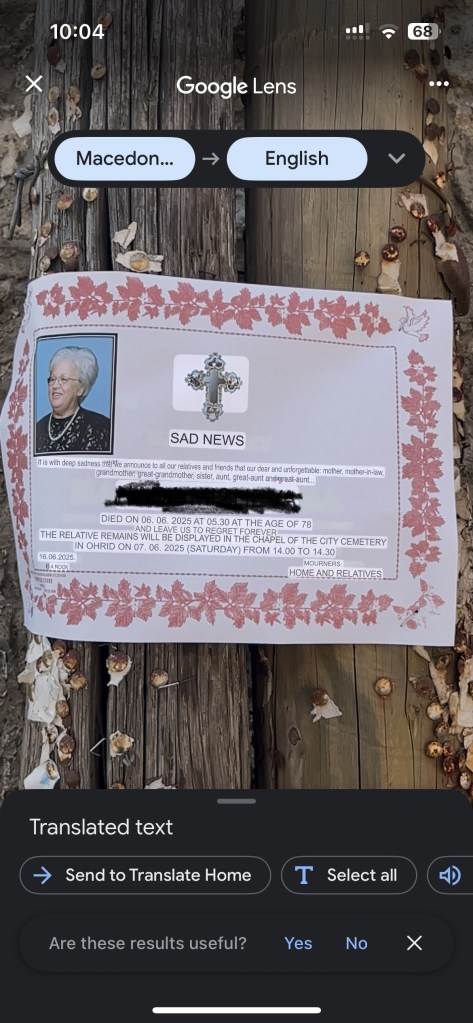
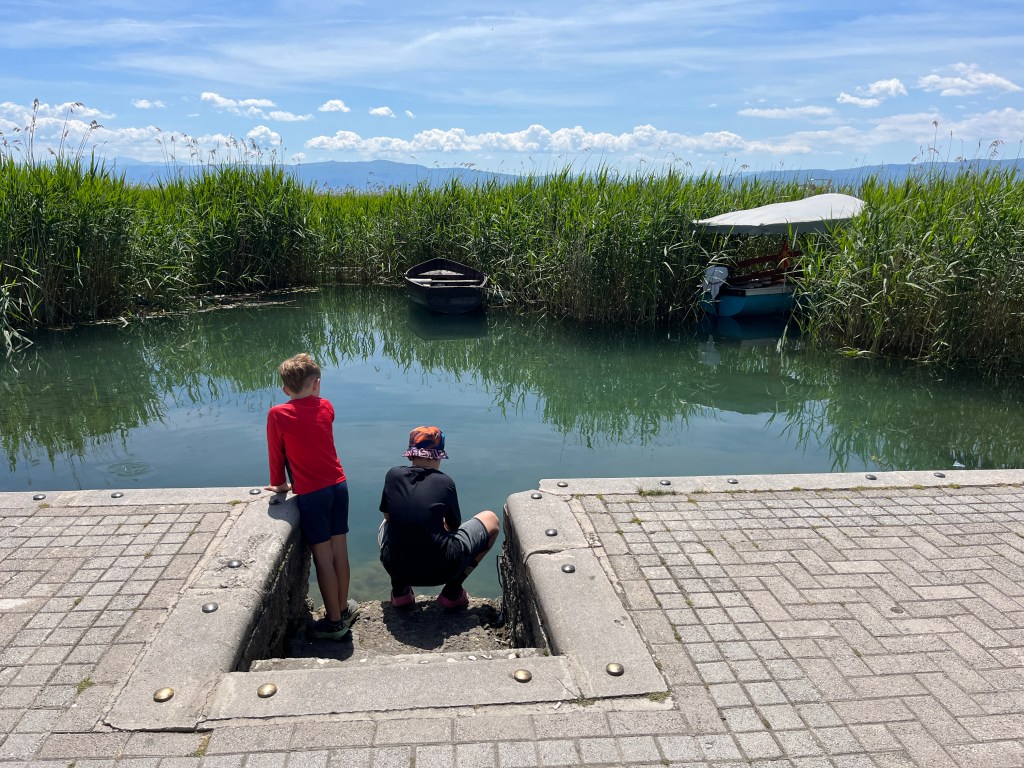
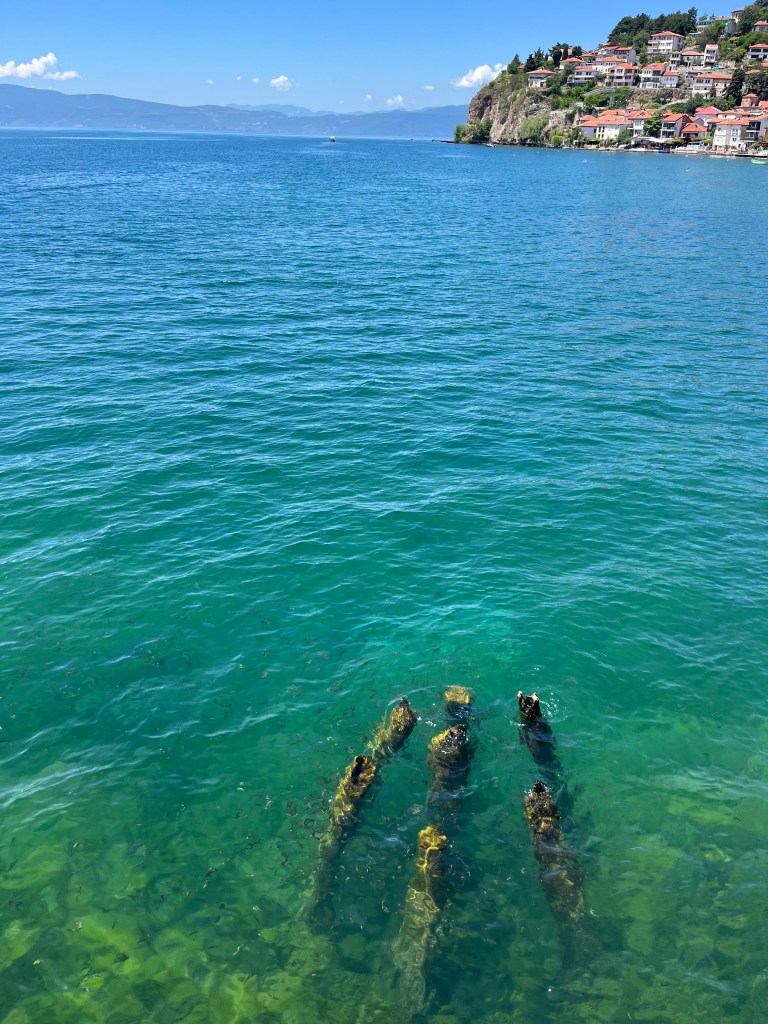
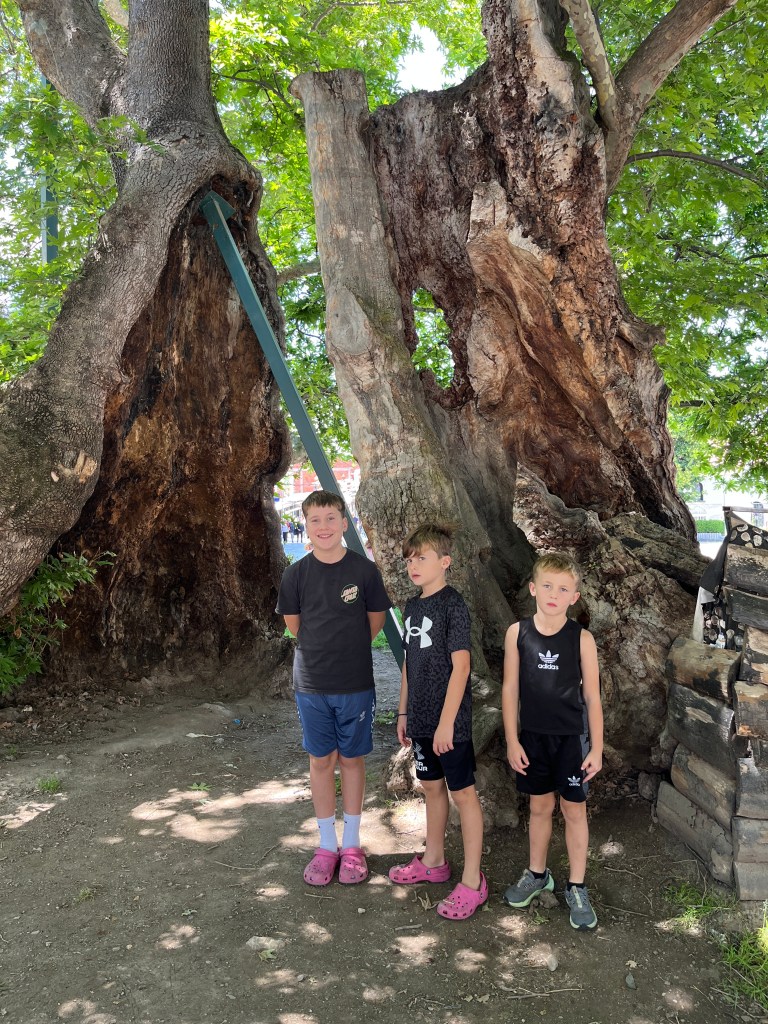
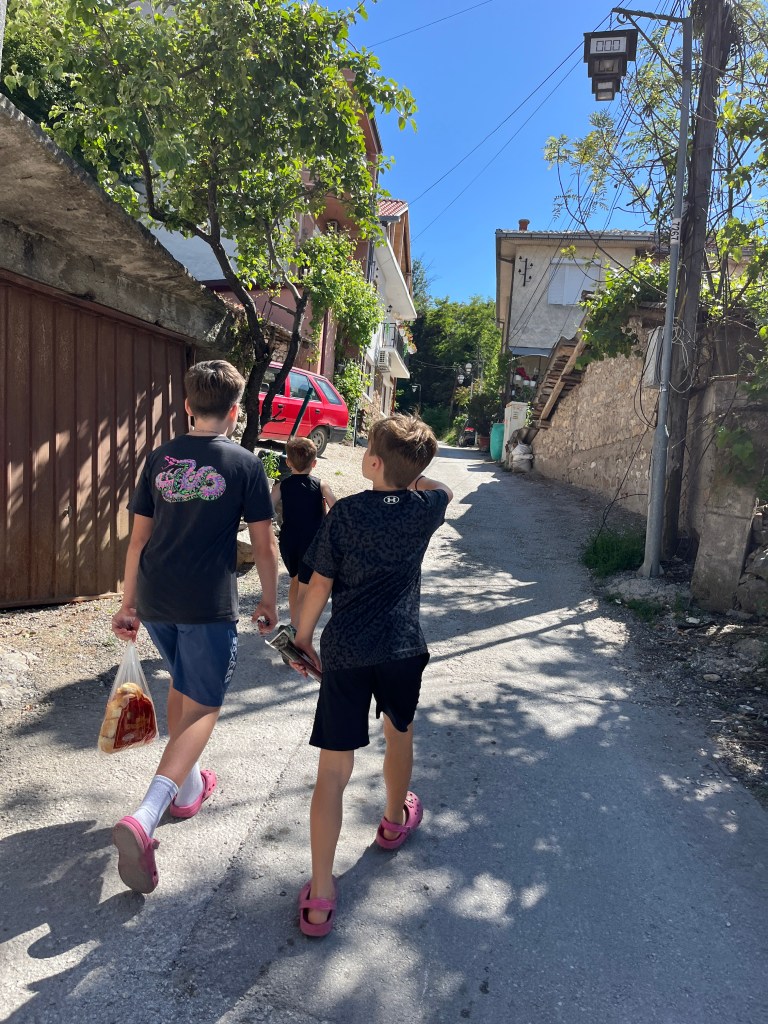
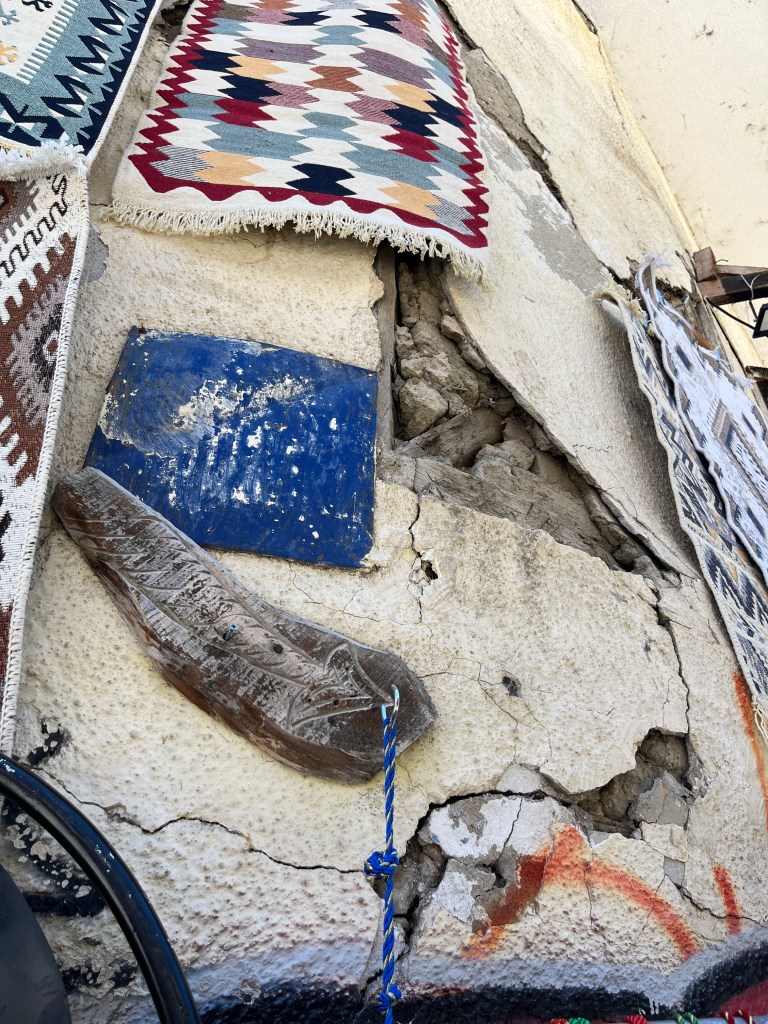
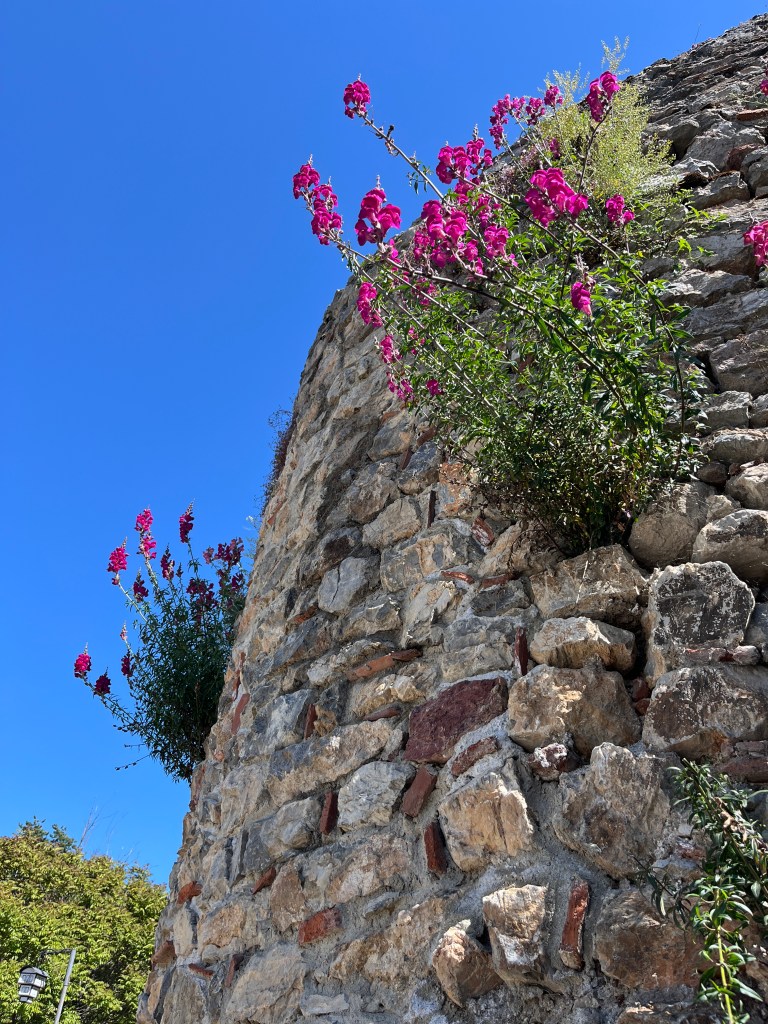
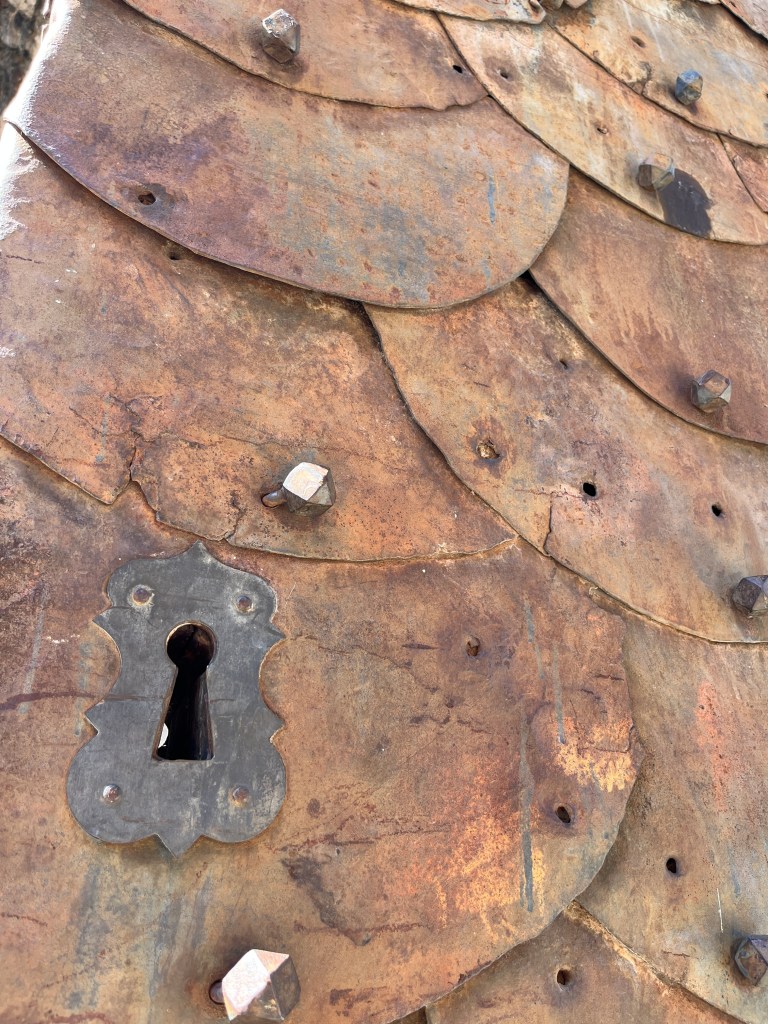
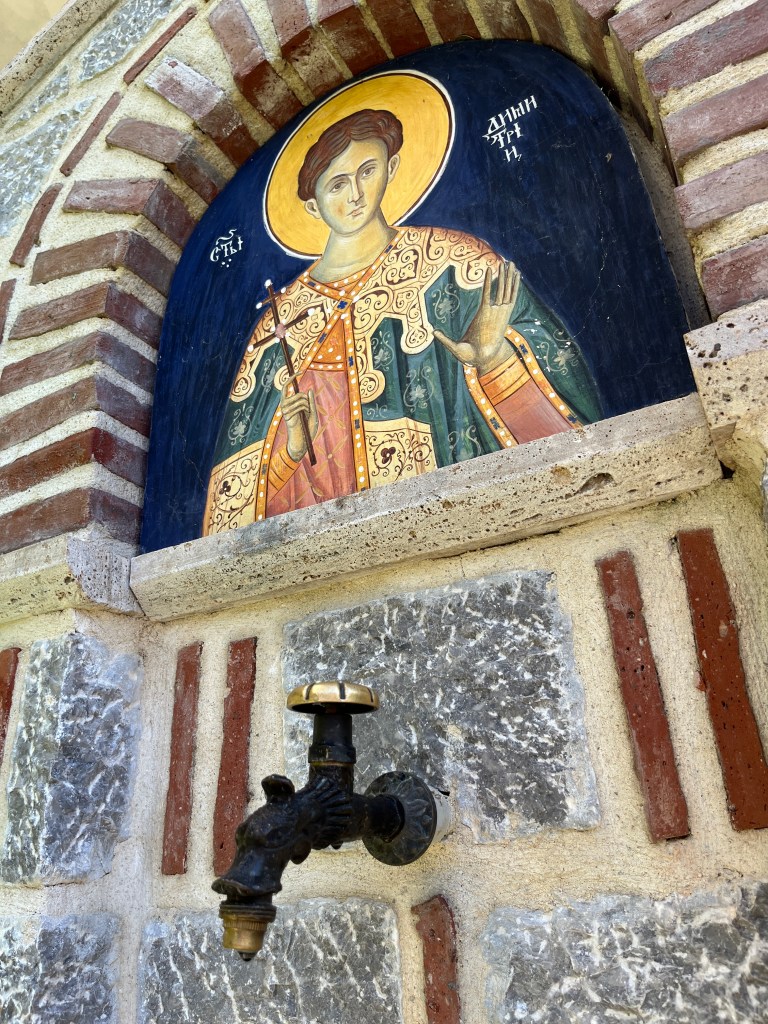
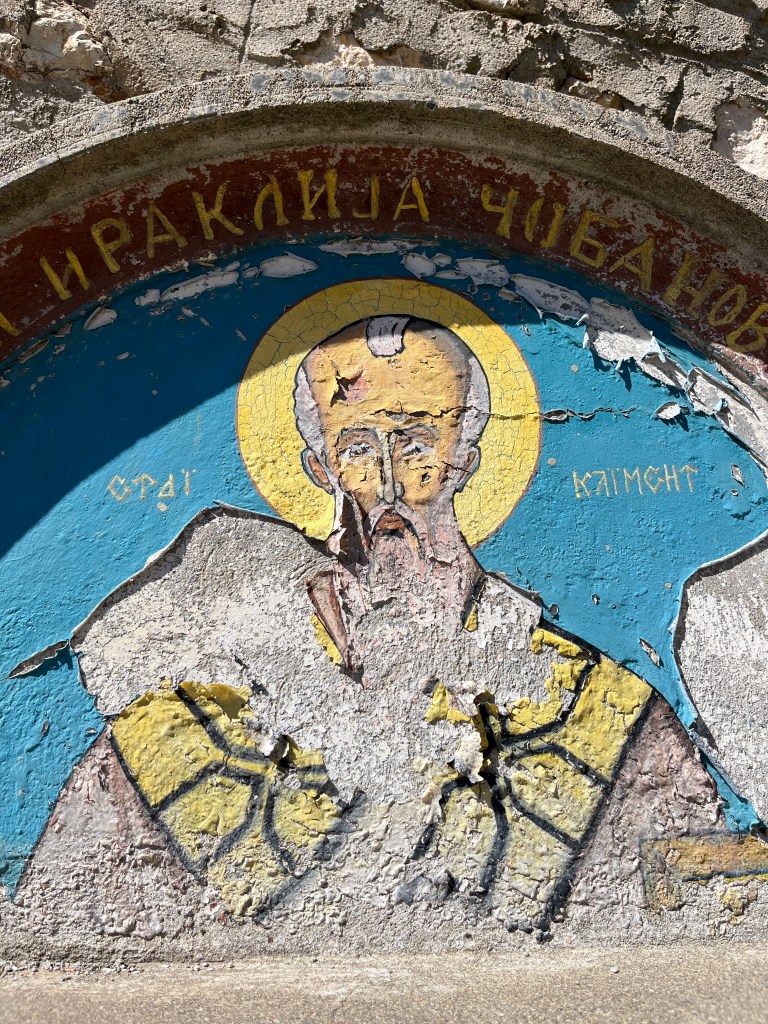
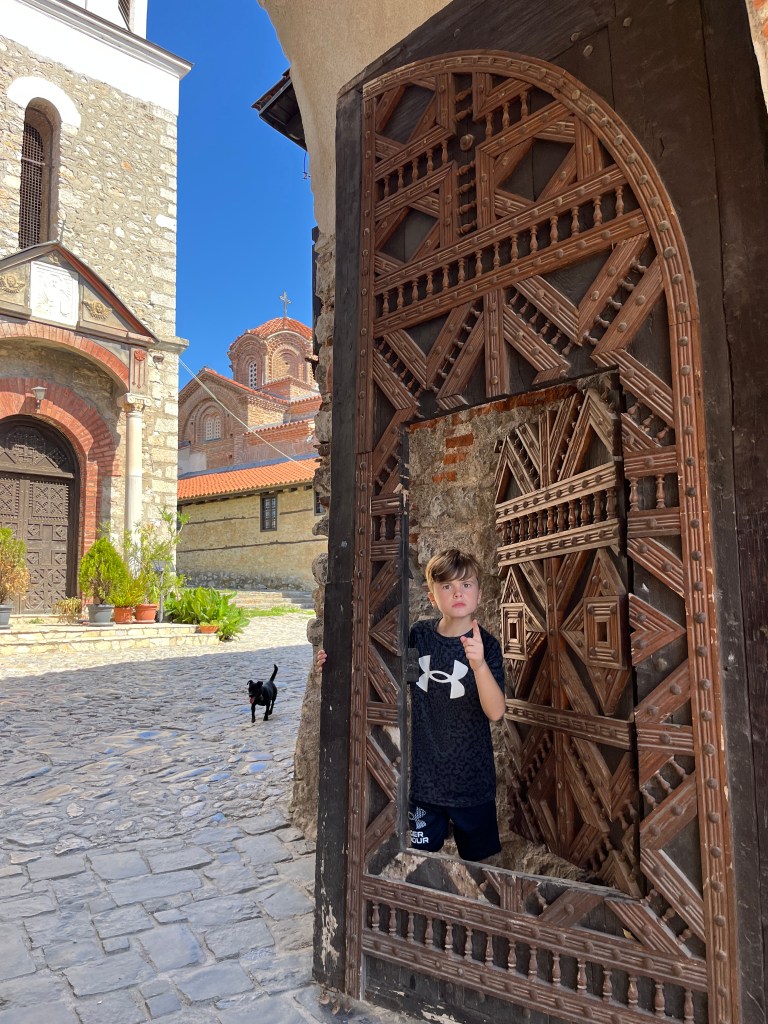
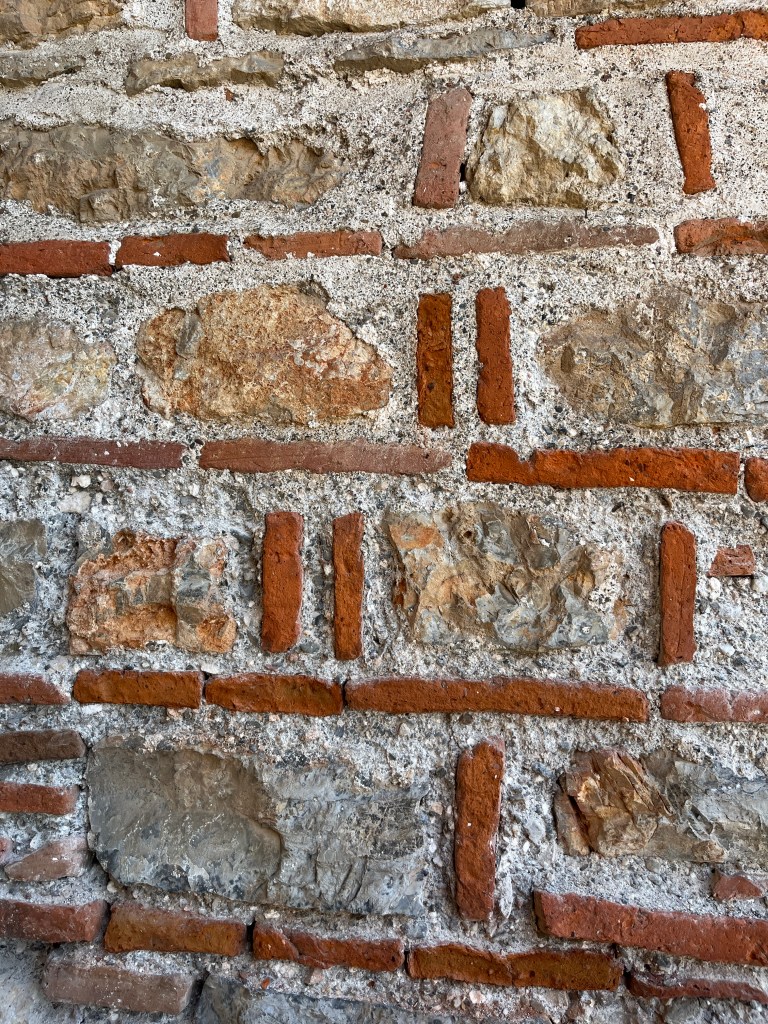
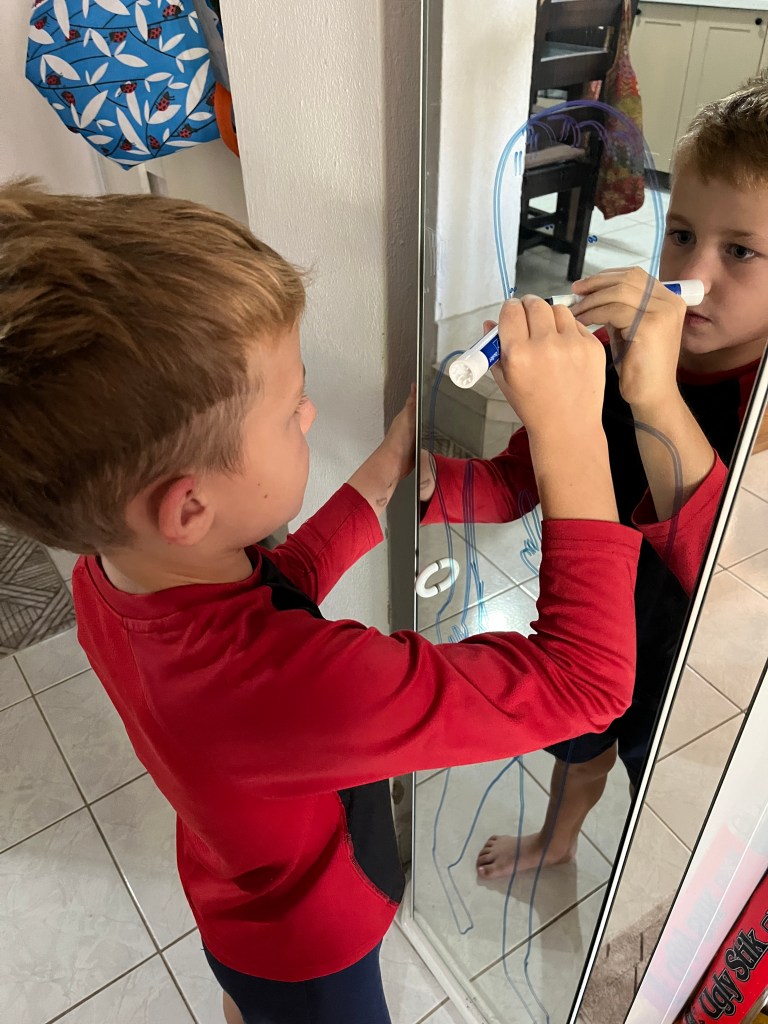
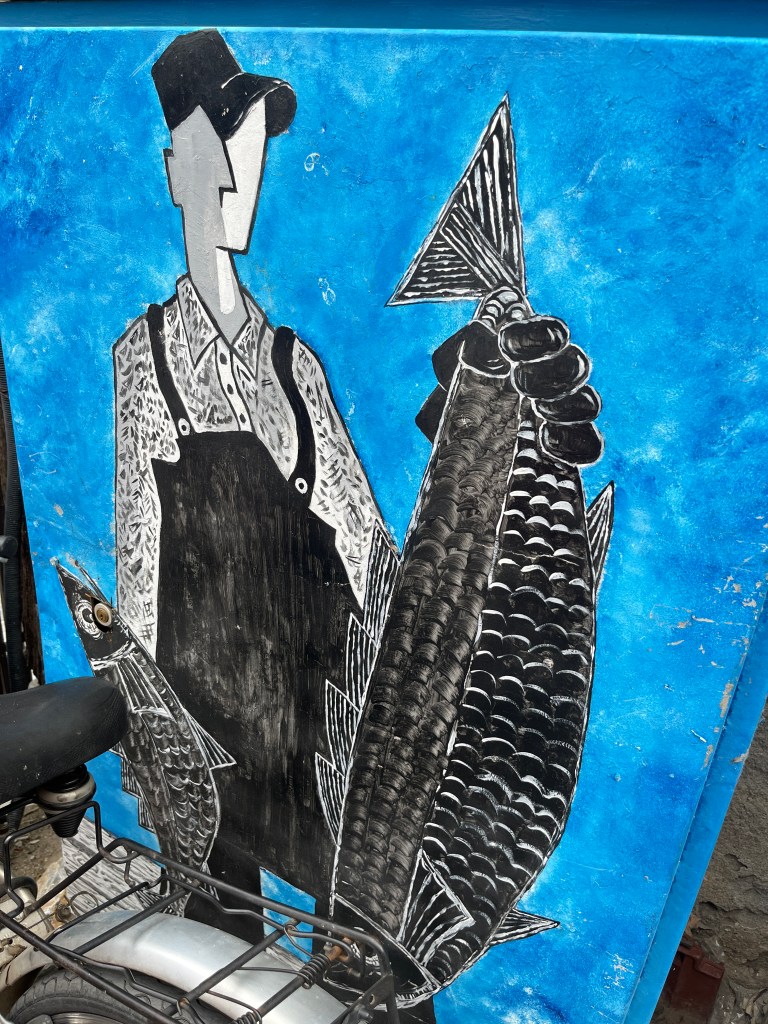
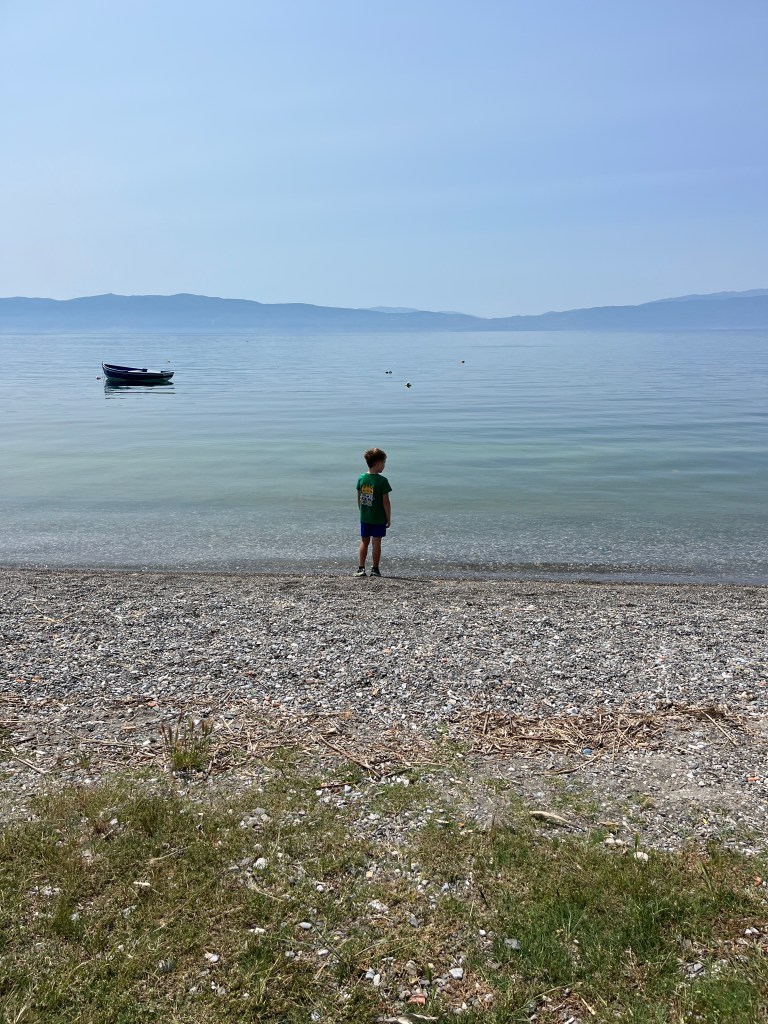
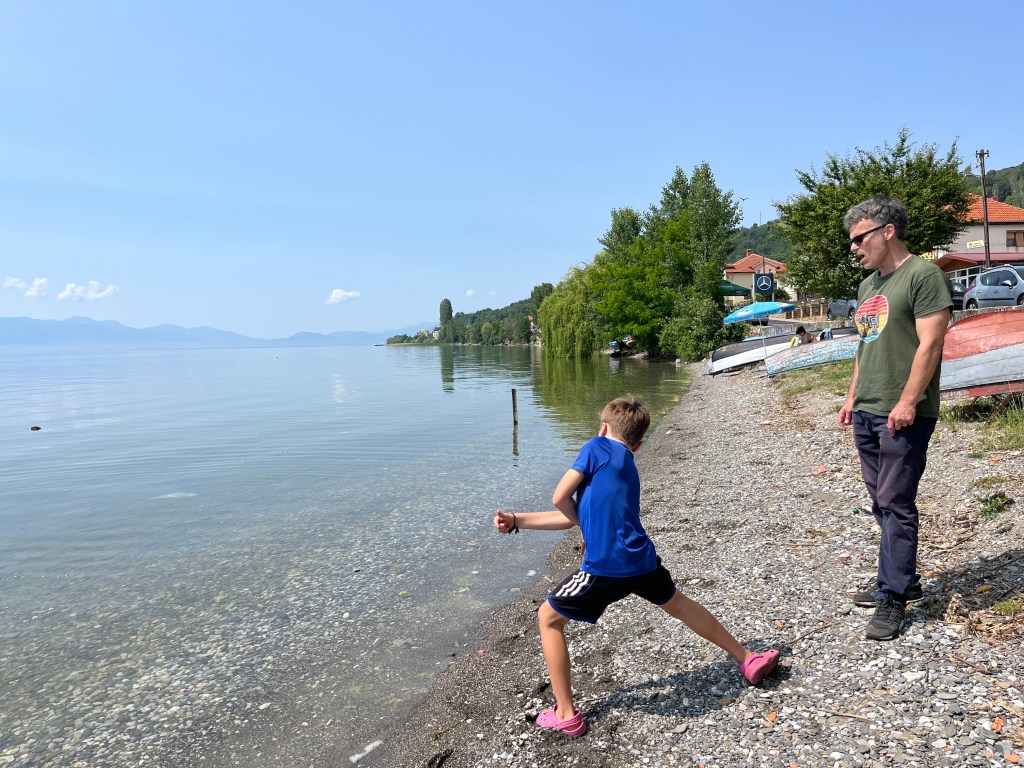
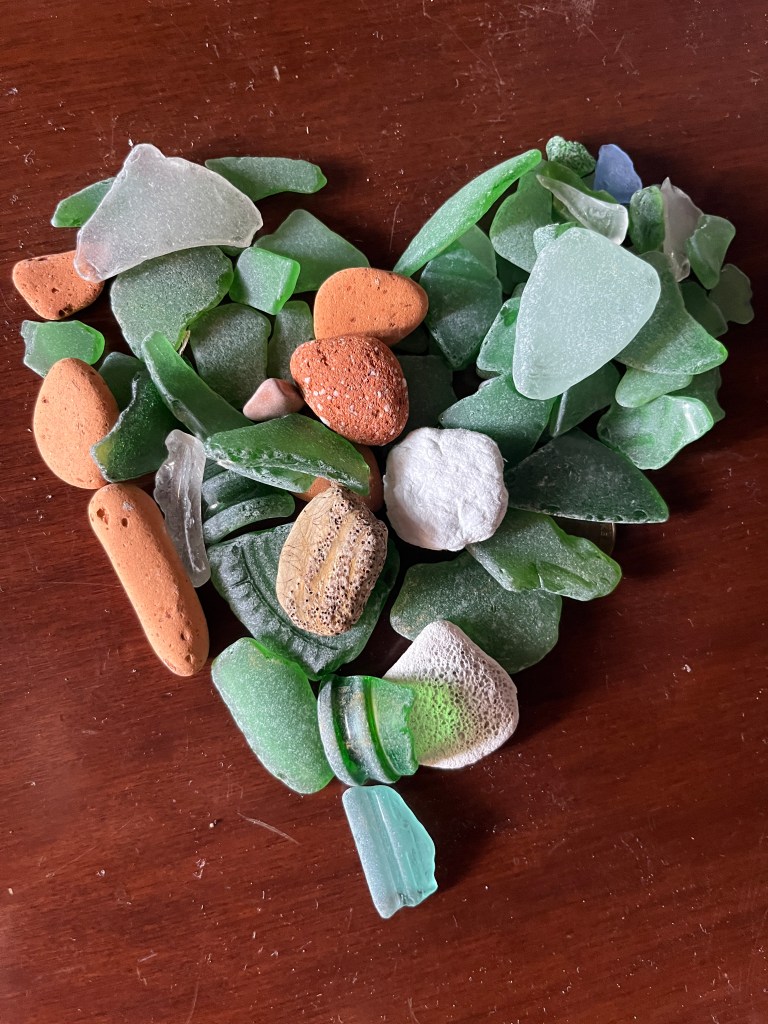
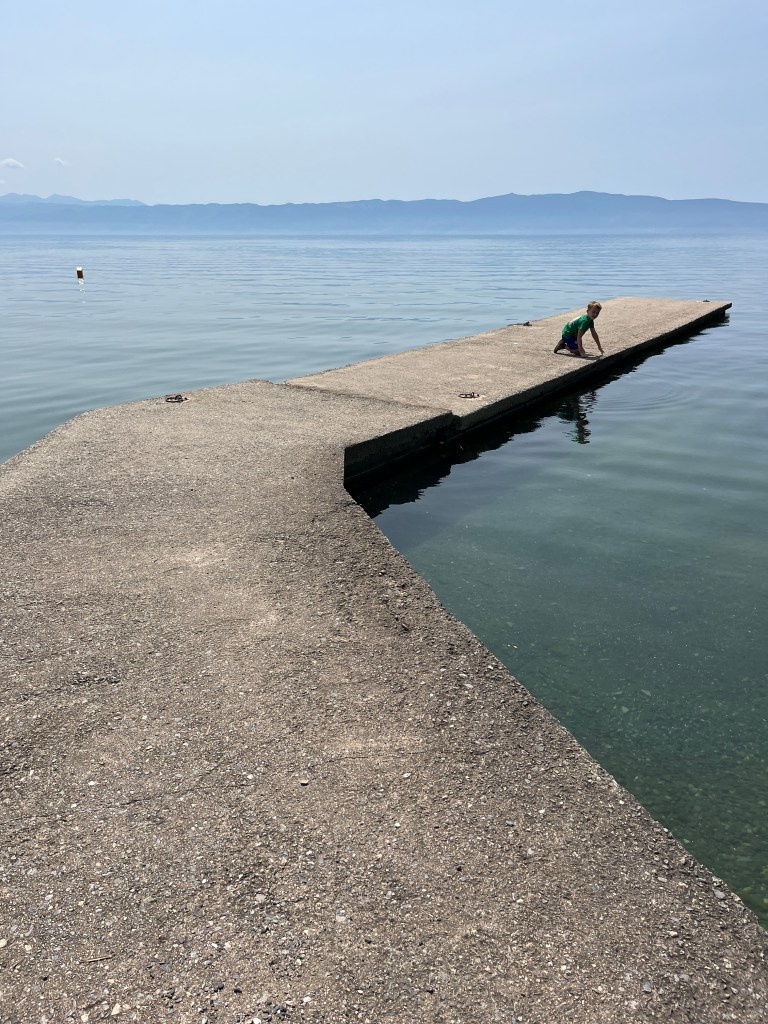
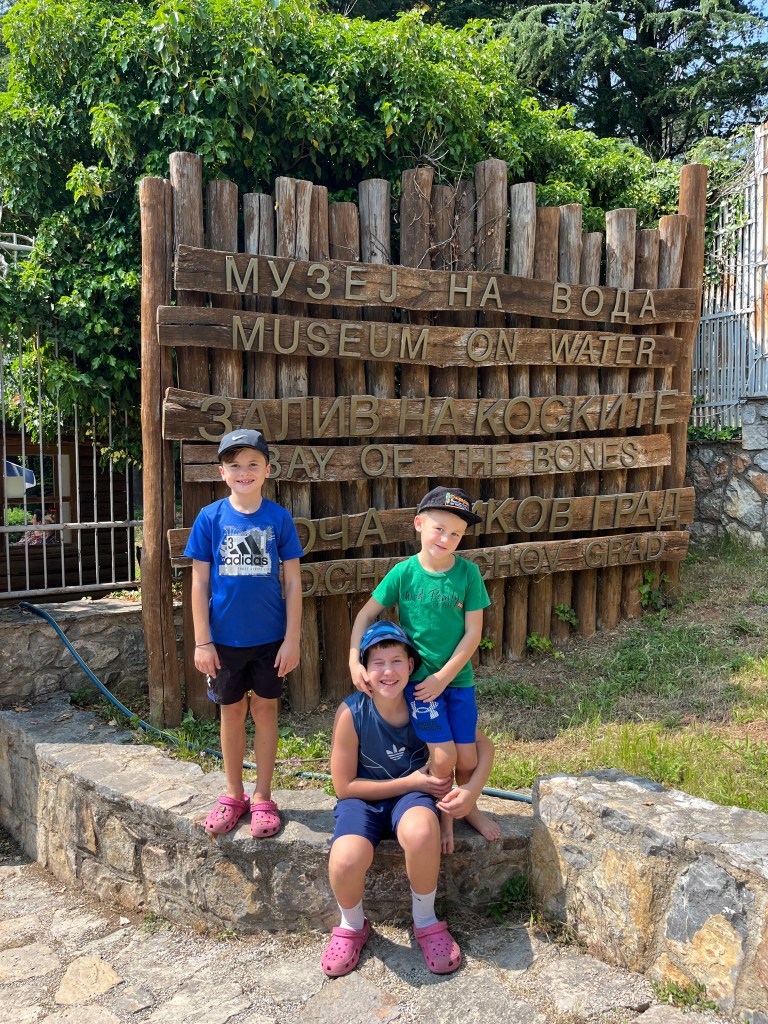
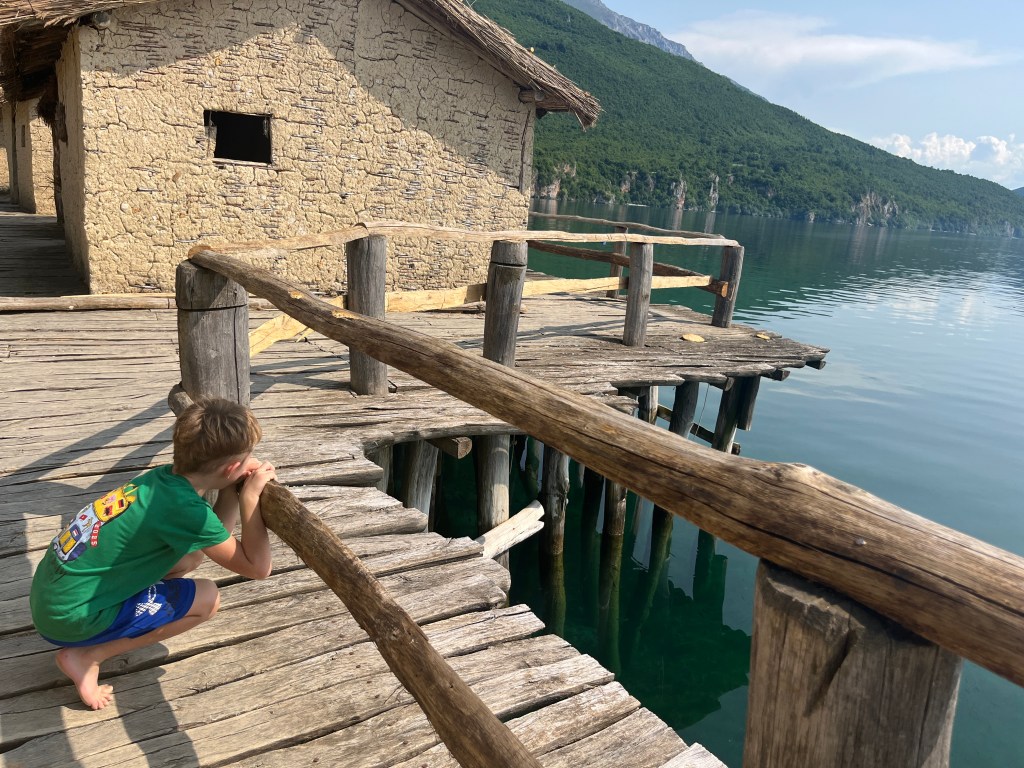
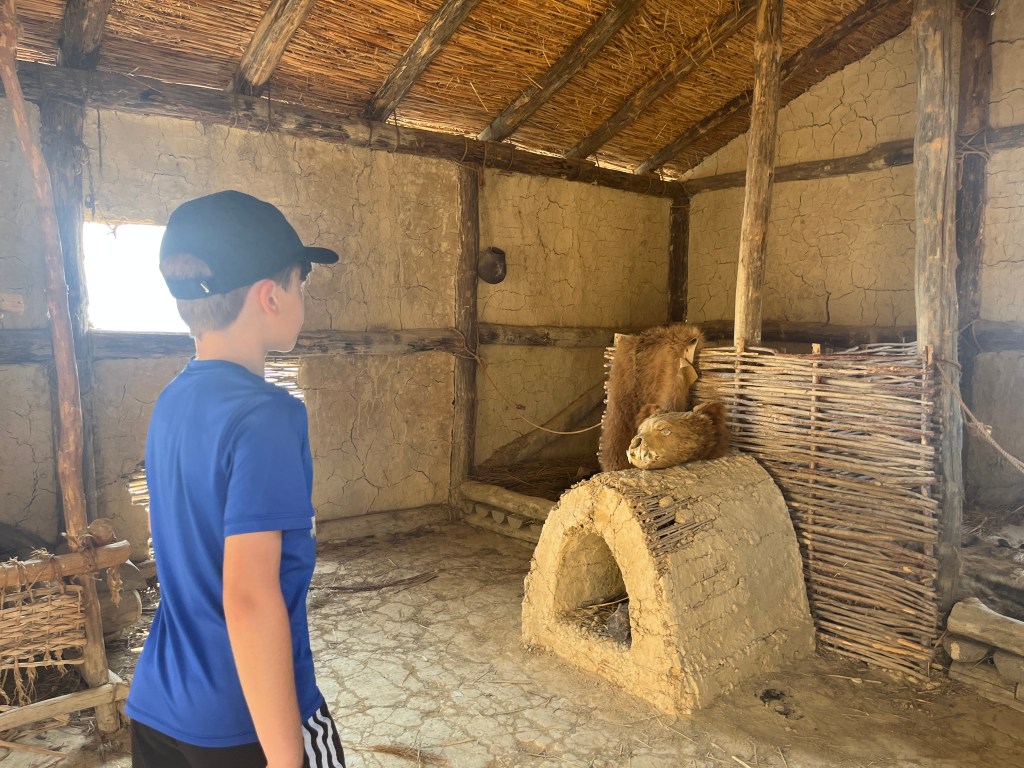
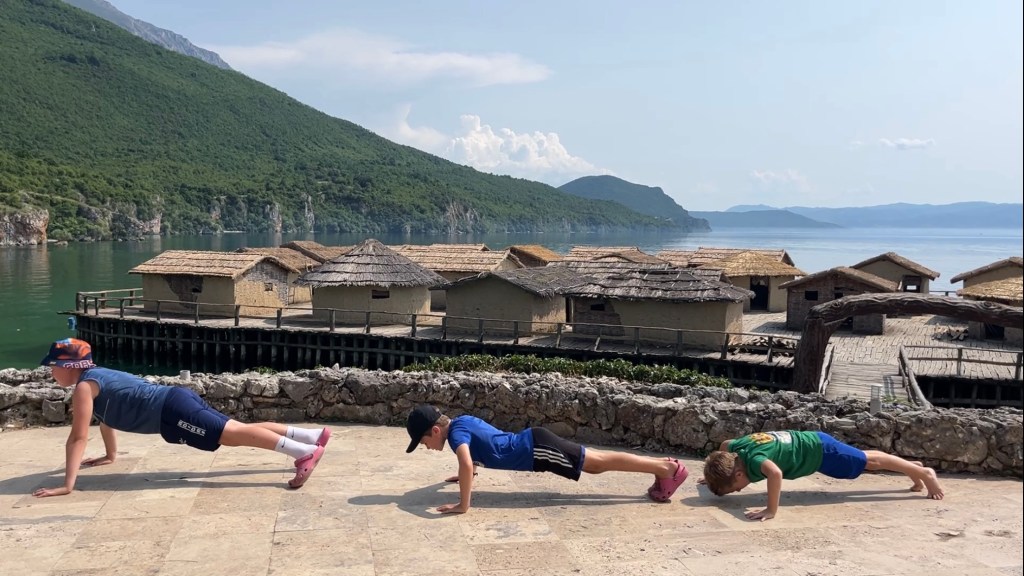
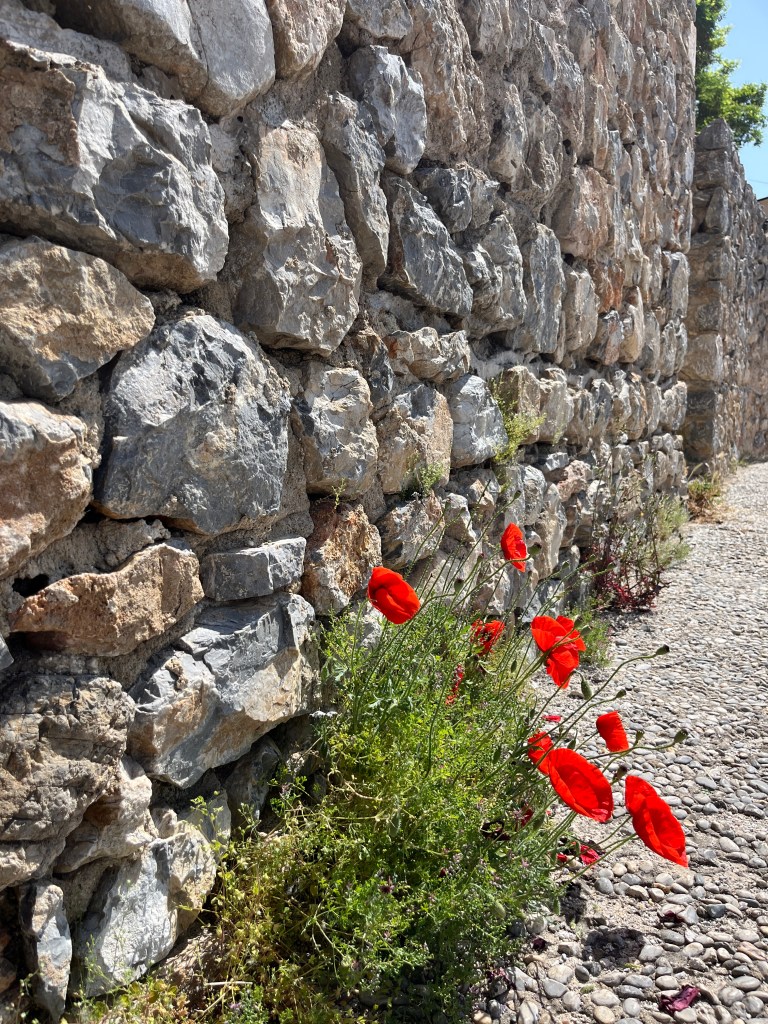
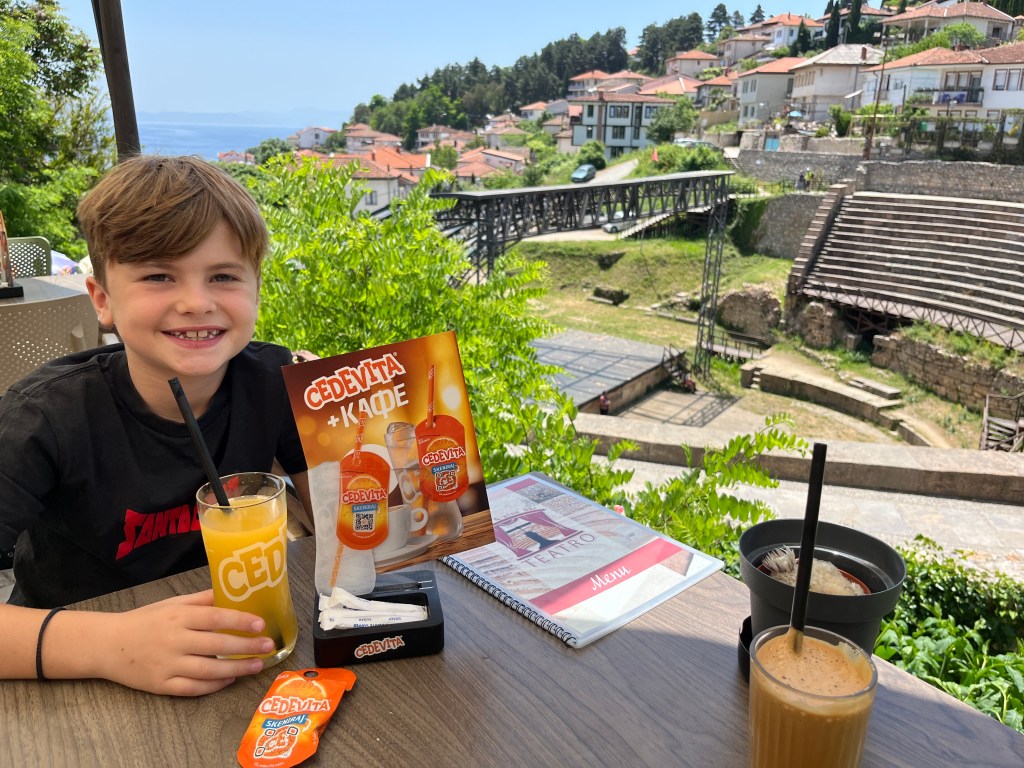
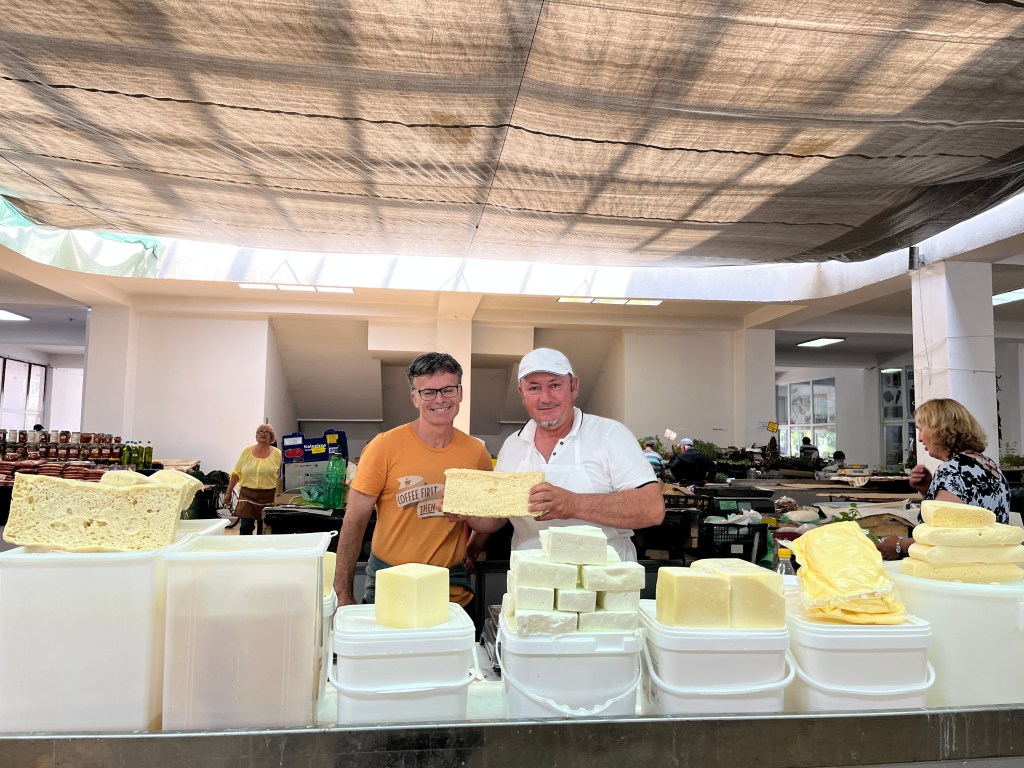
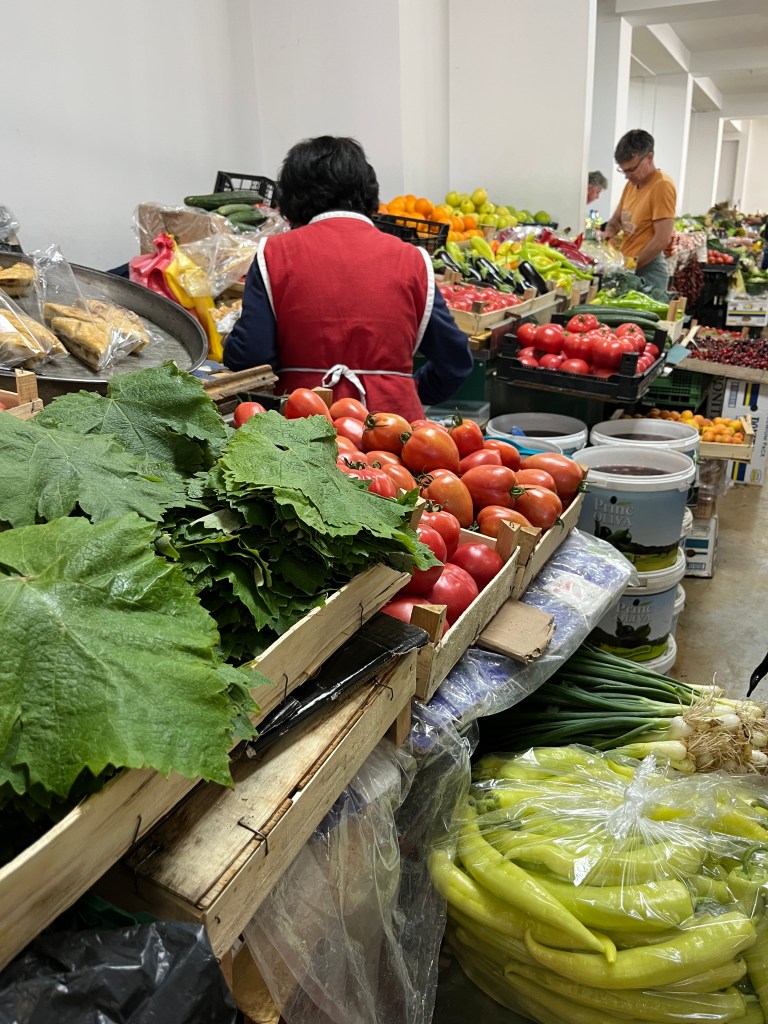
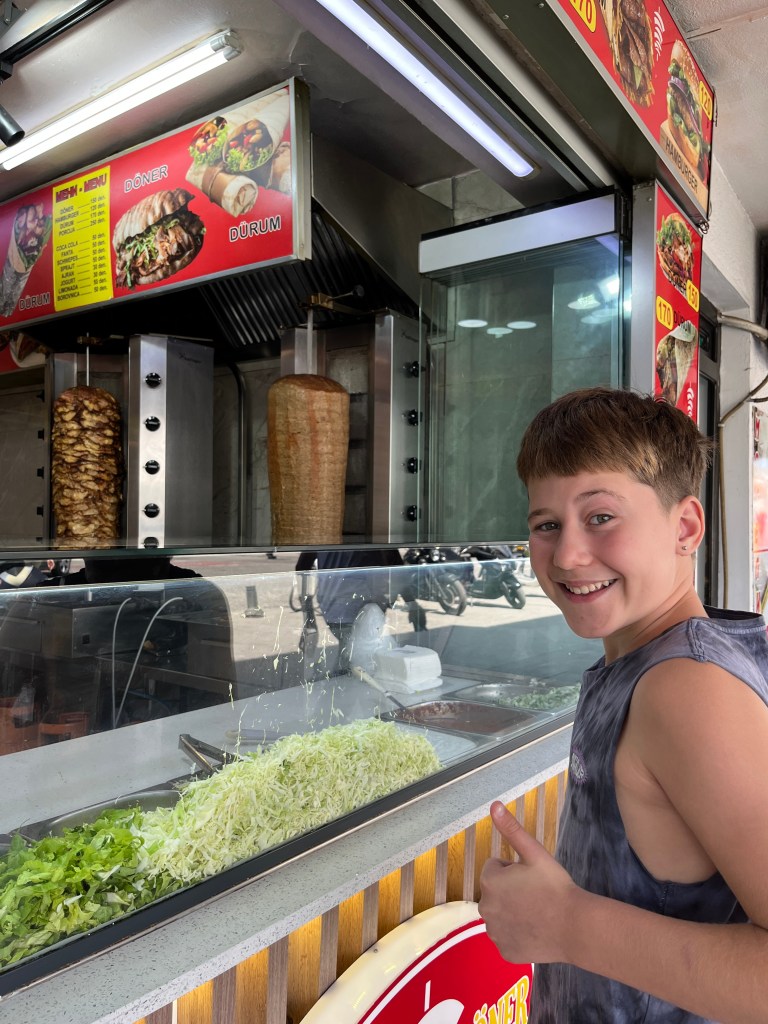
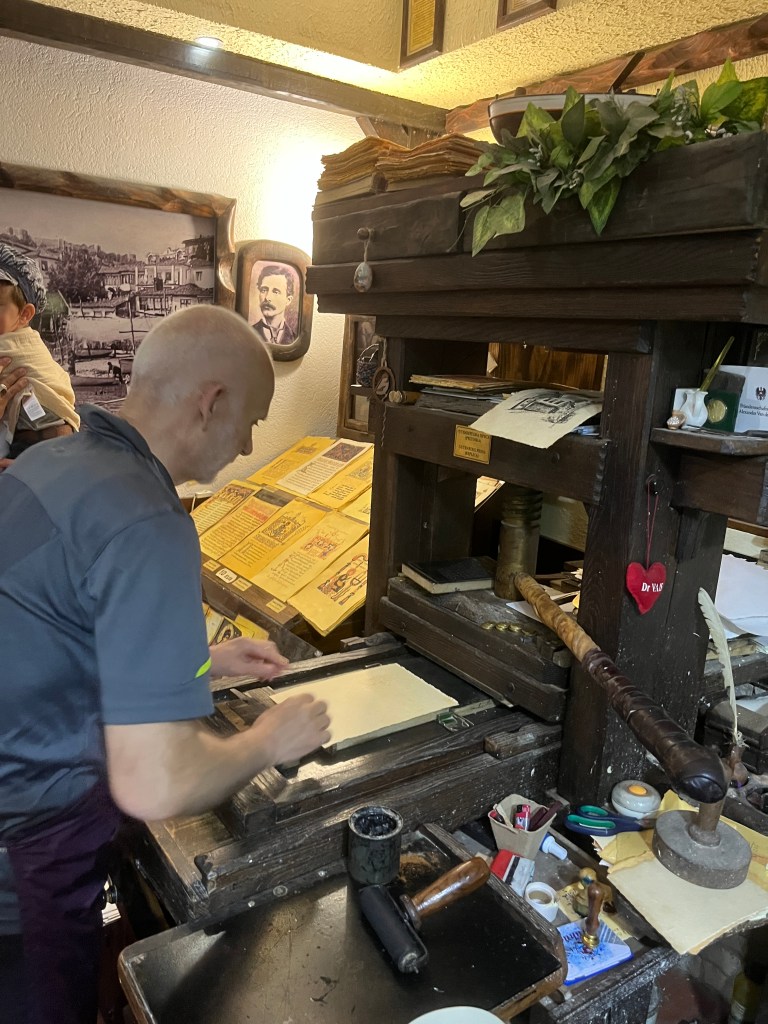
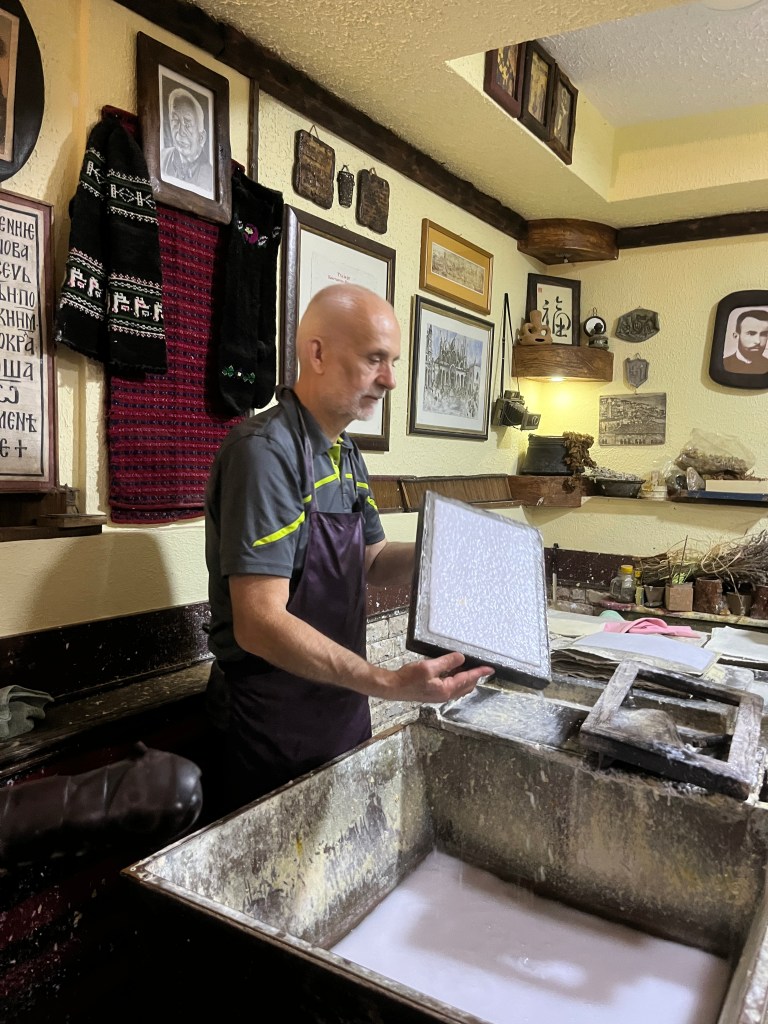
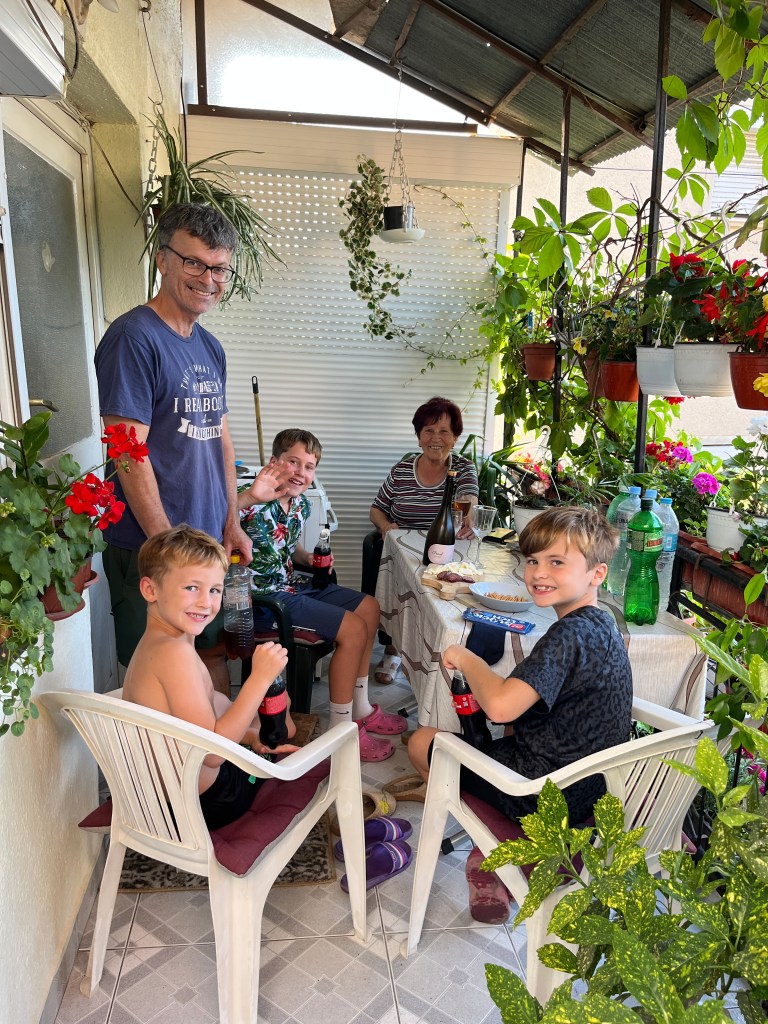
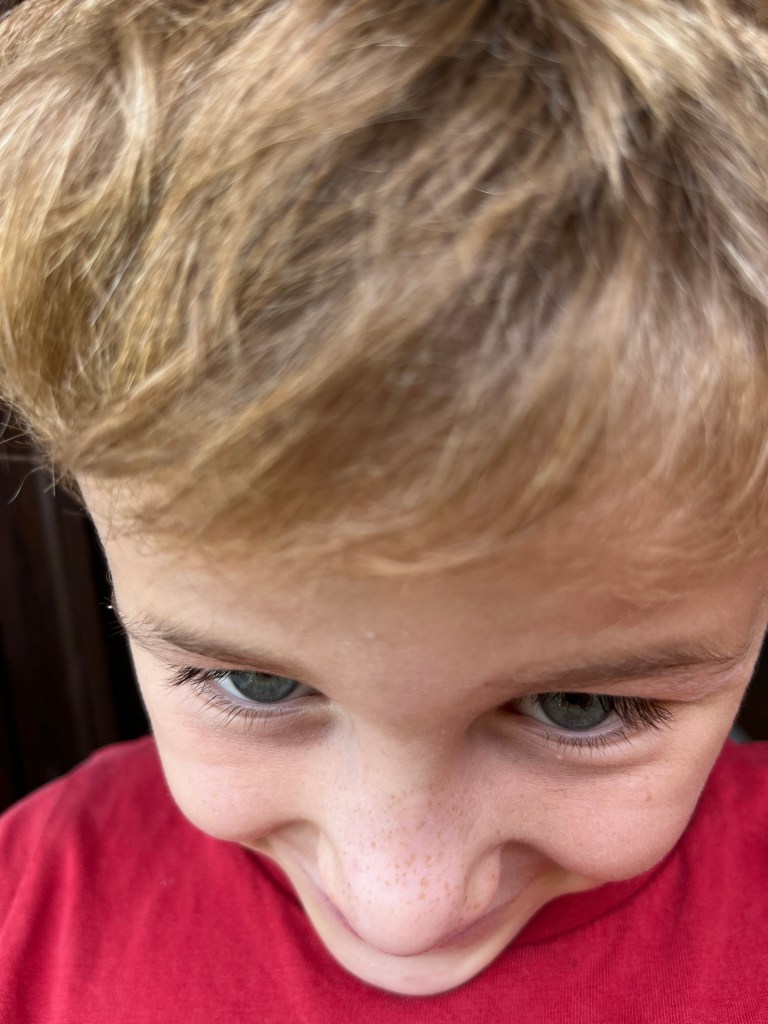
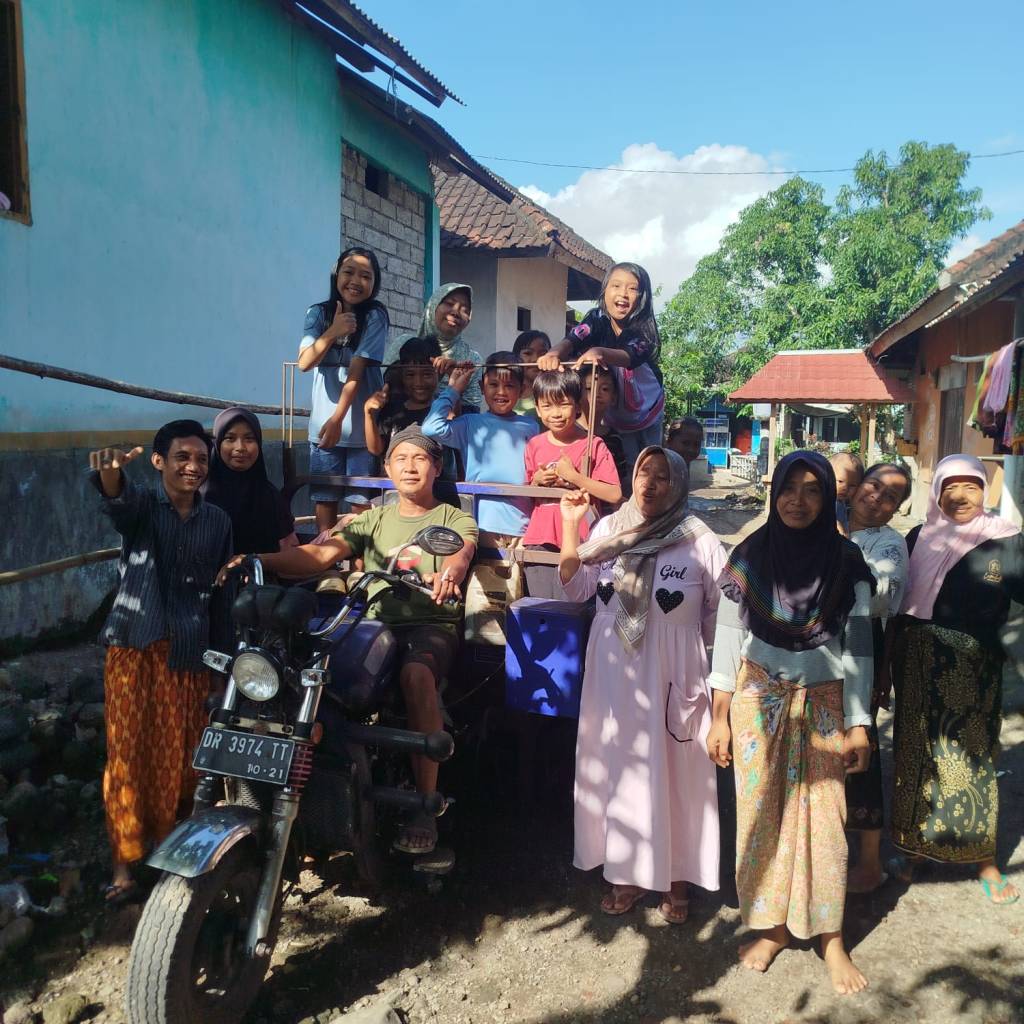
I hope this photo isn’t rude. We were very happy to have scored croissants, and he got inspired by this victory stance. The Catcher of the Cross statue here represents that Cross Throwing that happens on Epiphany in the Orthodox Church, January 19th each year. During Winter Festivities, a priest throws a wooden cross into the icy Lake Ohrid waters. Then hundreds of people (only men and boys, I gather) dive in to retrieve it in order to be the one to claim good fortune in the coming year. The event is said to symbolise the baptism of Jesus in the Jordan River.View to the NorthThe structure next door is very charming. These types of buildings are all over town, sometimes caved in and sometimes on the brink but still inhabited. Our happy balconies are in the background above.A mosque on the street of old town. The Albanians keep Muslim influence alive here. The call to prayer is still within earshot of home.Unlike in our other destinations, we’ve found the Macedonian language particularly difficult to pick up. It just doesn’t stick. It also uses the Cyrillic alphabet, which is named after Saint Cyril who (with his brother) created this Slavic writing system based off of the Greek alphabet but with new letters to capture the additional Slavic sounds. It shares some phonemes with the Latin alphabet, but phonetically reading what pops up on Google Translate has been impossible. Luckily, everyone is forgiving of our English assumptions. People from all over the Balkans, and all over the world, come to Lake Ohrid to enjoy its crystal clear water, lake sports, and charming waters-edge establishments. We did a little taxi ride to take in this perspective.Practicing rope knots… or something.Tension against one’s self. Seems about right.Like most places in the world, Ohrid has layers and layers of history built on top of one another. It claims to be one of the oldest settlements in Europe. It is first mentioned by the Greeks in 353 BCE as Lychnidos, meaning “City of Light.” There is no way of knowing why it was given this name so long ago, but I think most people who visit would say there is something special in the light here. The current name, Ohrid, may be from the Slavic phrase “vo hridi,” meaning “on the hill” – also an obvious characteristic of the area. The Bridge of Wishes is a shortcut along the rock wall that divides a couple nice stretches of lakefront cafes and beaches. “A tourist thing,” said our boat guide. People do that thing making wishes with locks on a chain, but they had to cut a lot off because it go too heavy for the little wooden passage. The weight of human want is ever heavy, eh?This is the classic site for Lake Ohrid photography (like those blue-domed roofs of Santorini in Greece). It is called Sveti Jovan Kaneo (Church of St John of Kaneo). The views over the cliffs are pretty breath-catching. Not much is known about its construction. 13th century-ish, they say.Sheer drop from the gate. We talked about vertigo and that scary pull we sometimes feel from a ledge. We considered what evolutionary purpose this could serve, being pulled forward. Fear. We decided it’s Fear tugging at you, grabbing you by the collar and saying, “See that? Feel that? Not good. Not good for your survival.” Then, she finishes with a little shove to the belly, and, boom, we back up with the quickness. Nice work keeping our ancestors alive to the eventual result of our existence. Our good ol’ friend, Fear. She’s a fierce one. A darn clever one.The water below is a gorgeous spectrum of blue green, and snakes can be seen diving from the surface down into the rocks. Time for TeaThe Macedonian denar is a very colourful currency with a lot of cultural symbols and storied artefacts. I can really geek out on the art and symbolism on the banknotes of a nation. This one is a bridal costume. Pretty snazzy.These papers can be found tacked to electricity posts and doors. They are community death notices. Lots of etiquette and history to wonder about here. “Sad News.”Crabbing assessments had to be conducted.Ohrid is both a cat and a dog city.This guy hops up to say hello at the top of his gate and then peeks his nose out the bottom when you leave.We have also arrived in the land of recognisable coffee. This is our coffee-man’s shop. He will grind the beans to whatever we need, and he shamelessly commits trademark infringement against both Starbucks and McDonald’s. SchoolThe native swans on the lake are a classic photographic sight too.The wetlands here provide the nesting grounds for a variety of native water fowl. It’s threatened habitat, like everywhere else. Where can any of these creatures escape the humans?Because the lake is fed by numerous underground springs and not rivers, it is considered to be quite clean and clear. Up to 22 meters visibility in some places, apparently. We drink it.The (possibly) 1,100-year-old Chinar tree is another classic site to visit in Ohrid. These two pieces of trunk were once one big tree. This beast is a symbol of resilience and strength for the local people, believed to bring luck and good fortune. The gaping hole supposedly housed a cafe and a barber shop at different points. Now people sit around it and eat ice cream. Us included.The locally-sourced red clay tiled roofs are a classic feature of Ohrid’s architecture. Another classic feature of Ohrid is the taper-levelled buildings. The lower floor, usually made of stone, is narrower than the upper floors, usually made of wood. This makes the upper living quarters, which often have a lot of windows, feel spacious and light. It also gives the streets a sort of tunnel effect. In a quirky nod to this architectural style, they have made all the streetlights mimic these top-heavy structures. You can see these funny street-lamps in the photos above and below. Our LaneThere are many places where the anatomy of a wall can be viewed around here. Most seem to be wooden frames filled in with rocks, reeds, and cement of all sorts.I just like this garage door. I’ve never seen snapdragons growing in the wild, but they are all around the fortress grounds. They even grow out of the walls… snapdragons guarding the castle walls. Classic!The doors of the Upper Gate look like dragon scales too.There is an Icon Gallery housing many of the beautiful frescos found in churches all over the region, but you cannot take photos in there, and their descriptions didn’t give much information. Religious icons are everywhere though, often above doors and water fountains.Some are more weather-beaten than others. All the more beautiful for its age though, right?It’s always fun to see new life in these ancient places. This church had a family of puppies living on the steps. There are supposedly 365 churches around Lake Ohrid, one for every day of the year. “The Jerusalem of the Balkans” is one of the area’s nicknames.The designs in the brickwork here are really fascinating to consider. I’m going to look more into this. We’ve been practicing our Spanish using whiteboard markers and mirrors. A body parts lesson here.The Ohrid OfficeMacedonian crabs didn’t stand a chance.I had to eat crow on the fishing scene in Lake Ohrid. I don’t think it was too silly to assume that a massive lake would have fishing opportunities, but apparently it’s all but forbidden due to previous overfishing and a dire need for population recovery. My eldest was more than a bit grumpy about that one. Albania across the way.Perfect skipping rocks all over the place.Lots of lake glass and other shore treasures.“Come look!” I love those words. The entrance to The Bay of Bones Museum on Water.This reproduced prehistoric settlement from 1200 to 700 BCE (late Bronze to early Iron age) occupied 8500 square meters and stood on over 10,000 piles embedded in the lake bottom.Building over the water like this offered protection from animals and “other land threats,” which I assume were invasions, as well as flooding. This area is called The Bay of Bones because of the large number of animals bones found in the water below, prehistoric dinner scraps tossed into the water. The homes all had holes in the floor through which each family could fish. The information in the museum said the small children in the families had ropes tied to their ankles to keep them safe from these openings.The older boys have been participating in the Push-Up Challenge for Mental Health in Australia. It’s been tough doing 70-200 a day! I’ve had to modify some…Beautiful swimming temp, but we saw too many snakes for my liking. The word “harmless” doesn’t comfort me.Just up the hill from us, at the top of the 148 steps to the Upper Gate, there is an ancient theatre. Built in 200 BCE, before the Roman’s came, it is in the Hellenistic style with excellent acoustics due to having wind-breaking hills on both sides. When the Roman’s came, they used it for gladiator fights, and cages for large animals were added beneath the seating. As it was also used for the executions of Christians, it was much disliked by the locals and was buried once the Roman Empire fell. It was only uncovered again in the 1980s when nearby houses were being built. This burying of the past did an excellent job of preserving this ancient theatre, which is now used for performances once again.Here is one of our many tortoise friends. One day I came across seven on a morning walk. On another more intentional tracking mission, the middle one and I managed to find 11. We are getting quite privy to their ways. Tortoise tracking is a good opportunity to talk about fight-flight-freeze. The quick scurry as we approach is always the sign of a lizard or maybe a snake, which wouldn’t have the protection of the shell and needs to scram. However, a rustling that stops when we approach is a sign of a tortoise in “freeze” mode, hiding in his shell. If we wait and listen, he’ll start to move again, and we can see the grass sway or follow the sound and find him. Luckily, we aren’t aware of any creatures in the area that fight at the first sign of threat.Another sweet shelled being.The Daily InvitationPoppies pop out all over the landscape. It’s amazing the effect they have with just four petals. As a symbol of remembrance, you wonder what lives should be remembered at an ancient theatre in North Macedonia. Some great tales could be told, I’m sure.Cedevita is a Croatian vitamin drink that the boys can get at the theatre cafe. Better than soda, I guess.When I asked to take a photo of this cheese-maker’s amazing stock at the local market, he invited my husband around to pose with a block. Such sweet people. So proud of his cheese, too. Adorable. The cheeses offer some pretty unique experiences on the palate. It’s happy days when cheese is on hand.In the foreground, you can see grape leaves used to make Sarma, that spring-roll like dish stuffed with rice or meat. Those white buckets of olives hold little bombs of yum too. These kebab joints have saved our dinners many a-times- affordable, nutrient balanced, and pleasing to the mouths of boys. This guy said he likes North Macedonia best of all the countries so far… I think the kebabs have something to do with it.Who would have guessed that Ohrid has one of the only two functional Gutenberg Presses in the world? We went to the Museum of Handmade Paper and saw a demo of how the press works. Invented in 1440, this press is often listed among the most important inventions of man. It took some finessing to explain exactly how wide-spread printing and reading could change the world when our boys are such mournfully resistant readers. Not sure I managed the sell, but one of them said “So, it was basically the beginning of technology.” I’ll take that as a win.The paper-making demo was quick and clear. Pulpy water on a screen. Flip it onto a piece of leather. Press out the water. Let it dry for a few days. Voila. Chuck it in the ol’ Gutenberg, and you’re in business. The paper-making method was based on a Chinese method from the 2nd century BCE. It was used at the nearby Monastery of St Naum in the 16th century. (We have yet to visit this site and its famous healing springs.) This workshop is meant to replicate this early site of learning.Anime drawing is a new pastime. Our neighbours are a delight. Next door, we have a house with rooms for tourists to rent. This man, Tomas, is the owner. After inviting us for coffee at a couple inopportune times, he would not accept my “um” as I returned from a walk one morning. Danny and the boys joined us on their veranda, and he offered a shot of brandy with our Turkish coffee. We couldn’t say no. Would have been rude, right? Well, turns out, his home brew was 56 proof. We had a very chummy chat through Google Translate after that.Our neighbour across the way is the best. She is always chatting with the passersby headed up to the fortress, and often invites us for coffee. We brought over bubbles and snacks for the middle one’s 10th birthday. Again, Google Translate saved the day. Otherwise, Maka will just chat and chat as if we speak Macedonian. As a gift, she gave the birthday boy socks and chocolate. Our little Macedonian grandmother, complete with geraniums.Gap Year Time means you notice the slightest change in freckle density and height gains. So much time together- for better and for worse. We’ll probably forget all the “worse” and remember only the “better.” Memory is so merciful.The lake swims are refreshing as summer ramps up, and the boys always end up with the fluffiest hair afterwards. Meanwhile, on the other side of the world, our friends in the Lombok pottery village in Indonesia got themselves a trailer for their motorbike and a new roof for their pottery studio with the money raised from our Gofundme campaign (We didn’t get enough for a truck.). Thank you to everyone who made this happen. They were over the moon and wanted us to pass on their thanks. They wish you all to be rewarded for your generosity.Two more weeks of this will be just about right.
WOW Dede, once again, a fantastic piece of journalism. You really are gifted, thank you for taking us along on your journey. We’ve done some Google searching, and are wondering if you were anywhere near the Kaneo apartments on Kocho Racin? It was fun looking up Lake Ohrid, and seeing where the fortress was, and imagining your apartment with the balconies overlooking that area. We’ve checked out all the walking trails that you must have run along. Just fantastic, thank you for taking us with you! 🩷🩵🤗




















 Mapping the Gap
Leave a comment