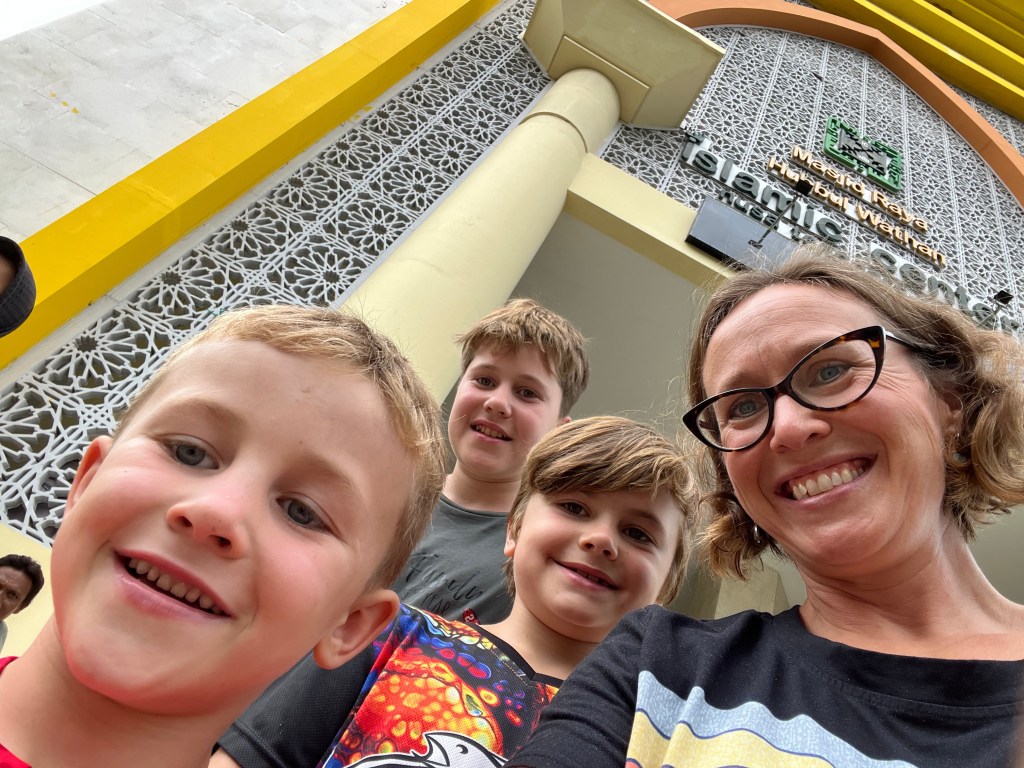
One of the best things about this gap year is the influence I get to have on my kids. Living day in and out together, I think we are reaching a nice family rhythm, a depth of family unity that is both cohesive and a bit saturating for us all. Amid the expected strains of this tight living, I have to keep reminding myself that these days of being together like this are a precious chapter not many families get to have and a time in our lives that we will never get to revisit. “This is it. Don’t miss it,” says the voice in my head. To have the time to be present and intentional with these bright and beautiful boys is something truly extraordinary- though they do drive me to both drink and meditate more.
Really though, the static of our usual modern life often leaves so little free mind space (theirs and ours) for just following the whims of a conversation. In the crush of our home-life routine, we hardly ever ask “what do you think?” and hang around long enough to listen to the disjointed, spontaneous answers that tumble out. Most conversations with the kids at home are done in multi-task mode, attention divided into slices of a hundred-piece pie. Now though, with a classroom rich and pulsing and a mother who is free to focus, this whole worldschooling thing is offering some pretty spectacular opportunities for listening and advancing ideas. Not every day, but most days, we are rocking this. (IXL still elicits wails, groans, and the occasional tear though.)
Taking the kids out of the system, I did get a call from NSW Department of Education about the boys’ absence from school without any record of distance learning or home-schooling registration. It was more of a child welfare call. According to the guidelines, all we are required to do is “consider” distance education. I did consider it briefly, and I found it would be too tedious, that it would keep my kids’ brains “there” in Australia instead of “here” in all these magnificent experiences. Thankfully, New South Wales Department of Education is enlightened enough to recognise that learning doesn’t have to be limited to brick-and-mortar classrooms and that parents are competent enough to decide what is best for their kids. It was an encouraging nod to our mildly rogue choice.
So then, I get to decide: What do I want my kids to know? What do I value? What is worth learning in this world? I have lots of answers to this. It’s maybe not even a list. It’s an ocean of answers. Art and creation, story and history, spirituality and religion, compassion and contribution, symbols and traditions, curiosity and observation, nature and conservation, gratitude and play, physical movement and mental control. The sea gets deep quickly. And the waves pound on and on. Cooking and cultivation of the land. Film, music, sport, fashion, language, geography, architecture, evolution, physiology, first aid, infrastructure, systems theory, democracy, communism, nutrition, carbon footprints, renewable energy, heritage preservation, road safety, map reading, social justice, human trafficking, dictatorships, revolutions, and genocide. Yes, I’d like them to learn about all of the above, please. And more. Thank you.
For me though, spirituality is a big one. Human faith and the practices that bond people over time and through space is something that I find very precious about people’s presence on the planet. I feel very aware of the fact that we, humans, will all be gone from the Earth one day, and that the Earth will probably be better off without us. But when we go, we will take our worship with us, and this will be a loss.
Our awareness of life and our capacity to comprehend the divine is one of humanity’s most admirable traits. If we can manage to look past all the judgement, division, and power-wielding that is so often woven into organised religion, our acts of devotion are really something quite spectacular. It is a uniquely human act to ritualise an honouring of that which cannot be seen. Religious communities of all breeds form bonds between followers, link us to our ancestors, and give substance and language to what is usually a private and wordless experience. I want my kids to see, hear, and feel the profundity of this. I want them to marvel at what is done in the name of God (not just the bad stuff) and to see how people are physically and mentally moved in devotion.
Islam certainly moves people. Very impressively, I might add. With a history beginning in the 7th century and a world population of over 1.9 billion followers, Islam has such a massive presence in the world, and their unity of movement is expansive. Yet, I have known very little of it. As an ESL teacher of international classes, I had a lot of students of the Islamic faith: Somalis, Saudis, Kuwaitis, Burmese, and more. Aside from the halal dietary restrictions, regular daily prayers, varying clothing requirements, and the fact that student focus waned greatly during the fasting month of Ramadan, I can’t say I knew much about the religion and its practices.
I made a point to change that here in Indonesia, one of the few Muslim countries on our itinerary. Indonesia has the largest population of Muslims in the world, and unlike the more popular, neighbouring Hindu island of Bali, Lombok’s population is 80% Muslim. Auspiciously, we happened to booked our month-long stay on The Island of a Thousand Mosques exactly in alignment with the beginning and end of the holy month of Ramadan. (Though we are actually skipping the last days because the final celebrations of Eid-al-Fitr could prohibit us leaving the island before our 30-day visas expire.) While we may have encountered more sleepy locals and quieter businesses on this island of hungry humans, our timing has been a great opportunity for us to have a nice study of Islamic practices, and we totally took advantage.
There are Five Pillars of Islam, five things all Muslims must do. As a worldschooling project, we investigated each of them in turn.
Pillar 1: Shahada- The Declaration of Faith
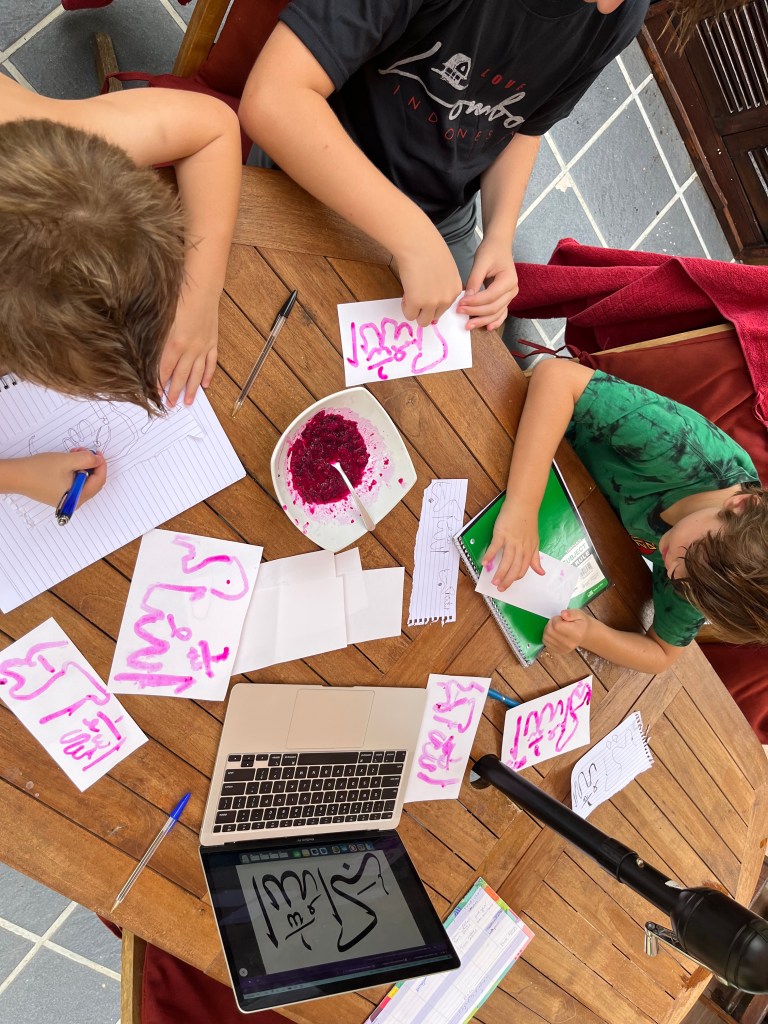
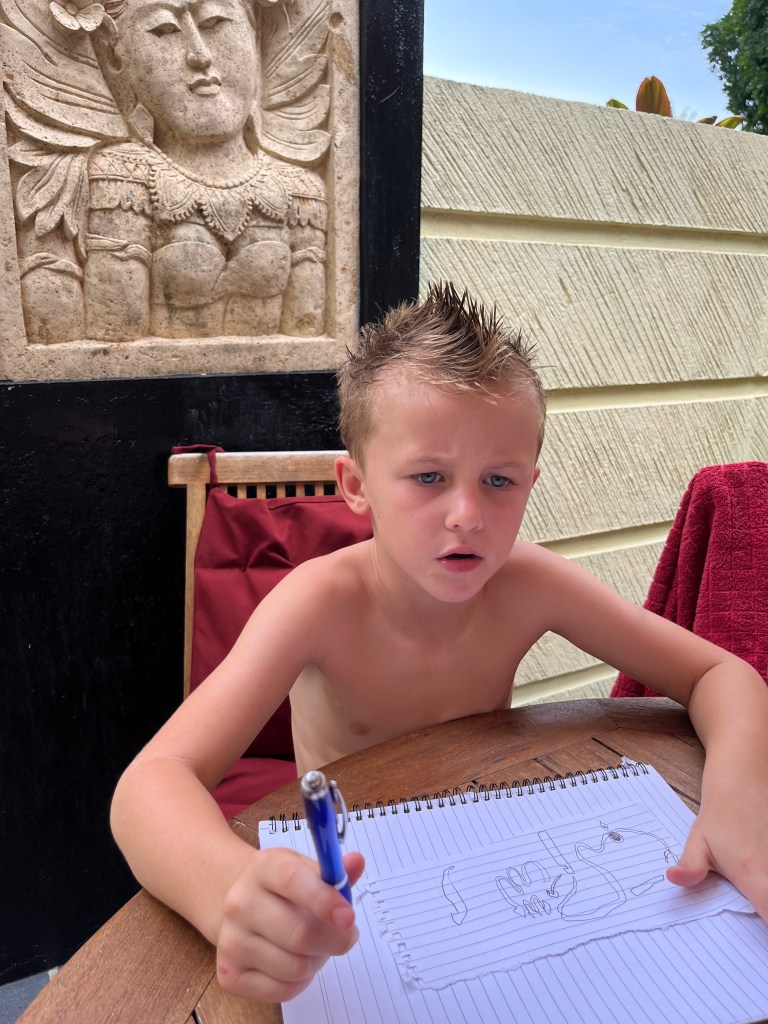
I remember this one from world religion classes. All Muslims must proclaim, “There is no God by Allah, and Mohammed is his prophet.” (Or a similar translation.) To get the boys interested in this one, I had to get a little creative. After checking that it was okay for us to artfully depict the name of Allah, we sat down to practice our Arabic script. In the absence of paint, I mashed some dragonfruit and set the boys to finger painting “Allah” in pink juice. If we did this with respect, apparently, it’s okay. (No doubt, for some, this is crossing over a line. Apologies. You can see from their faces they were considerate, and our purpose was educational.)
As the boys copied and painted and made multiple drafts, I talked in their ears. I shared what it means to be a prophet, comparing Mohammed to Christianity’s Jesus. I explained that Allah is said to have 99 names, sort of like how saints are given distinct causes to patron- “The Bestower of Mercy,” “The Ever-Watchful Guardian,” “The Bountiful,” “The One Who Cures.” I explained that Mohammed is a common Muslim name, reminding them of Mohammed Ali, boxer and convert to Islam. We talked about Arabic script and how it goes right to left, which they practiced doing. It was a lovely, little lesson. Hopefully, some memorable aspects slipped into their beautiful brains.


Pillar 2: Salah – Prayer
All Muslims are required to pray five times a day. The famous “call to prayer” can be heard all over the island and all over the world- a different prayer each of the five occurrences based on the movements of the sun. The AirB&B description of our villa warned of this potential disruption to sleep, touting our remote location as a bonus. It doesn’t wake us, but we still hear it, every morning and throughout the day, a stirring, climbing voice that moves millions to acknowledge God. Even if you are not a follower, you can feel a summoning that buzzes your viscera. It’s moving and reminiscent of something meaningful and something old. Something somehow understood.
I was a little disappointed to find out that the minarets now house loudspeakers, not men trained to call out the holy words from these tall narrow towers of a mosque. Now, it is sometimes a scratchy loudspeaker attached to a microphone held by the Imam inside the mosque that rouses the faithful from their routines to honour their spiritual duty. Some new mosques are now built without any minaret at all. Seems sad somehow. Changing times, I suppose. Our evolution isn’t always as charming as we’d like.
Honestly though, I am very impressed that Islam manages to sustain such frequent demands of its followers. So many other religions have much more meagre membership dues. Five times a day, seven days a week, 365 days a year. That’s a lot of praying. That’s meeting the prayer mat 35 times a week (though many people do not do this to a T). I mean, most humans only eat three times a day. Five times a day? God is heavily built into the Muslim daily routine, a commitment to sustenance of spirit greater than that of the body. Pretty hard to imagine (for me). I can only wonder what this might be like, how each individual approaches this tight connection with their maker in these regular visit within. And the prayer rituals are no joke, not like my wishy-washy meditation practice. The boys and I watched some videos about it. There are a lot of elements to it, as you might expect. We practiced some words and movements, including the seven points of prostration- both hands, both knees, both feet, and the forehead along the nose touching the ground in a gesture of piety. Even just assuming this position, you can feel the commitment of this pillar. This isn’t light devotion.
Also, the prayers are always directed toward Mecca in Saudi Arabia. We had to figure out which way that was (geography, tick!). It’s quite moving to pass a mosque at prayer time and to think that all the people in that room are united in stance with millions of Muslims in similar spaces all over the world (albeit at different times). This synchronisation is admirable and is a testament to the human capacity for unity in worship. I find this regular rounding up of us rambunctious mortals quite remarkable.
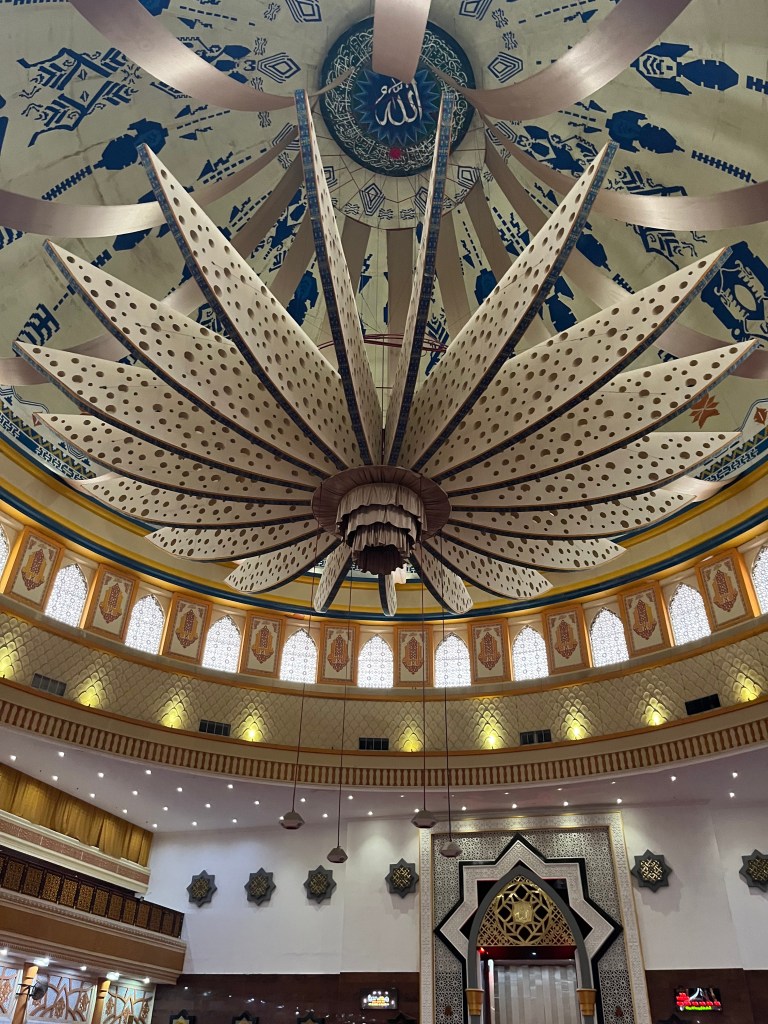
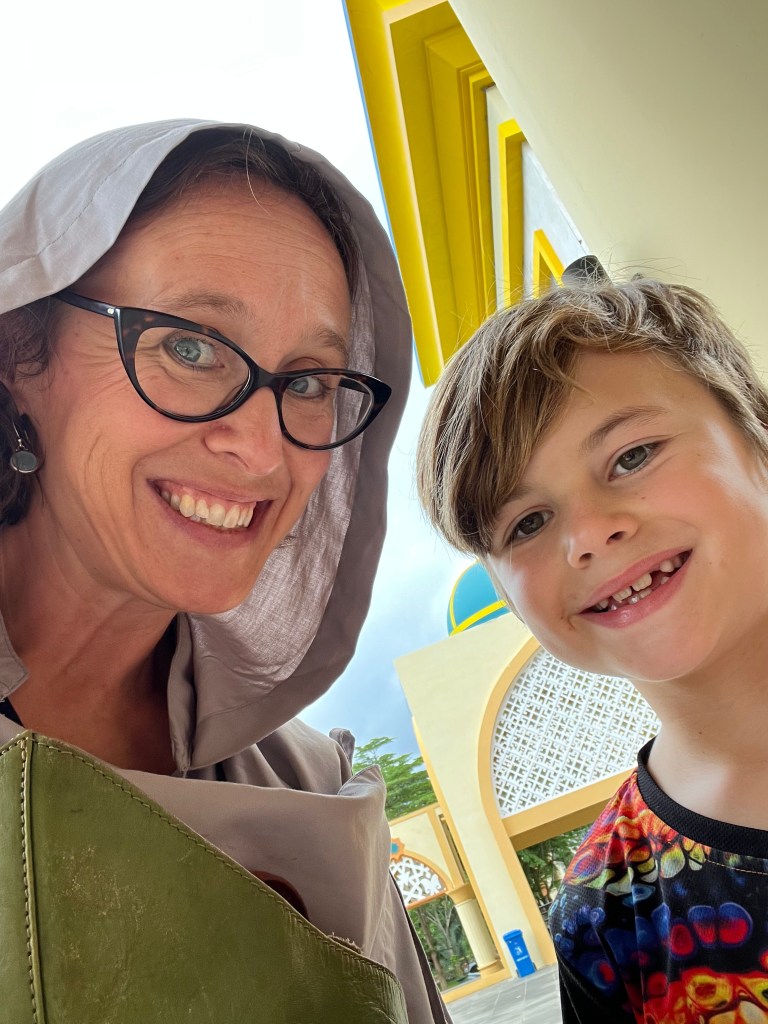
We visited the largest mosque on Lombok to get a sense of a prayer space, but it was a miscommunication with our driver that took us there when we hadn’t eaten, needed to use the toilet, and thought we were going home. With forced graciousness, we took a little tour. I was offered a covering for my feminine aspects, and we had a look at the musalla or prayer hall. Men were lying on the floor resting post-prayer. People take it easy during Ramadan. Understandably low on glucose to move. Under the artful dome with “Allah” painted in the centre, red digital clocks on the wall counted down to the next mustering of the faithful.

Pillar 3: Zakat – Almsgiving
Zakat means “purification.” This is an obligatory act of charity where Muslims donate a portion of their wealth to those in need. This is done to purify their wealth and contribute to the community. Usually, it is 2.5% of one’s wealth for those that can afford it (as defined in the Quran). There are Zakat calculators online now to help determine what is owed based on all assets.
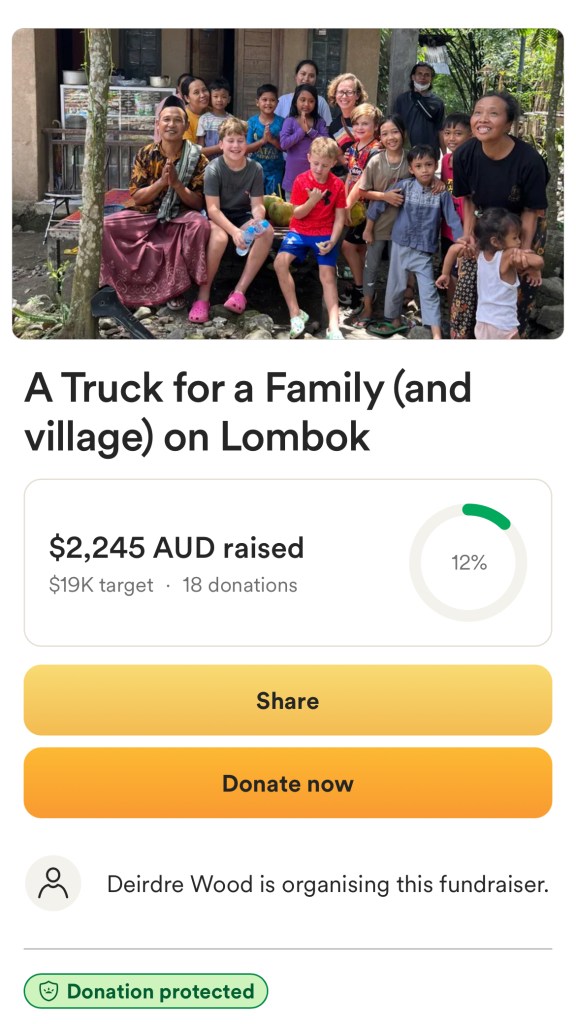
For us, we decided to engage with this pillar by starting a Gofundme campaign for the family we made friends with in the pottery village, roasting coffee and making coconut oil. We didn’t make pottery because we don’t want to carry it around with us for the next eight months, but this is their tradition and main livelihood. (https://lombokpottery.mystrikingly.com/)
We learned in casual conversation that a truck would elevate their community in countless ways and help their small business in transporting stone harvested from the mountain down to their village to be crushed into clay. Even carrying a bag of rice can be a challenge on the motorbikes they currently have. We had the opportunity to discover the warmth and generous spirit of this village. (You will see in Pillar 4.) We want to do what we can to elevate them. Please consider making a donation if you can. Thank you to those who already have.
Pillar 4: Sawm- Fasting during Ramadan
Swam is the daily fasting from dawn until dusk for the whole month of Ramadan. When I found out we’d be on Lombok during this holy month, I knew I wanted to try fasting for a day. I thought I’d recruit the boys in some modified way, but the two eldest wanted to go all in (and Dad too). The spiritual intention of this pillar is multi-pronged. It is intended to bring people closer to God in a number of ways.
First, living in hunger can be a constant reminder of our mortality and frailty as humans and pull one’s thoughts to a higher power again and again throughout the day. The discipline it takes to keep to the fast is a testament to one’s devotion to God and the Islamic faith. This is a sense of pride for many Muslims from what I gather. Some are so strict they don’t drink water or even take their medications. I remember a pregnant student I had once who wouldn’t drink anything all day despite the urging of others in her community. When Ramadan falls on the long, hot days of summer, devotion can become dangerous for the vulnerable. Children are expected to start fasting at various ages. Ten seems to be common around here with kids starting to fast for part of the day just to get their feet wet at earlier years. I can’t help but marvel how this faith can get so many people to do this, even in a modified way, for a whole month. I mean, teenagers too? God’s hand must certainly be at work.
One is also supposed to abstain from sex, smoking, frivolous pleasures, and impure thoughts and words, such as lying, gossiping or being critical of others. This, to me, is the greatest of all challenges- to maintain the climate of the mind and to hold one’s tongue. Fasting is an excellent way to be continually aware of one’s thoughts, watching them reach, and reach, and reach again to satisfy the call of the body. We only fasted for a day and were so aware of the workings of our minds. The middle one said, “My body keeps telling me to ask for food.” How interesting that we usually don’t even notice these thoughts. We just act. I also realised how often I feed the boys’ moods. When one sprouts a bit of attitude, I always ask, “Have you eaten?” Meals are also used to break up the day into manageable chunks: before lunch, after lunch, after dinner. I found my brain falling flat as I reached for a meal on which to hang my next thought. It was fascinating.
The fasting is also supposed to increase one’s compassion for those who suffer, those who often go without a body’s basic needs. To feel a sense of hunger and see our animalistic instincts circle back again and again does lead one to think of those who have no choice but to live in a ravenous state. The headache, the grumpiness, the watching of the clock, the stomach’s growl and ache. I wonder if the boys will remember this feeling when they see people who are suffering with life in the streets. (I’ll remind them. And myself. Don’t worry.)
There is also a sense of gratitude you gain when you abstain. It is a reset on your awareness of the abundance of comforts and pleasures we usually consume without consciousness. No drink, no food, no pleasure-seeking, no knee-jerk negativity of the privileged. The next day, when you resume your usual consumption with more mindfulness, you realise how much you usually take for granted. How long this wakefulness lasts for most, I don’t know, but I was happy to renew my appreciation for all that I do not properly honour.. at least for a day or two.
Starting at 4:30am, we prepped ourselves for the day by having the Suhoor, the predawn meal. Loading up on nutrition before light hit the sky, we had a little feast of cereal and eggs. Then we went back to bed, as many people do, cutting off coffee at about 5:15am. Water was all we allowed ourselves for the day. We saved the excitement of adding ice until the hot afternoon. This may have been cheating, I’m not sure. It seems people make their own rules on these technicalities. We lazed about, swam in the pool, watched Netflix, and regularly lamented the slow movement of the clock. Poor Dad had to keep working, as usual. However, we did have a light at the end of the tunnel. This had been one of the kid’s first queries: What will we have for our sunset feast!?!
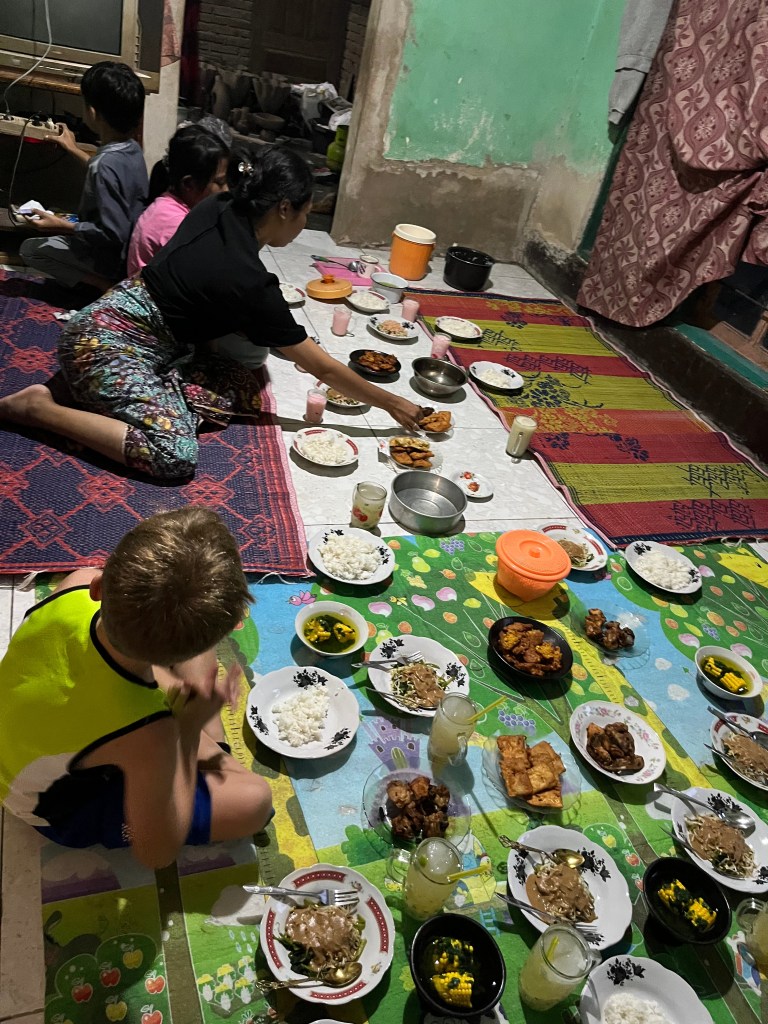
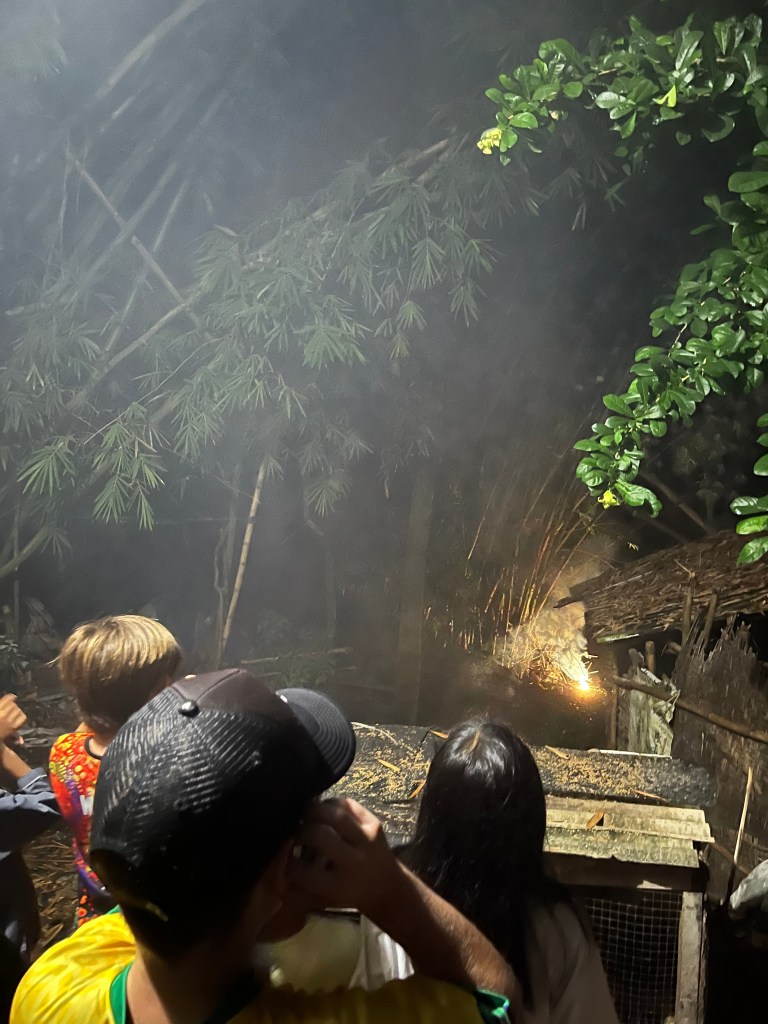
We had shared our desire to experience the Swam with our friends at the pottery village. We were always picking people’s brains for details of Islamic life, asking questions about the actual practices. When we told them we were going to fast, they invited us to break our fast with them in a traditional Indonesian way. The breaking of the fast is a feasting of family and friends, a joyful celebration at the end of each day. Marked by a call from the mosque, this fast-breaking is the balance to all of this abstinence, a rebounding gluttony that is so very human. Of course, all this feasting is reverently done in gratitude to God and all the blessings one has been given. Abundance is embraced with a renewed recognition. Interestingly, people often gain weight during this holy month of fasting, thanks to all this nocturnal feasting.
I’ll let photos tell the tale of our fast-breaking. Our hosts, Nurel and Hanna, touched all of us with their welcome and generosity. It was a humbling and delicious experience that I won’t even try to touch with my words.

Pillar 5: Hajj – Pilgrimage to Mecca
Finally, perhaps the biggest ask of the Muslim faith, we have the pilgrimage to Mecca. This is the sacred duty for every able-bodied, financially-capable Muslim to travel to the most sacred city of Islam to perform rites and follow particular cleansing customs. This should be done at least once in a person’s life, and from what I can tell, this sets a bonding lifelong goal among these scattered people of Islam. This is another enormous element of unity that is not present in many other religions.
In Indonesia, each year a certain number of citizens is grated visas to perform this pilgrimage. About 200,000 Indonesians were granted these Hajj visas in 2025. The manager of our AirB&B was supposed to be one of them, but it ended up that he never went. Not quite sure why.
We watched videos about the rites one is to perform in Mecca, and Medina too. One in particular is the live webcam you can access of people walking around the Kabba, which is a stone structure built by the prophet Ibrahim and his son Ismial (who interestingly unite three of worlds major religions: Judaism, Christianity, and Islam). Pilgrims walk counter-clockwise around this silk-covered, black ,cube-like structure seven times as one of the rites of the Hajj. It’s beautiful to watch this mass of people moving in unison in real-time, knowing they are fulfilling a life-long aspiration and spiritual duty together, the culmination of an expensive and arduous life journey. And you can just Google it to watch. Our world is so weird nowadays.
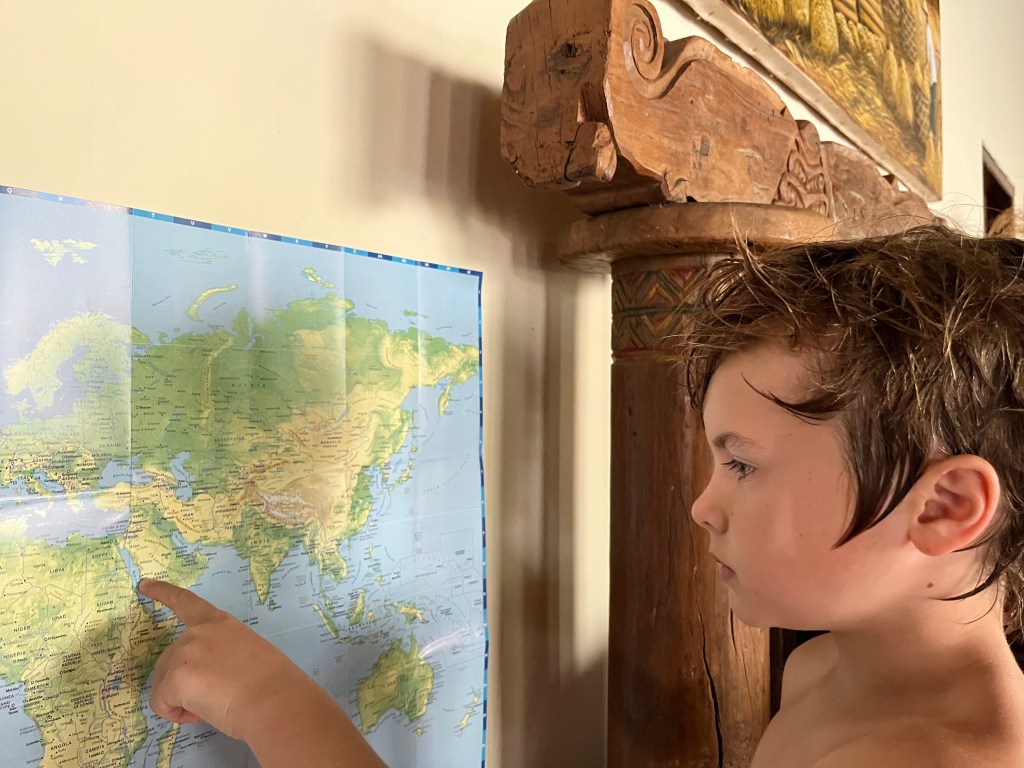
Our boys found Mecca on a map and did a search for the seas and other peninsulas on the Earth. The Hajj is a huge and impossible journey for so many in this wide world.
This little lesson took the whole month to complete. Hence the length of this post. I hope I’ve transmitted some of my new-found admiration for this religion and its practices. I think I’ve balanced the scales in my own mind against all of the well-seeded violent media imagery and feminist objections to this faith. I hope this depth of study will inoculate my boys from being infected by sweeping generalisations of others based on membership to any religious group. It’s so easy to judge and dismiss other humans. We need to make a concerted effort to pause and consider instead. How cool to have the time.


 Mapping the Gap
Leave a comment